Cats · Travel
Hard-Sided vs Soft-Sided Cat Carrier: Which Fits Your Trips?
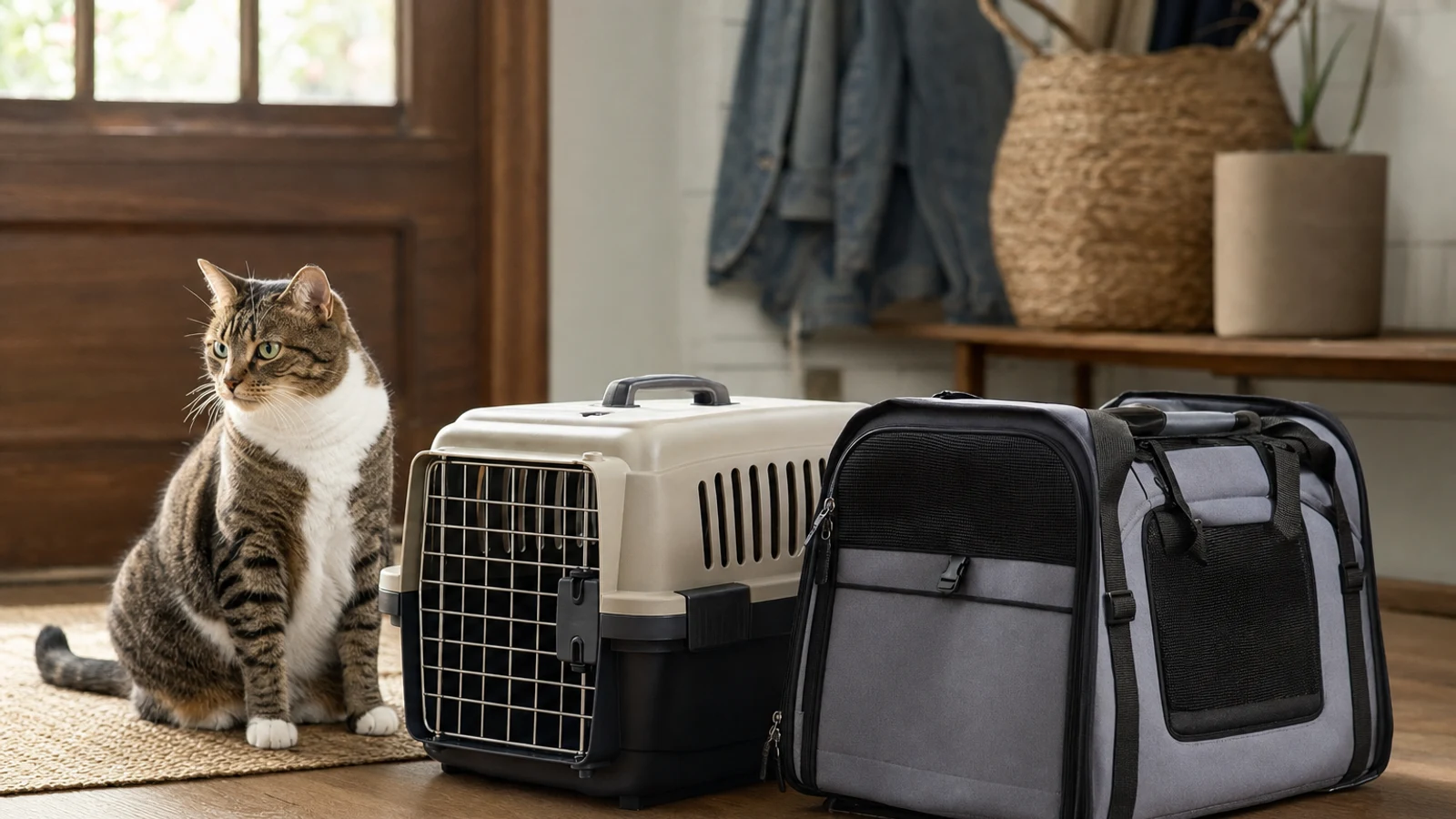
Hard carriers are usually easier to clean and more protective; soft carriers are lighter and easier to store. The trip determines the better fit.
Quick answer
For routine vet and car trips, a sturdy hard-sided carrier with a removable top is often the easiest to clean and gives useful access to a nervous cat. A well-structured soft carrier can be lighter, easier to store, and more forgiving for some in-cabin airline dimensions. Whichever style you choose, it must fit the cat, close securely, and suit the actual trip.
Shop this guide
Current Amazon options
Six current listings related to this buying decision. Use the guide to compare fit and trade-offs, then verify the latest seller, price, size, and availability on Amazon.
As an Amazon Associate I earn from qualifying purchases. Product availability, seller, price, and listing details can change.
Start with the trip, not the carrier material
A carrier that is excellent for a ten-minute drive to the veterinarian may be annoying in an airport. A bag that slides neatly under an airline seat may be less convenient when a motion-sick cat soils it on the way to the clinic. That is why “hard or soft?” is best answered after you define the journey.
For everyday cat households, the most useful questions are simple: Can the cat stand, turn, and settle comfortably? Can you get the cat in and out without a wrestling match? Can you clean the carrier thoroughly? Can it be secured for the way you are traveling?
What hard-sided carriers do well
Hard plastic carriers are easy to wipe and contain messes better than fabric. Veterinary guidance also points out the usefulness of removable tops: a worried cat may sometimes remain in the bottom half while parts of an examination are performed.
The rigid shell gives the carrier a predictable shape and keeps the sides from collapsing inward. The trade-off is storage. Hard carriers take up the same volume in the closet that they take up in the car, and larger ones can feel awkward to carry through stations or airports.
What soft-sided carriers do well
Soft carriers are lighter and often easier to carry over a shoulder. Many fold flatter when not in use, and some are more forgiving when you need to fit within an airline’s under-seat dimensions.
But “soft” should not mean floppy. A carrier that collapses onto the cat, has weak zippers, or distorts badly when lifted is not a good trade. Look for structure around the base and roof, secure closures, ventilation, and enough internal room for the cat to change position.
Compare options for your pet
Hard-Sided vs Soft-Sided Cat Carrier: Which Fits Your Trips?
Compare current Amazon listings using the fit and safety checks in this guide. Confirm size, specifications, seller and availability before ordering.
See on Amazon →As an Amazon Associate I earn from qualifying purchases. Links open Amazon search results; individual listings have not been independently verified.
Car travel and airline travel are different buying jobs
For car travel, the priority is secure containment. Feline veterinary guidance recommends transporting cats in carriers and securing them appropriately in the vehicle; some guidance specifically notes that seat belts should only be used with carriers that are crash-test certified.
For air travel, airline rules control dimensions and carrier requirements. A soft-sided in-cabin carrier may fit under a seat more easily, while cargo travel typically has much stricter requirements for a rigid crate. Never rely on a product page that simply says “airline approved.” Check the airline’s current dimensions and rules for your specific flight.
The carrier should become furniture before it becomes transportation
One of the most useful pieces of veterinary behavior advice has nothing to do with hard versus soft construction: leave the carrier out. When the carrier only appears before a frightening trip, the cat learns exactly what it predicts.
Place familiar bedding inside, let the cat explore it without being trapped, and occasionally drop treats or toys inside. A carrier that doubles as a safe resting place is easier to use on travel day than a perfect carrier that lives in a closet until the last minute.
A practical buying rule
Choose hard-sided when easy cleaning, rigid structure, removable-top access, or routine car and veterinary use matters most. Choose soft-sided when low weight, storage, carrying comfort, or specific in-cabin airline dimensions matter more.
Then judge the individual product. Door size, latch security, ventilation, base stiffness, handle placement, and interior dimensions can matter more than the category name printed on the product page.
Common questions
FAQ
Are hard carriers better for cats?
They are often easier to clean and can offer useful rigid structure and removable-top access, but they are bulkier. A good soft carrier can be more convenient for carrying and storage.
Can a soft cat carrier be used on a plane?
Sometimes. In-cabin rules vary by airline and aircraft, so verify current dimensions and requirements directly with the airline before travel.
How big should a travel carrier be?
Veterinary guidance says a travel carrier should allow the cat to stand, stretch, and turn around comfortably without being excessively large for transport.
Sources & further reading
Where the factual guidance comes from
Compares plastic, wire, and other crate styles and gives travel sizing guidance.
Discusses hard plastic versus soft mesh carriers and carrier acclimation.
Current feline veterinary position statement on safe carrier use in vehicles.
Ready to choose?
Hard-Sided vs Soft-Sided Cat Carrier: Which Fits Your Trips?
Compare current Amazon listings using the fit and safety checks in this guide. Confirm size, specifications, seller and availability before ordering.
See on Amazon →As an Amazon Associate I earn from qualifying purchases. Links open Amazon search results; individual listings have not been independently verified.
Keep researching