Other Pets · Habitat
Digital vs Analog Reptile Thermometers: Which Is Easier to Rely On?
Digital probe thermometers are usually easier to use for routine reptile habitat monitoring, but the sensor’s placement and the product’s stated accuracy matter more than the display type alone. Analog gauges can work as simple backup checks, while infrared thermometers are useful for spot-checking surfaces rather than replacing fixed probes.
Quick answer
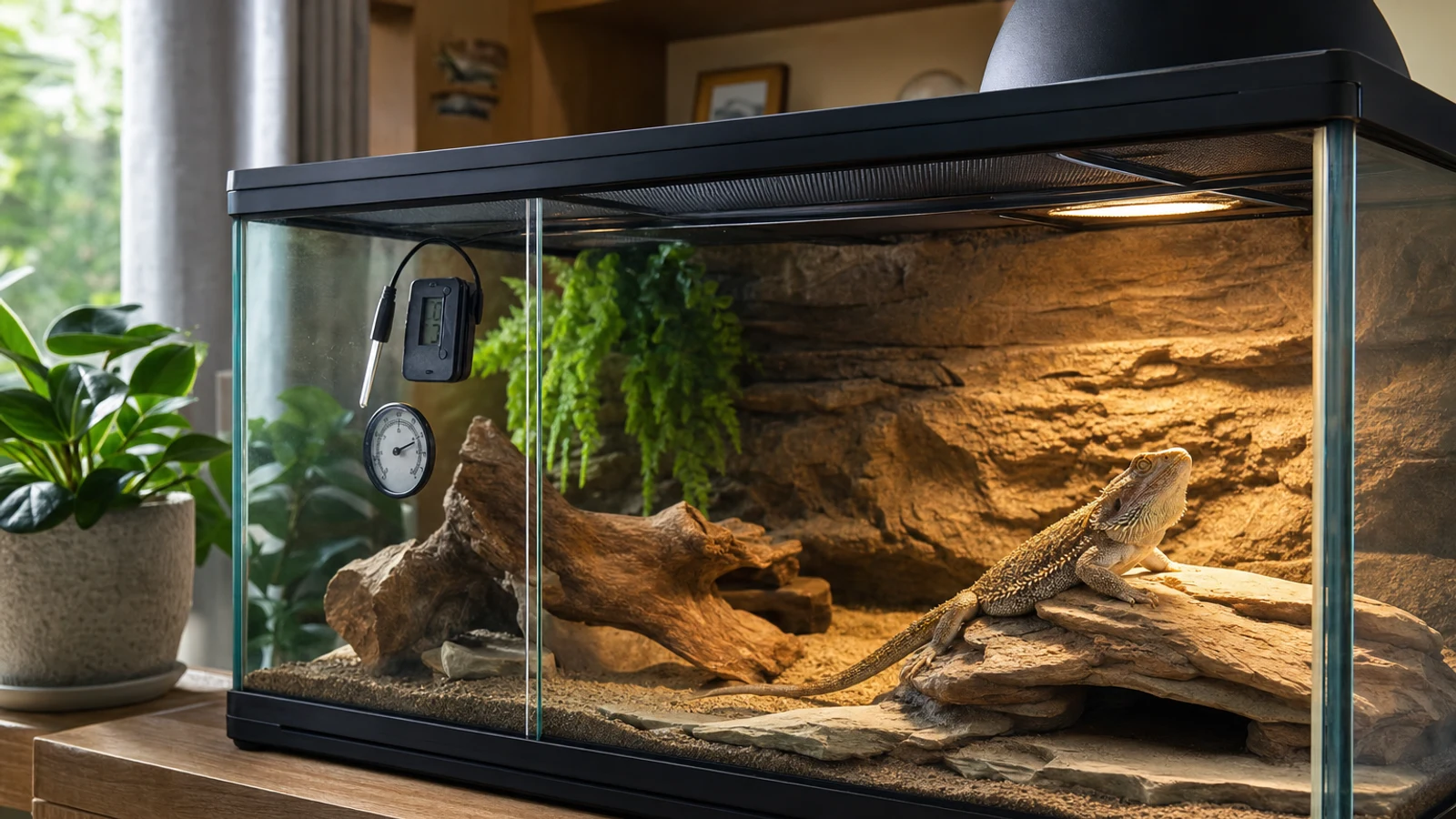
For most reptile enclosures, choose digital probe thermometers because they are easier to read, can place the sensor at the animal’s level, and may offer minimum/maximum readings or alarms. Use at least two readings to monitor the warm and cool zones. An analog dial can serve as a simple secondary check if it is securely mounted and its accuracy is known, but it is a weaker choice when you need precise readings near a basking site. An infrared thermometer is useful for checking surface temperature, not for continuously measuring enclosure air.
Shop this guide
Current Amazon options
Six current listings related to this buying decision. Use the guide to compare fit and trade-offs, then verify the latest seller, price, size, and availability on Amazon.
As an Amazon Associate I earn from qualifying purchases. Product availability, seller, price, and listing details can change.
Key decision checks
Digital is usually the easier primary choice
Digital probe thermometers are generally the more practical option for a reptile enclosure because the display can stay outside the habitat while a wired sensor sits where the reptile actually experiences the temperature. Many models also show minimum and maximum readings, which helps reveal overnight drops or daytime spikes that a quick glance might miss.
That does not make every digital thermometer accurate. A large decimal display describes resolution, not necessarily accuracy. Give priority to a model that states its accuracy range, includes a probe suitable for enclosure use, and explains how the sensor should be positioned. A poorly placed digital probe can produce a misleading reading just as easily as a poorly placed dial gauge.
- Best fit for routine warm-zone and cool-zone monitoring.
- Look for a remote probe, clear display, and stated accuracy specification.
- Minimum/maximum memory is useful for detecting temperature swings.
- Keep the display outside the enclosure when possible.
The real job is measuring a temperature gradient
A reptile should not usually be managed by one number taken from one point in the enclosure. Most species need access to warmer and cooler areas so they can move between them and regulate body temperature. The correct targets depend on the species, life stage, enclosure design, heat source, and time of day.
For that reason, a thermometer should be judged by whether it can measure the relevant location—not just whether it is digital or analog. Veterinary housing guidance commonly recommends monitoring at least the warm and cool ends. For basking species, the warm reading may need to represent the surface where the animal sits, while the cool reading should describe the shaded area at the animal’s level.
- Confirm the temperature targets from a species-specific care guide or reptile veterinarian.
- Monitor the warm or basking area and the cool area separately.
- Measure where the animal rests, not only near the enclosure ceiling.
- Recheck readings after changing bulbs, heaters, substrate, décor, or room temperature.
Where digital thermometers have the advantage
A digital probe can be placed on a basking surface, in a warm hide, or in a shaded cool zone without moving the display into the habitat. That flexibility makes it easier to measure different microclimates and to keep the sensor at the same location over time. It also reduces the temptation to interpret a wall-mounted reading as the temperature of the entire enclosure.
Some digital models record high and low readings, and some monitoring systems provide alarms or connect to thermostatic controls. These features can be helpful in homes where room temperatures change, during travel preparation, or when a heat source operates on a timer. They are conveniences rather than substitutes for correct setup: a thermostat controls a heat source, while a thermometer tells you what the habitat is actually doing.
- Remote probes can be positioned at the basking surface or inside a hide.
- External displays are easier to read without opening the enclosure.
- High/low memory can expose changes that happen while you are away.
- A thermometer should verify a thermostat’s result; it should not be the only safety control for a heater.
When an analog thermometer can still make sense
Analog dial thermometers are simple, do not require batteries, and provide a continuous visual reading. They can be convenient for a quick room-side check or as a secondary indicator in a low-risk location. A well-made analog instrument may be serviceable when its measurement range, tolerance, and calibration method are documented.
The limitation is that many inexpensive dial gauges provide little information about their accuracy, response time, or calibration. Their fixed position also makes it harder to measure a basking surface or a warm hide precisely. If the dial is attached inside the habitat, confirm that the mounting method cannot detach, expose adhesive, or create a place where the reptile can become trapped or injured. Treat an analog gauge as a backup unless you have verified it against a dependable reference.
- Choose analog only when the manufacturer provides usable accuracy information.
- Check whether the model can be calibrated and follow its instructions.
- Avoid relying on one analog dial for both warm and cool zones.
- Inspect suction cups, adhesives, and mounting hardware regularly.
Compare options for your pet
Digital vs Analog Reptile Thermometers: Which Is Easier to Rely On?
Compare current Amazon listings using the fit and safety checks in this guide. Confirm size, specifications, seller and availability before ordering.
See on Amazon →As an Amazon Associate I earn from qualifying purchases. Links open Amazon search results; individual listings have not been independently verified.
Do not confuse probe, infrared, and thermostat readings
A fixed digital probe and an infrared thermometer answer different questions. A probe can monitor a location continuously, while an infrared device takes a quick reading from the surface it is aimed at. Infrared readings can be valuable for checking basking rocks, branches, substrate, or other surfaces, but they do not replace a probe that tracks the enclosure over time.
A thermostat is different again: it regulates a connected heater according to its own sensor and settings. The thermostat probe must be positioned according to the manufacturer’s instructions and the animal’s actual exposure. After setup, use an independent thermometer to verify the temperature at the animal’s level. Never assume that the number shown by a thermostat, wall gauge, or heat-source setting is automatically the temperature your reptile receives.
- Use a digital probe for continuous monitoring.
- Use an infrared thermometer for quick surface-temperature checks.
- Use a thermostat to control a heater, not as the only temperature display.
- Verify important readings with an independent device, especially after installation or adjustment.
Placement determines whether the reading is useful
Probe placement should match the habitat feature you are trying to measure. For a basking reptile, secure the warm probe to the basking surface or position it where the animal rests beneath the heat source, following the care guide and product instructions. Place the cool-side probe in a shaded area at the reptile’s level, away from direct heat and drafts.
Secure every cable so the animal cannot chew, pull, wrap around it, or dislodge the sensor. Keep electronic displays, batteries, and thermostat controls outside the enclosure unless the instructions specifically allow otherwise. Recheck placement frequently because climbing, burrowing, cleaning, and rearranging décor can move a probe enough to change the reading.
- Warm-zone probe: on or immediately at the surface the animal uses for basking.
- Cool-zone probe: in shade, at the animal’s usual level.
- Keep probes away from direct contact with heating elements unless the instructions specify otherwise.
- Inspect cable routing and probe position during routine checks.
A practical buying decision
Choose digital if you are setting up a new enclosure, need two or more monitoring points, want high/low readings, or need to place sensors inside hides and on basking surfaces. A basic digital probe model can be sufficient when it has a clear specification and safe mounting method. You do not necessarily need a connected or app-based system for a single enclosure.
Choose analog only if simplicity and battery-free operation matter more than flexible placement, and you can verify the gauge against a dependable reference. For valuable, temperature-sensitive, incubating, recovering, or heavily heated setups, a digital primary system plus an independent spot-checking method offers more information than a single analog dial. If you are unsure of the correct temperature range, ask a veterinarian experienced with reptiles or another species-qualified professional before changing the habitat.
- Most keepers: two digital probe thermometers, one for each main zone.
- Basking-focused setup: digital probe plus an infrared spot-check tool.
- Backup-minded setup: digital primary monitor with a verified secondary gauge.
- Avoid choosing by display style alone; compare accuracy information, probe design, mounting, and replacement support.
Common questions
FAQ
Are digital reptile thermometers always more accurate than analog ones?
No. Digital models are often easier to position and read, but accuracy depends on the sensor, manufacturing quality, stated tolerance, and placement. An inexpensive digital unit can be wrong, while a well-made analog instrument may perform adequately. Compare the manufacturer’s accuracy information and verify important readings with an independent device.
How many thermometers does a reptile enclosure need?
Many enclosures need at least two monitoring points: one for the warm area and one for the cool area. Larger, taller, multi-level, or unusually designed habitats may need additional sensors. The correct number depends on the species and whether the enclosure contains separate basking, hide, nocturnal, or humidity-sensitive zones.
Can I use an infrared thermometer instead of a digital probe?
Not completely. An infrared thermometer is useful for quickly checking surface temperatures, but it does not continuously record air temperature or show what happened while you were away. Pair it with fixed probes when you need ongoing monitoring of warm and cool zones.
Can a thermometer control my reptile’s heater?
A standard thermometer only measures temperature. Heater control requires a thermostat designed for the heat source. Use an independent thermometer to confirm that the thermostat is producing the intended temperatures where the reptile actually sits, and follow the thermostat and heater manufacturer’s safety instructions.
When should I ask a veterinarian about enclosure temperature?
Ask a reptile-experienced veterinarian when you cannot determine the correct species-specific targets, when readings differ substantially between devices, or when your reptile shows changes in appetite, activity, shedding, breathing, or behavior after a temperature change. Product guidance cannot diagnose illness or replace veterinary care.
Sources & further reading
Where the factual guidance comes from
Ready to choose?
Digital vs Analog Reptile Thermometers: Which Is Easier to Rely On?
Compare current Amazon listings using the fit and safety checks in this guide. Confirm size, specifications, seller and availability before ordering.
See on Amazon →As an Amazon Associate I earn from qualifying purchases. Links open Amazon search results; individual listings have not been independently verified.
Keep researching