Other Pets · Aquatics
Glass vs Acrylic Aquarium: Which Trade-Offs Matter Most?
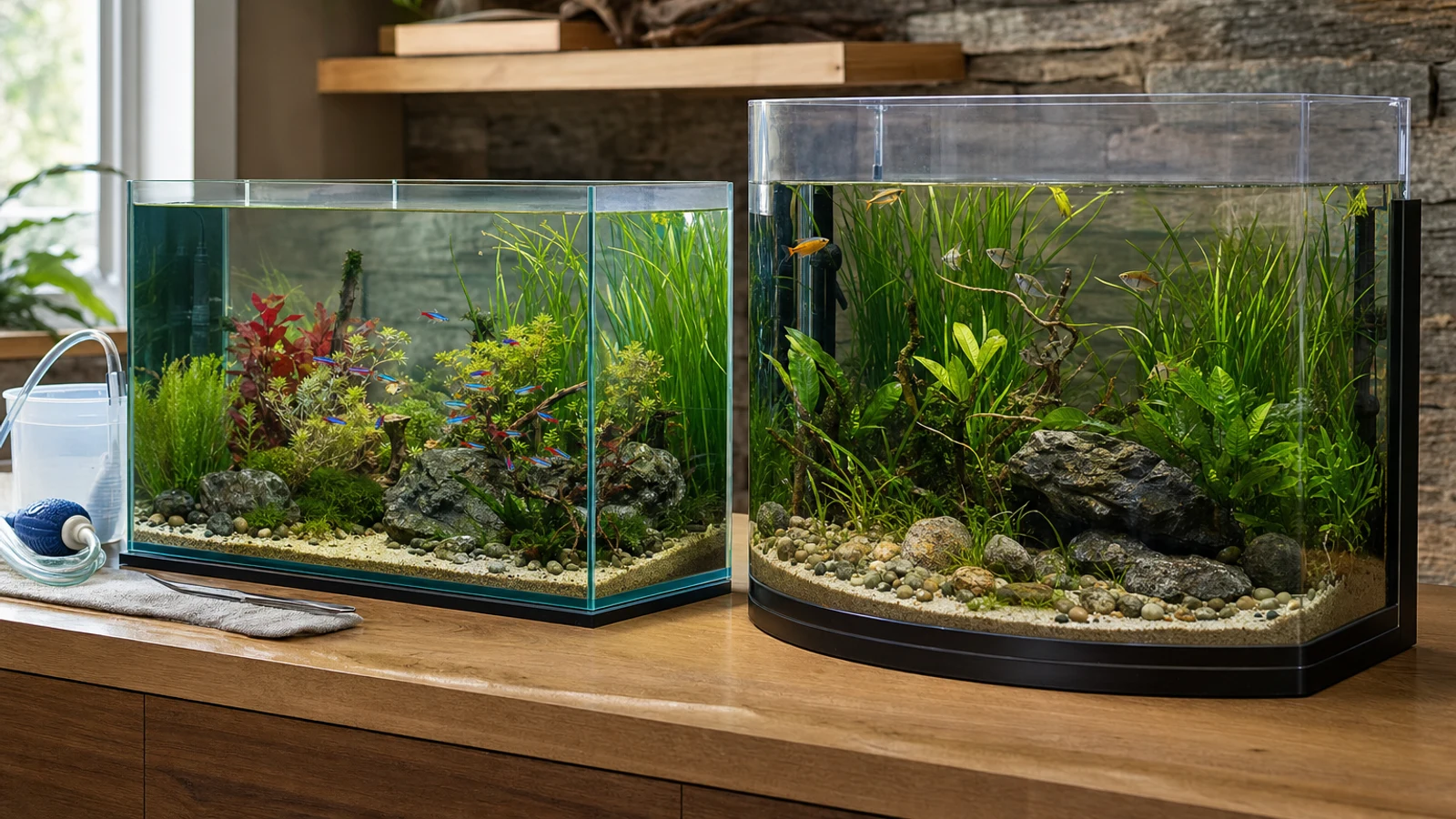
Glass is usually the practical choice for smaller, flat aquariums and scratch resistance. Acrylic becomes more compelling when low weight, impact resistance, curved shapes, or custom drilling matter most.
Quick answer
Choose glass when you want a lower-cost, scratch-resistant tank that is relatively straightforward to clean and support. Choose acrylic when moving weight, impact resistance, unusual shapes, large panels, or custom drilling matter more than scratch resistance. Neither material is universally better: the right choice depends on the aquarium’s size, location, stand, inhabitants, maintenance habits, and whether appearance must stay pristine over years.
Shop this guide
Current Amazon options
Six current listings related to this buying decision. Use the guide to compare fit and trade-offs, then verify the latest seller, price, size, and availability on Amazon.
As an Amazon Associate I earn from qualifying purchases. Product availability, seller, price, and listing details can change.
Key decision checks
Start with the aquarium’s job
The better material depends first on what the tank must do in your home. A small rectangular freshwater aquarium in a stable location has different priorities from a large reef display that must be moved through narrow doorways, a room divider with curved panels, or a custom system that needs drilled plumbing. Decide whether your main problem is weight, impact risk, long-term surface clarity, design flexibility, or price.
For fish and other aquatic animals, the material does not replace correct volume, filtration, heating, cycling, water quality, and species-appropriate habitat design. If you are planning a large, deep, unusual, or custom-built aquarium, have the manufacturer or a qualified aquarium professional confirm panel thickness, stand requirements, seams, and plumbing rather than choosing by material name alone.
- Choose glass first when scratch resistance, conventional rectangular design, and purchase cost are the leading priorities.
- Choose acrylic first when reducing lifting weight, avoiding brittle breakage, or creating curved or custom geometry is especially important.
- Treat the stand and support surface as part of the tank decision, not as an afterthought.
Glass is usually the simpler choice for small and medium tanks
Glass generally makes sense for a conventional aquarium that will stay in one place. It resists everyday scratching better than standard acrylic, does not normally discolor with age, and is often less expensive, particularly in smaller and medium-size formats. Its rigid panels also make it familiar to many aquarium owners and compatible with common rectangular stands, lids, and maintenance tools.
The main glass drawback is weight combined with brittleness. A filled aquarium is heavy regardless of panel material because water, substrate, rocks, and décor add substantial load, but the empty tank itself is heavier in glass. Glass can also break from a severe impact, so placement away from high-traffic areas and careful moving are important. A cracked or damaged aquarium should not be filled until its condition is professionally assessed.
- Best fit: standard rectangular tanks, budget-conscious setups, planted displays, and owners who want fewer scratch-related restrictions.
- Check whether the aquarium is framed or rimless. Frameless glass tanks require full bottom support according to manufacturer guidance.
- If visual color matters, compare standard glass with low-iron or ultra-clear glass rather than assuming all glass looks identical.
Acrylic earns its keep through low weight and impact resistance
Acrylic is much lighter than glass of comparable size and thickness, which can simplify delivery, carrying, installation, and future moves. It is also less vulnerable to shattering from impact and can be formed into curved panels, cylinders, unusual profiles, and large viewing sections. Those advantages become more valuable as aquariums get larger or the room layout makes moving a heavy glass box difficult.
Acrylic is not automatically stronger in every structural sense. It is softer and more flexible than glass, expands and contracts more with temperature changes, and depends heavily on appropriate thickness, fabrication, seams, and full-bottom support. Follow the specific manufacturer’s stand and placement instructions; a general furniture surface should not be assumed suitable simply because an acrylic tank is lightweight.
- Best fit: larger displays, difficult-to-access rooms, custom shapes, impact-prone locations, and systems requiring easy drilling or fabrication.
- Confirm that the stand supports the entire bottom and is level before filling.
- Ask how the manufacturer handles seam construction, bracing, expansion, and warranty requirements for the exact model.
Scratches and cleaning are the biggest daily trade-off
Standard acrylic scratches more easily than glass, and small scratches can become especially visible when aquarium lighting reflects across the front panel. Sand, gravel, hard algae deposits, and debris trapped in a cleaning magnet can scratch acrylic if they are dragged across the surface. Acrylic therefore rewards slower, more deliberate maintenance and tools specifically labeled for acrylic rather than assuming a glass scraper or pad is safe.
Glass is more forgiving during routine algae removal, but it is not impossible to scratch, and its silicone seams still need care. For either material, use aquarium-safe equipment, keep abrasive debris away from the cleaning surface, and follow the tank maker’s instructions. Never use soap, household cleaners, or an unapproved chemical inside the aquarium; residue can harm aquatic life.
- For acrylic: use acrylic-safe pads or magnets, inspect the cleaning tool for trapped grit, and avoid blades unless the manufacturer specifically permits them.
- For glass: use a suitable glass scraper or pad, but still check for sand and grit before wiping.
- Clean the outside with a product approved for aquarium use and keep all household cleaners away from the water.
Compare options for your pet
Glass vs Acrylic Aquarium: Which Trade-Offs Matter Most?
Compare current Amazon listings using the fit and safety checks in this guide. Confirm size, specifications, seller and availability before ordering.
See on Amazon →As an Amazon Associate I earn from qualifying purchases. Links open Amazon search results; individual listings have not been independently verified.
Clarity depends on material, thickness, and viewing expectations
Acrylic can provide excellent optical clarity and avoids the green edge tint that becomes more noticeable in thicker conventional glass. It is also useful when a manufacturer needs to create a large, curved, or nearly seamless viewing panel. However, acrylic’s long-term appearance depends strongly on preventing scratches and using compatible cleaning methods; a scratched surface can undermine its original visual advantage.
Glass remains a strong choice when a flat viewing panel must stay resistant to routine abrasion. Standard glass may show a subtle green cast, particularly at greater thicknesses, while low-iron glass is designed to reduce that color shift. Compare the actual panel material and thickness in the product specifications instead of treating “glass” or “acrylic” as a complete description of image quality.
- Prioritize low-iron glass when accurate color and a premium flat display matter more than minimizing weight.
- Prioritize acrylic when curved geometry, very large viewing panels, or impact resistance outweigh scratch sensitivity.
- If buying used, inspect the viewing panels under strong side lighting before committing; scratches and haze may be less obvious in a dim store.
Compare cost, installation, and future changes
Glass usually offers the easier entry price for ordinary aquarium sizes, but the total project cost includes the stand, delivery, lid, lighting, filtration, heater, substrate, and any plumbing modifications. Acrylic may cost more initially, yet its lower empty weight can reduce handling difficulty and make a custom or large installation practical. Avoid comparing material prices without comparing equivalent dimensions, thickness, bracing, included equipment, and support requirements.
Acrylic is generally easier to drill and fabricate for custom plumbing, but drilling a finished tank can void a warranty or create a serious leak risk if done incorrectly. Some glass aquariums can also be drilled, depending on the glass type and manufacturer’s instructions. Treat drilling, overflow placement, and modifications as design decisions to settle before purchase, not as casual upgrades after setup.
- Request the exact tank dimensions, empty weight, panel material, support requirements, and included accessories.
- Price the complete setup, including a suitable stand and safe delivery or moving help.
- Confirm whether drilling, modifying, or replacing the supplied stand affects the warranty.
A practical decision rule
For most first-time owners choosing a conventional aquarium, glass is the sensible default when the tank will remain on a properly rated stand and can be moved safely. It usually offers better scratch resistance and a lower purchase cost, with fewer special cleaning precautions. This is especially persuasive for smaller tanks, planted aquariums with frequent maintenance, and households comfortable leaving the display in one location.
Choose acrylic when its specific advantages solve a real household problem: the tank must pass through tight access points, the display is large or unusually shaped, impact resistance matters, or custom drilling and fabrication are central to the project. Do not choose it merely because it is lighter if you are unlikely to follow acrylic-safe cleaning practices. The best material is the one whose maintenance and support requirements fit your actual routine.
- Glass wins the everyday practicality test for many small and medium rectangular aquariums.
- Acrylic wins when moving difficulty, impact risk, custom geometry, or large-panel design dominates the decision.
- For either material, reject a tank or stand with visible cracks, damaged seams, bowing, instability, or unclear support instructions.
Common questions
FAQ
Is acrylic clearer than glass for an aquarium?
It can be, especially in thick or curved panels, because acrylic avoids the green tint that can appear in thicker conventional glass. Low-iron glass can also provide excellent color clarity. In practice, long-term appearance depends on panel quality, thickness, lighting, and whether the surface accumulates scratches.
Does acrylic aquarium plastic turn yellow?
Some acrylic tanks may discolor over time, but the risk depends on the material, manufacturing quality, ultraviolet exposure, and product design. Ask the manufacturer about the specific acrylic formulation and placement guidance rather than assuming every acrylic tank will yellow or every tank will remain unchanged.
Can I use a razor scraper on an acrylic aquarium?
Do not assume a razor is safe for acrylic. Acrylic scratches more easily than glass, so use tools specifically approved for acrylic and follow the tank manufacturer’s instructions. If debris is trapped between a magnet cleaner and the panel, stop and remove the debris instead of dragging it across the surface.
Does an acrylic aquarium need a special stand?
Often, yes. Manufacturer guidance commonly requires the entire bottom of an acrylic tank to be supported, along with a level surface. Frameless glass tanks may have similar requirements. Use the stand, mat, and support method specified for the exact aquarium rather than adapting a generic cabinet.
Which material is better for a reef aquarium?
Neither is universally better. Glass may suit reef keepers who prioritize scratch resistance and a flat display, while acrylic may suit large or custom systems where low weight, impact resistance, curved panels, or drilled plumbing matter. Compare the complete tank design, including bracing, overflow, stand, maintenance access, and manufacturer support.
Is glass safer than acrylic for fish?
The material choice itself does not determine whether fish are kept safely. The aquarium must be structurally sound, correctly supported, appropriately sized, and equipped for the species. Keep the tank away from impacts, use secure lids where appropriate, and consult a qualified aquarium professional for large, deep, or custom installations.
Sources & further reading
Where the factual guidance comes from
Ready to choose?
Glass vs Acrylic Aquarium: Which Trade-Offs Matter Most?
Compare current Amazon listings using the fit and safety checks in this guide. Confirm size, specifications, seller and availability before ordering.
See on Amazon →As an Amazon Associate I earn from qualifying purchases. Links open Amazon search results; individual listings have not been independently verified.
Keep researching