Other Pets · Aquatics
Sponge Filter vs Hang-On-Back Filter: Which Fits Your Aquarium?
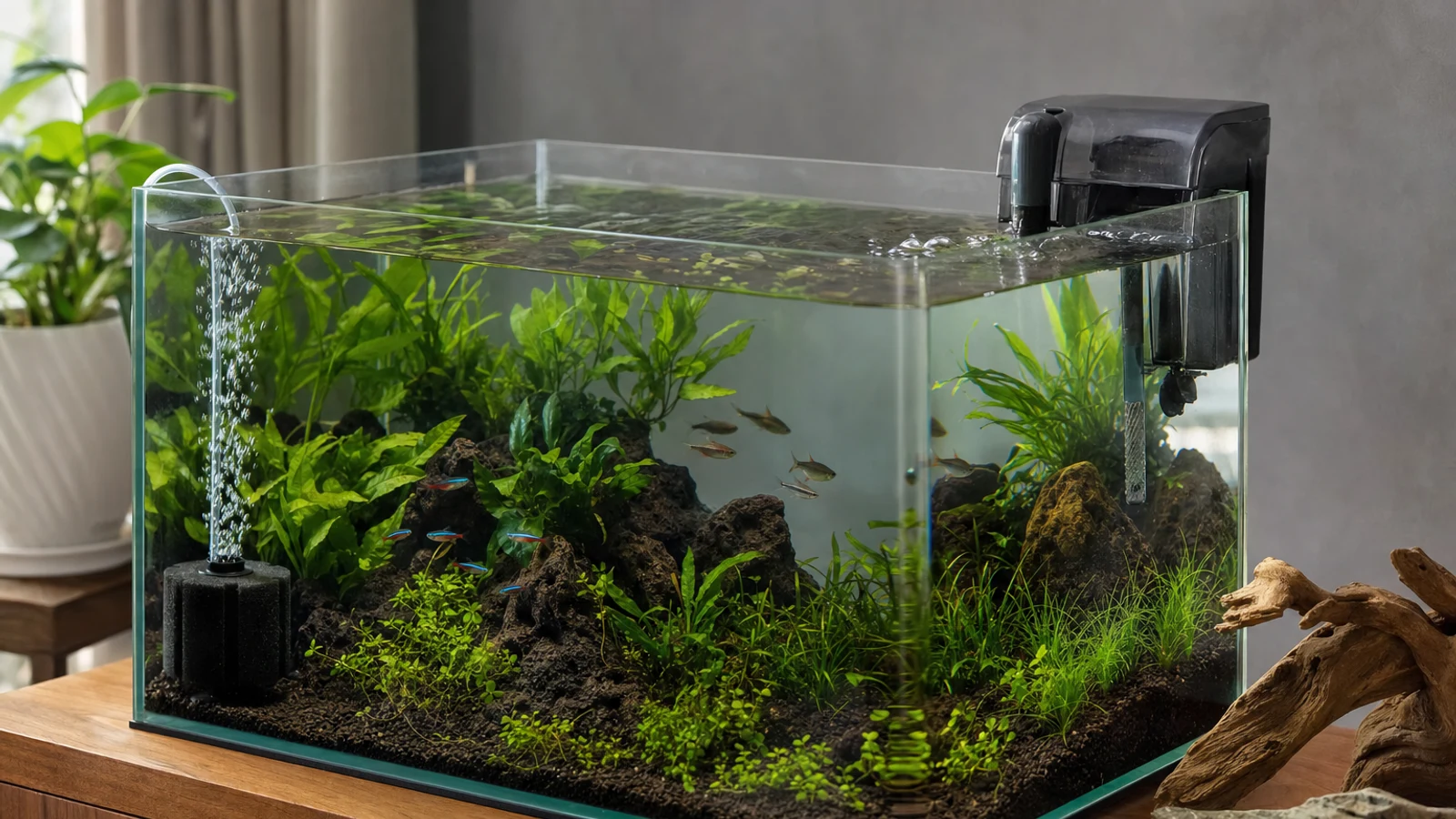
Sponge filters prioritize gentle flow and simple biological filtration, while hang-on-back filters offer stronger circulation and more flexible mechanical, biological, and chemical media. The better choice depends on your livestock, tank layout, maintenance habits, and tolerance for visible equipment or air-pump noise.
Quick answer
Choose a sponge filter when gentle flow, fry or shrimp safety, low complexity, and dependable biological media matter most. Choose a hang-on-back filter when you want stronger circulation, clearer water from mechanical media, built-in pumping, and easier access to different filter media. Neither is universally better, and some aquariums benefit from using both.
Shop this guide
Current Amazon options
Six current listings related to this buying decision. Use the guide to compare fit and trade-offs, then verify the latest seller, price, size, and availability on Amazon.
As an Amazon Associate I earn from qualifying purchases. Product availability, seller, price, and listing details can change.
Key decision checks
The practical difference: gentle biology versus broader filtration
A sponge filter sits inside the aquarium and uses an external air pump to pull water through porous foam. The foam provides a home for nitrifying bacteria and traps some suspended debris, but its main strength is biological filtration with gentle water movement. It also aerates the aquarium through bubbles and surface agitation, although the bubbles themselves are not a substitute for choosing an appropriately sized filter and maintaining water quality.
A hang-on-back, or HOB, filter clips onto the aquarium rim, pulls water through an intake, passes it across filter media, and returns it to the tank. Depending on the design and media arrangement, it can combine mechanical filtration for particles, biological filtration for beneficial bacteria, and optional chemical filtration. That makes an HOB the more versatile general-purpose choice, while a sponge filter is often the calmer, simpler choice.
- Sponge filter: air pump required, gentle flow, visible inside the tank, strong emphasis on biological media.
- HOB filter: integrated water pump, stronger circulation, equipment outside the tank, more room for layered or replaceable media.
- Both types need routine cleaning, correct sizing, and regular water changes; neither replaces proper stocking and feeding practices.
Choose a sponge filter for fry, shrimp, bettas, or simple setups
A sponge filter is usually the better fit when livestock could be harmed by a strong intake or return current. The broad foam surface is less likely to trap newly hatched fry or small shrimp than an unprotected power-filter intake, and the flow can be adjusted through the air supply. This makes sponge filters common choices for breeding tanks, nursery tanks, shrimp aquariums, and other setups where gentle circulation is a priority.
The trade-off is that the sponge occupies space inside the display and may be more noticeable than an HOB. You also need an air pump, airline tubing, and usually a check valve to complete the system. The air pump introduces another device to position and maintain, and its vibration or bubbling may be more noticeable than the hum of a motorized filter.
- Use a sponge filter when small animals could be drawn into an intake.
- Favor it when fish need low current or when the aquarium is used for breeding or rearing fry.
- Check that the air pump can drive the sponge at the tank’s depth and that tubing connections are secure.
- Leave room around the sponge so it can be removed and rinsed without disturbing decorations or livestock.
Choose an HOB for clearer water and flexible media
An HOB is often the easier all-around option for a normally stocked community aquarium. Its intake and media chamber move more water through mechanical media, which can collect floating waste and fine particles more effectively than many small air-driven sponge filters. The return also creates circulation across the tank, helping distribute heat and prevent stagnant areas when the flow is appropriate for the fish and aquascape.
HOB designs vary, so do not assume every model provides the same media options. Some rely heavily on disposable cartridges, while others allow separate foam, biological media, and chemical media. A model with reusable mechanical and biological media can give you more control over maintenance and replacement. Carbon or other chemical media may be useful for specific purposes, but it is not automatically required for routine aquarium operation.
- Choose an HOB when visible debris and water polishing are important priorities.
- Look for adjustable flow or a controllable outlet if your fish prefer calmer water.
- Prefer a media chamber that lets you retain biological media while cleaning or replacing mechanical material.
- Confirm that the filter fits the aquarium rim, lid, water level, and available clearance behind the tank.
Compare flow, oxygenation, and livestock compatibility
Sponge filters generally create a soft upward current and surface movement. That suits many bettas, juvenile fish, shrimp, and other animals that struggle in forceful flow, but it may provide less whole-tank circulation in a long aquarium or a heavily decorated layout. You may need to position the sponge carefully or add a second filter if water movement is uneven.
HOB filters usually provide more directional flow and surface agitation, but a strong return can stress slow-swimming fish, disturb floating plants, or push food and lightweight decor around the aquarium. Adjustable flow, a diffuser, a pre-filter sponge, or a modified return can reduce the force. Watch the animals rather than choosing by a label alone: persistent hiding, struggling to swim, or being pinned near the intake indicates that the setup needs adjustment. Aquarium filtration advice is not a substitute for species-specific veterinary or aquatic-professional guidance when fish show illness, injury, or unexplained behavior changes.
- For fry and shrimp, protect the intake or choose a sponge-based design.
- For bettas and other low-flow fish, prioritize controllable output over maximum advertised flow.
- For active community fish, assess whether a sponge alone circulates water throughout the full footprint.
- For planted tanks, place the return so it moves the surface without constantly uprooting floating plants.
Compare options for your pet
Sponge Filter vs Hang-On-Back Filter: Which Fits Your Aquarium?
Compare current Amazon listings using the fit and safety checks in this guide. Confirm size, specifications, seller and availability before ordering.
See on Amazon →As an Amazon Associate I earn from qualifying purchases. Links open Amazon search results; individual listings have not been independently verified.
Maintenance, reliability, and power-outage considerations
Sponge-filter maintenance is straightforward: remove accumulated debris by gently squeezing the sponge in water taken from the aquarium during a water change. Avoid cleaning biological media with chlorinated tap water unless the product instructions specifically direct otherwise, because disinfecting chemicals can damage the established bacterial community. The air pump, airline, check valve, and airlift tube also need occasional inspection for clogs, cracking, or reduced output.
HOB maintenance adds an impeller, intake strainer, filter housing, and media path. Debris or mineral buildup can reduce flow and increase noise, so these parts need periodic cleaning according to the manufacturer’s instructions. Do not automatically discard all filter media at once just because a cartridge is dirty; preserving established biological media helps maintain the nitrogen cycle. During a power outage, an HOB stops when its pump loses power, while a sponge filter stops circulating if its air pump loses power. A battery-backed air pump or other outage plan may be appropriate for valuable or densely stocked aquariums.
- Clean mechanical media when flow drops or debris accumulates, not by an arbitrary replacement schedule alone.
- Keep biological media established and avoid replacing every bacterial surface simultaneously.
- Inspect HOB impellers and intake screens when flow becomes weak or rattling begins.
- Keep sponge-filter air pumps above the aquarium or use a properly installed check valve to reduce back-siphoning risk.
Sizing and setup checks that matter more than the filter label
Use the manufacturer’s aquarium-size guidance as a starting point, then account for actual water volume, livestock load, feeding, plant density, and the filter’s position. A heavily stocked aquarium may need more biological capacity or multiple filters, while a lightly stocked tank may not need the strongest available flow. Advertised pump or flow figures are not a guarantee of performance after media becomes dirty, the intake is restricted, or the aquarium is filled with plants and decor.
Whichever type you choose, cycle the aquarium before adding a full livestock load and monitor ammonia and nitrite during new or disrupted setups. Filtration supports the nitrogen cycle, but it does not remove the need for partial water changes, sensible stocking, and careful feeding. If fish are repeatedly gasping, lethargic, injured by flow, or showing signs of disease, test the water and contact a veterinarian experienced with aquatic animals or a qualified aquatic professional rather than solving the problem with a larger filter alone.
- Confirm the filter is compatible with the tank’s rim, lid, water depth, and available rear clearance.
- Size for the real livestock and maintenance routine, not only the empty tank volume.
- Check that replacement media and air-pump parts are easy to obtain before committing to a design.
- Plan how you will maintain biological filtration during cleaning, replacement, or a power interruption.
When using both filters makes sense
A sponge filter and HOB can complement each other when an aquarium needs both gentle biological support and stronger mechanical circulation. The sponge can provide a protected bacterial surface and safer intake area for small livestock, while the HOB can collect fine debris and distribute water across the tank. Running both also gives you some redundancy: one filter can continue supporting the aquarium if the other needs cleaning or repair, provided the biological capacity and stocking are appropriate.
This combination is not automatically better. Two filters mean more equipment, more cleaning, more electrical or air connections, and potentially more current or noise. Use the arrangement when each filter solves a clear problem, such as a community tank with shrimp, a breeding setup that later becomes a grow-out tank, or an aquarium where one device alone leaves dead spots or inadequate mechanical filtration.
- Add both when you need gentle intake protection plus stronger water circulation.
- Use a sponge alongside an HOB when you want extra biological media without relying on a disposable cartridge.
- Reduce or redirect flow if the combined output disturbs fish, plants, substrate, or feeding.
- Do not use extra filtration to justify overstocking or skipped water changes.
Common questions
FAQ
Is a sponge filter better than an HOB filter for beginners?
A sponge filter is simpler mechanically, but it requires a separate air pump and tubing. An HOB is often more convenient for a first community aquarium because the pump and media chamber are integrated. The better beginner choice depends on whether low flow and simple biological filtration or broader mechanical filtration and built-in pumping matter more.
Can a sponge filter keep aquarium water clear?
Yes, a sponge traps some suspended particles, but its main role is biological filtration. Water clarity depends on sponge pore size, maintenance, stocking, feeding, plant debris, and circulation. If fine particles remain suspended, an HOB with suitable mechanical media may provide more noticeable polishing.
Do HOB filters harm shrimp or baby fish?
They can if small animals are pulled into an exposed intake or if the return creates excessive current. Use a pre-filter sponge or another intake guard, adjust the output, and inspect the setup as livestock grows. A sponge filter is often the lower-risk starting point for fry and very small shrimp.
Does a sponge filter add oxygen better than an HOB filter?
Both can support gas exchange when they disturb the water surface. Sponge filters visibly aerate through rising bubbles, while HOB returns usually agitate the surface as water falls back into the aquarium. Oxygenation depends on surface movement, temperature, stocking, and overall circulation, not simply on whether bubbles are visible.
Should I replace my HOB cartridge every month?
Follow the manufacturer’s instructions for that specific filter, but do not assume every cartridge should be discarded on the same schedule. Mechanical media may need cleaning or replacement when clogged, while biological media should generally be preserved. Replacing all established media at once can unnecessarily reduce biological filtration.
Sources & further reading
Where the factual guidance comes from
Ready to choose?
Sponge Filter vs Hang-On-Back Filter: Which Fits Your Aquarium?
Compare current Amazon listings using the fit and safety checks in this guide. Confirm size, specifications, seller and availability before ordering.
See on Amazon →As an Amazon Associate I earn from qualifying purchases. Links open Amazon search results; individual listings have not been independently verified.
Keep researching