Cats · Travel
Cat Backpack vs Traditional Carrier: Which Fits Your Travel Routine?
A cat backpack can be easier for a person to carry, but a well-designed traditional carrier is usually the more versatile choice for veterinary visits and car travel. Compare space, stability, ventilation, cleaning, entry, and travel routine before deciding.
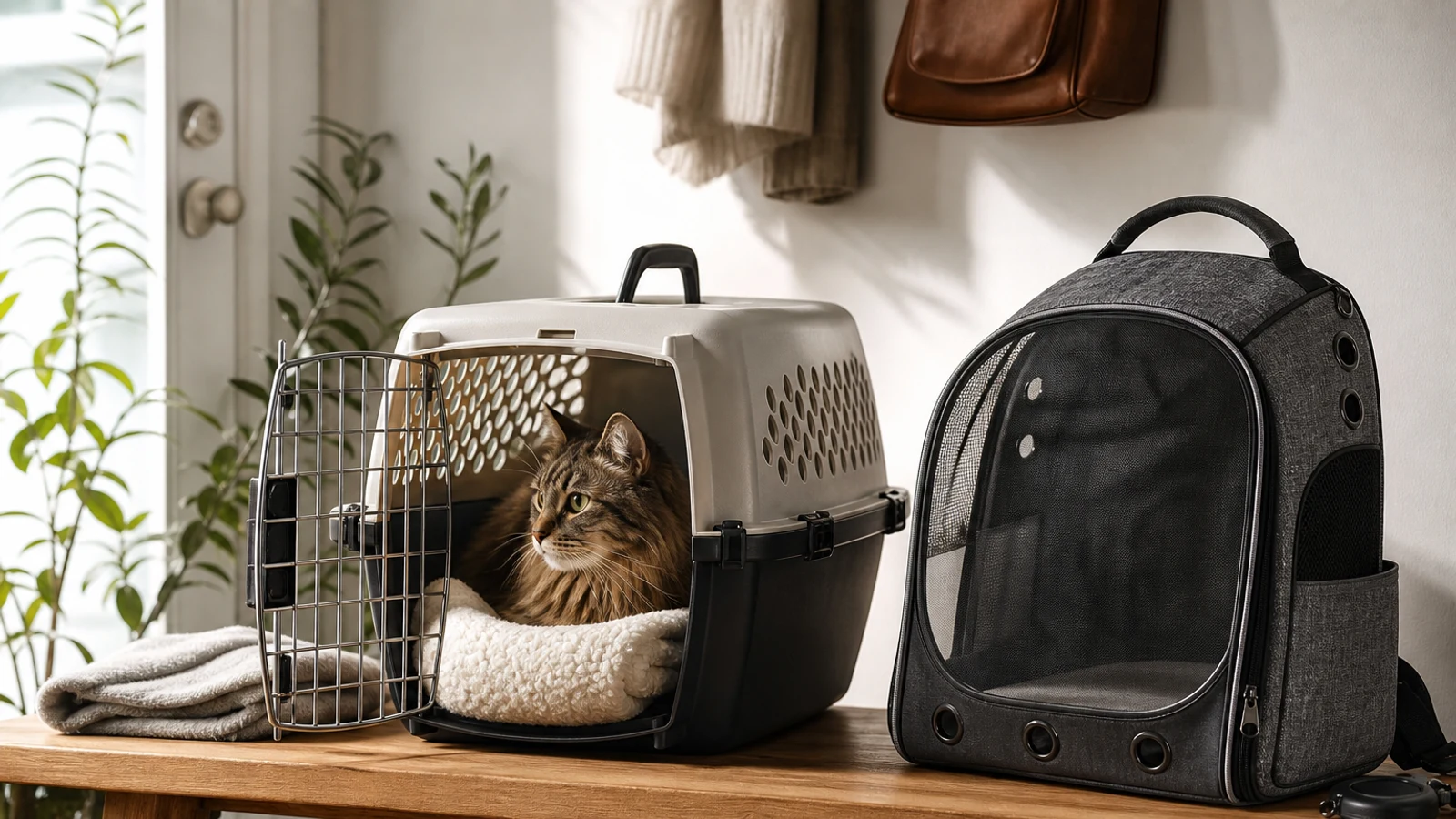
Quick answer
For most cats, a sturdy traditional carrier is the better all-purpose choice because it usually provides a more stable base, easier cleaning, better access for veterinary examinations, and enough room for the cat to stand, turn, lie down, and reposition. A backpack may make sense for essential walking or public-transit trips when carrying a conventional carrier is difficult, but choose one with a rigid base, secure closures, breathable ventilation, visual shielding, and enough interior space. A backpack should not be selected simply because it looks more convenient or stylish.
Shop this guide
Current Amazon options
Six current listings related to this buying decision. Use the guide to compare fit and trade-offs, then verify the latest seller, price, size, and availability on Amazon.
As an Amazon Associate I earn from qualifying purchases. Product availability, seller, price, and listing details can change.
Key decision checks
Start with the trip, not the carrier style
The right carrier must keep your cat contained, supported, ventilated, and reasonably calm while also fitting the way your household travels. Begin with the actual routine: a short drive to the veterinarian, a walk to public transit, an airplane cabin, an emergency evacuation, or a longer relocation trip can place very different demands on the carrier.
For most households, a traditional carrier is the stronger single-carrier solution. It is usually easier to place on a stable surface, clean after an accident, cover without blocking airflow, and open for a veterinary examination. A backpack can solve a real human-handling problem, but it should be judged as a compromise rather than an automatic upgrade.
- Choose around the cat’s full adult size, not only the current kitten size.
- Plan for the carrier to remain useful during illness, emergencies, and unexpected delays.
- Treat airline acceptance and under-seat dimensions as separate checks; airline rules vary by carrier and route.
Traditional carriers usually win for stability and feline access
A good traditional carrier gives the cat a firm floor and enough room to stand, turn around, lie down, and adjust position without sliding excessively. Hard-sided models are also generally easier to wipe clean and less likely to collapse when the door is opened. Many veterinary-friendly designs have a top opening or removable upper section, allowing staff to examine the cat while it remains in the lower half.
The carrying method still matters. A traditional carrier should be supported from underneath rather than allowed to swing from one handle. In a vehicle, keep the cat inside the carrier and place it in a stable location; veterinary guidance commonly recommends a secure, low position such as the floor behind the front seats, subject to the vehicle and carrier design.
- Look for a rigid, non-slip base that stays level when lifted.
- Prefer strong fasteners and doors that cannot be pushed open by the cat.
- Favor multiple ventilation surfaces, while retaining the option to partially cover the carrier.
- Check whether the top can be removed or opened for lower-stress veterinary handling.
Backpacks solve a carrying problem, not every cat problem
A backpack can be useful when the person must keep both hands available, walk to an appointment, climb stairs, or use public transportation. Weight distribution may feel better for the caregiver than carrying a conventional box at arm’s length. That benefit is practical, especially for people with limited strength or mobility, but it does not remove the need for a stable interior and sufficient feline space.
The main concern is motion. A carrier on a person’s back can sway, tilt, and move with every step. Some backpack designs also use a narrow, upright compartment or a clear front window that leaves little room to reposition or hide. Cat welfare organizations and feline veterinary guidance caution that many backpack carriers are too cramped or unstable for comfortable routine use.
- Use a backpack only if the cat can stand, turn, lie down, and change position comfortably.
- Avoid designs with a soft or sagging floor, weak mesh, exposed zippers, or a single small opening.
- Prefer breathable mesh over sealed clear plastic, while providing a way for the cat to retreat from visual exposure.
- Test the empty backpack for balance and handle security before placing the cat inside.
Match the carrier to your travel routine
For a short car trip to the veterinarian, a traditional carrier is usually the easiest choice. Its stable base, broad opening, washable surfaces, and compatibility with a towel cover make it easier to manage a nervous or nauseated cat. A backpack may be workable when the clinic is within walking distance, but only if the route is smooth and the carrier does not jolt or overheat.
For public transit or walking, the decision becomes more balanced. A backpack can reduce arm fatigue and leave one hand free for doors, transfers, or mobility equipment. However, a conventional carrier on a small cart or stroller may provide a steadier ride. For flights, do not assume a backpack is accepted because a listing uses terms such as airline-ready or cabin-friendly; confirm the current airline rules, dimensions, ventilation requirements, and under-seat fit before booking.
- Vet visit by car: favor a sturdy traditional carrier with top access or a removable top.
- Walking or transit: consider a backpack only when portability is the limiting problem.
- Air travel: verify the airline’s current carrier policy before purchase and again before departure.
- Moving or emergency travel: prioritize structural strength, escape resistance, cleaning, and room for supplies.
Compare options for your pet
Cat Backpack vs Traditional Carrier: Which Fits Your Travel Routine?
Compare current Amazon listings using the fit and safety checks in this guide. Confirm size, specifications, seller and availability before ordering.
See on Amazon →As an Amazon Associate I earn from qualifying purchases. Links open Amazon search results; individual listings have not been independently verified.
Check comfort, ventilation, and cleaning before convenience
The carrier should be large enough for the cat to reposition but not so oversized that the cat slides during movement. Add a familiar, washable towel or blanket that provides traction without taking up the usable floor area. A cover can reduce visual stimulation, but it must not obstruct ventilation or create a hot enclosed space.
Accidents happen during stressful travel, so cleaning is not a minor detail. Hard plastic surfaces are generally simpler to disinfect than absorbent fabric. If choosing a soft traditional carrier or backpack, inspect the seams, floor insert, door frame, and underside for areas that can trap urine, vomit, fur, or moisture. The carrier should dry fully before reuse.
- Measure the cat from nose to base of tail and compare that with the usable interior, not the exterior dimensions.
- Check ventilation on more than one side and avoid designs that rely mainly on a clear plastic window.
- Choose bedding that stays flat and does not bunch under the cat.
- Inspect every zipper, latch, seam, and mesh panel for escape opportunities.
Consider the veterinary and emergency use case
Even households that rarely travel should treat the carrier as emergency equipment. Keep it accessible in the home rather than stored where it appears only before stressful appointments. Familiar bedding, treats, and gradual practice can help the cat enter voluntarily. A carrier that is difficult to open, unstable to lift, or impossible to clean may become a liability when time is limited.
For cats that panic, drool, vomit, injure themselves, or become unusually distressed during transport, product selection is only part of the solution. Ask your veterinarian about carrier training, travel preparation, and whether medication is appropriate for that individual cat. Do not give sedatives or other medication without veterinary direction, and do not assume a backpack will resolve travel anxiety.
- Keep the carrier out and accessible so it becomes ordinary household furniture.
- Practice brief, calm carrier sessions before an unavoidable trip.
- Use a separate carrier for each cat, even if the cats normally get along.
- Ask a veterinarian about severe fear, motion sickness, pain, breathing concerns, or air travel suitability.
Bottom line: choose the carrier that removes your biggest risk
Choose a traditional carrier when you want the best all-purpose option for veterinary visits, car travel, emergencies, cleaning, and stable handling. The strongest choice is usually a supportive carrier with adequate room, reliable ventilation, secure closures, and a top or removable opening. Traditional does not automatically mean hard-sided, but a soft model must still keep its shape and provide a stable floor.
Choose a backpack when carrying a conventional carrier is the main barrier and your cat tolerates the design. Select the largest practical model that still fits your route, and use it for controlled, necessary travel rather than extended sightseeing by default. If the backpack cannot provide comfortable repositioning, predictable movement, visual refuge, and dependable ventilation, it is the wrong tool regardless of how convenient it feels for the person.
- Best default for most cats: sturdy traditional carrier.
- Best reason to choose a backpack: hands-free walking or transit when a conventional carrier is impractical.
- Best reason to reject either style: inadequate space, unstable movement, poor airflow, or unreliable escape prevention.
- Best long-term strategy: carrier training plus a design that can support veterinary handling.
Common questions
FAQ
Can a cat backpack replace a traditional carrier?
Sometimes, but it is not the best universal replacement. A backpack may work for essential walking or transit when it provides enough room, a firm base, secure closures, ventilation, and visual refuge. A traditional carrier is generally more versatile for car travel, veterinary examinations, cleaning, and emergencies.
Are clear-window cat backpacks comfortable for cats?
Not necessarily. A clear window can expose a cat to constant movement, people, animals, and noise while offering little opportunity to hide. If a backpack has a window, it should still provide good airflow and a safe way to reduce visual exposure without blocking ventilation.
Is a hard carrier better for car travel?
A sturdy carrier with a stable base is often easier to manage in a car, but the material alone does not determine safety. The carrier must be appropriately sized, escape-resistant, ventilated, and placed securely. Keep the cat contained throughout the drive and follow vehicle and carrier instructions.
Can I use a backpack for a veterinarian appointment?
It can be appropriate when carrying a conventional carrier is difficult, but choose carefully and tell the clinic what type of carrier you are bringing. A backpack with a rigid base, secure fasteners, adequate space, and a large opening is more practical than a cramped or unstable design. Ask your veterinarian about any cat that becomes highly distressed during transport.
Should two cats share one carrier?
No. Each cat should have a separate carrier, even if they normally live peacefully together. Travel can increase fear and change behavior, and separate carriers make handling, examination, and emergency separation easier.
What should I put inside a cat carrier?
Use a familiar, washable towel or blanket that provides traction and does not bunch under the cat. For longer or more complicated travel, ask your veterinarian how to handle food, water, medication, toileting, and temperature. Keep the carrier ventilated and avoid loose items that could shift or obstruct the door.
Sources & further reading
Where the factual guidance comes from
Ready to choose?
Cat Backpack vs Traditional Carrier: Which Fits Your Travel Routine?
Compare current Amazon listings using the fit and safety checks in this guide. Confirm size, specifications, seller and availability before ordering.
See on Amazon →As an Amazon Associate I earn from qualifying purchases. Links open Amazon search results; individual listings have not been independently verified.
Keep researching