Cats · Feeding & Hydration
Timed vs Microchip Cat Feeder: Which Solves the Right Feeding Problem?
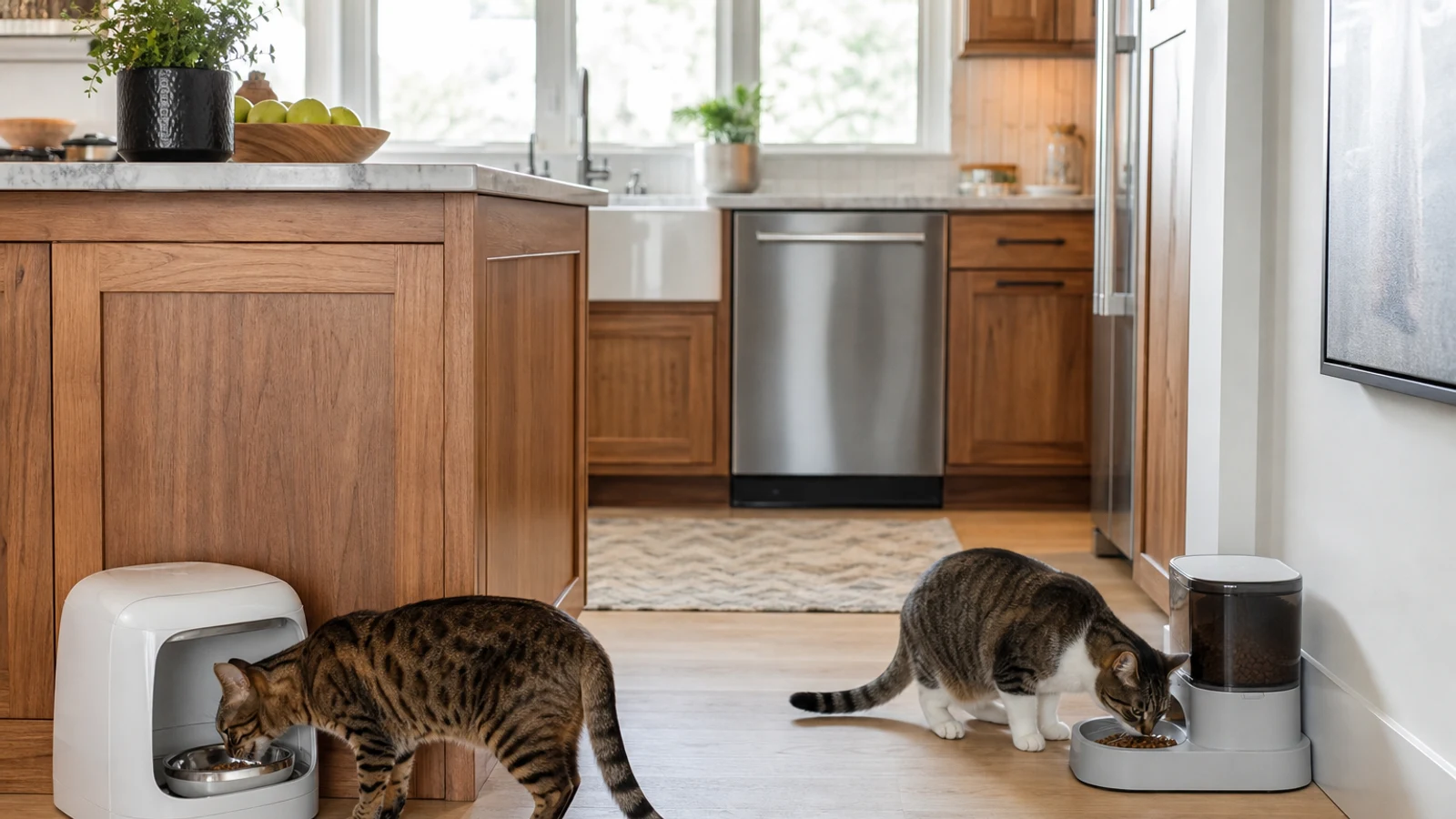
A timed feeder solves schedule and portion problems. A microchip feeder solves access problems. Choose based on whether your main concern is feeding food on time or stopping one cat from eating another cat’s meal.
Quick answer
Choose a timed cat feeder when one cat needs measured dry-food meals at predictable times, you want to reduce missed feedings, or your household cats can safely share the same food. Choose a microchip or RFID feeder when one cat steals food, cats eat different diets, one cat needs weight control, or a shy cat must have reliable access. A timed feeder manages when food appears; a microchip feeder manages who can reach it. In some homes, separate rooms or a timed feeder plus physical separation may work better than either product alone.
Shop this guide
Current Amazon options
Six current listings related to this buying decision. Use the guide to compare fit and trade-offs, then verify the latest seller, price, size, and availability on Amazon.
As an Amazon Associate I earn from qualifying purchases. Product availability, seller, price, and listing details can change.
Key decision checks
The practical difference: schedule versus access
A timed feeder releases a measured amount of food according to a schedule. It is useful when the household need is consistency: breakfast before work, several small portions during the day, or a controlled amount for a cat that begs whenever someone enters the kitchen. Most timed feeders are designed primarily around dry food, though some tray-style models are intended for short-term wet-food scheduling and may have different freshness limits.
A microchip feeder does not usually replace a full hopper-and-schedule system. Instead, it uses a registered implanted microchip or an RFID collar tag to unlock access for an approved cat while keeping other pets out. Its core job is food security, not simply meal timing. That makes it more relevant when the problem is food stealing, incompatible diets, or unequal access between cats.
- Timed feeder: controls when food is dispensed and often how much is offered.
- Microchip or RFID feeder: controls which cat can open or reach the bowl.
- Timed feeder plus separate rooms: a lower-tech option when cats tolerate scheduled meals and supervision.
- Neither product automatically determines the correct daily calorie allowance; that should be based on the individual cat and veterinary guidance.
Choose a timed feeder for predictable portions and routines
A timed feeder is usually the simpler choice for a single cat or for cats that eat the same food without competing. It can divide a daily dry-food allowance into smaller meals, reduce reliance on human availability, and make a routine easier to maintain. It may also help when a cat wakes the household for food or when different caregivers might otherwise offer duplicate meals.
The limitation is important: a standard timed feeder generally opens or dispenses for any cat that reaches it. In a multi-cat home, a second cat may eat the meal, return for extra food, or block a more timid cat. A dual-bowl design may divide food between bowls, but it does not necessarily identify the cats or guarantee that each cat receives its intended share.
- Best fit: one cat, shared diet, predictable dry-food meals, or a household that can supervise feeding.
- Check whether portions are measured by volume, rotations, or dispensing cycles; these are not interchangeable measures.
- Look for a lid or hopper that is difficult for a determined cat to pry open or knock over.
- Confirm what happens during a power interruption and whether the unit can still dispense without an internet connection.
- Keep the feeding station away from litter boxes, noisy appliances, and busy traffic if your cat is easily startled.
Choose a microchip feeder when food stealing is the real problem
A microchip feeder is the stronger match when cats must not share food. Examples include a cat on a prescription diet, a cat that gains weight by visiting another bowl, a kitten that should not eat an adult cat’s food, or a shy cat that leaves before finishing because another cat approaches. The feeder reads an authorized microchip or collar tag and opens for that individual animal.
This type of feeder can protect food access, but it does not remove every management challenge. The cat must learn to approach the device, remain comfortable with the moving lid, and wear a tag if an implanted chip is not used. A determined cat may still try to reach food while the lid is open, so placement, spacing, and observation matter. A microchip feeder also may not dispense a series of meals from a large reservoir unless the specific model includes that function.
- Best fit: different diets, food stealing, unequal body condition, grazing, or a cat that needs protected access.
- Verify whether the model reads an implanted microchip, an included RFID tag, or both.
- Plan for collar safety and tag retention if using a tag-based system; replace or adjust equipment if the cat resists it.
- Allow a gradual introduction with the lid held open or disabled according to the manufacturer’s instructions.
- Use one feeder per protected cat when several cats need different diets or independent access.
Multi-cat homes need more than a clever feeder
Feeder technology works best when it supports a calm feeding layout. Feline behavior guidance recommends separate food resources with distance and visual separation because cats may eat quickly, overeat, avoid food, or become stressed even when there is no obvious fight. A feeder placed beside another cat’s station may still allow staring, blocking, guarding, or ambushing.
If cats eat scheduled meals and finish promptly, separate rooms with closed doors can be the most reliable and least complicated solution. If one cat grazes, eats slowly, or needs food available for longer periods, a microchip feeder may be more practical. If a cat stops eating, loses weight, vomits, or shows a sudden change in appetite, treat that as a veterinary concern rather than a feeder-selection problem.
- Provide each cat with a defined feeding station rather than relying on one shared bowl.
- Use visual barriers, separate rooms, elevated locations, or greater distance when one cat intimidates another.
- Observe who actually eats; food disappearing from a bowl does not prove that the intended cat consumed it.
- Keep water available in clean, accessible locations separate from the feeding decision.
- Ask a veterinarian to set or review portions for cats with obesity, diabetes, kidney disease, urinary disease, growth needs, or other medical conditions.
Compare options for your pet
Timed vs Microchip Cat Feeder: Which Solves the Right Feeding Problem?
Compare current Amazon listings using the fit and safety checks in this guide. Confirm size, specifications, seller and availability before ordering.
See on Amazon →As an Amazon Associate I earn from qualifying purchases. Links open Amazon search results; individual listings have not been independently verified.
Wet food, dry food, and freshness change the decision
Timed hopper feeders are most convenient for dry food because kibble can remain in a covered reservoir and be dispensed later. They are less suitable for leaving ordinary wet food exposed for long periods. If your cat relies on wet food, consider a covered rotating tray, a chilled feeder designed for that purpose, or feeding behind a closed door. Check the manufacturer’s instructions for the exact food type, cleaning routine, and safe holding period.
Microchip feeders are often bowl-access devices rather than large-capacity dispensers. Their advantage is that the authorized cat can return to its own food without another pet taking it. This can suit wet-food grazers or cats that eat slowly, provided the bowl is refreshed and cleaned appropriately. A microchip feeder may need to be paired with a separate timer or human visit if meals must appear at specific times.
- For dry food, compare hopper capacity, portion consistency, jam resistance, lid security, and cleaning access.
- For wet food, prioritize covered access, bowl hygiene, cooling or freshness instructions, and realistic meal timing.
- Do not assume an app, camera, or notification feature proves that a cat ate the full portion.
- Choose a bowl shape your cat accepts; some cats dislike deep or narrow dishes that press against their whiskers.
Features worth paying attention to
The most useful feature is the one that addresses your household’s failure point. A timed feeder needs dependable dispensing and a portion setting you can understand. A microchip feeder needs accurate recognition, a lid or barrier that discourages unauthorized access, and an introduction process your cat will tolerate. App controls can be convenient, but they should not distract from basic access, cleaning, power, and food-safety requirements.
Before buying, measure the space and consider how your cat behaves around equipment. A food-motivated cat may knock over a lightweight feeder, pull at exposed components, or wait beside another cat’s station. A timid cat may need a quiet location and time to learn. Products that require collars are a poor fit if your cat regularly removes collars or cannot safely wear one.
- Timed model: schedule clarity, portion repeatability, backup power, offline operation, anti-jam design, and easy-to-wash food-contact parts.
- Microchip model: chip or tag compatibility, number of authorized pets, lid speed, training mode, battery life, and unauthorized-access resistance.
- Either type: stable base, protected controls, accessible replacement parts, transparent cleaning instructions, and a bowl your cat will actually use.
- Avoid making a purchase based only on camera, app, capacity, or marketing claims; those features do not solve the wrong feeding problem.
How to decide in five minutes
Start with the failure you are trying to prevent. If the failure is “my cat is fed late, begs at night, or receives inconsistent portions,” begin with a timed feeder. If the failure is “the wrong cat eats the food,” begin with a microchip or RFID feeder. If both problems are present, look for a model that explicitly combines scheduled dispensing with individual access, or use separate feeding rooms and add automation only where it improves the routine.
Then test the plan against the food and the cat. A dry-food grazer may benefit from protected access, while a wet-food cat may need a different style of feeder altogether. A cat with a medical diet, unexplained appetite change, or prescribed calorie target should have the feeding plan reviewed by a veterinarian before automation replaces direct observation.
- Pick timed first when schedule and portion control are the main goals.
- Pick microchip or RFID first when identity and food protection are the main goals.
- Pick separate-room feeding when cats can be fed in defined meal windows and the household can supervise.
- Use a hybrid plan when one cat needs protected access and the household also needs automated timing.
- Reassess the setup if a cat avoids the feeder, eats less, eats faster, gains weight, or shows increased conflict.
Common questions
FAQ
Can a timed feeder stop one cat from eating another cat’s food?
Usually not. A standard timed feeder controls release time, but it generally does not know which cat is eating. You still need separate rooms, supervision, physical barriers, or an individual-access feeder.
Does a microchip feeder dispense food on a schedule?
Some models may combine identification with scheduled dispensing, but many microchip feeders primarily control access to food already placed in the bowl. Check the exact model rather than assuming that “microchip” means hopper automation.
Is an RFID feeder the same as a microchip feeder?
They solve a similar access problem, but the identification method can differ. Some devices read an implanted pet microchip, while others use a proprietary RFID collar tag. Confirm compatibility before buying.
Can one microchip feeder serve multiple cats?
It depends on the model and the access settings. A feeder may recognize more than one authorized cat, but that does not create separate portions or separate diets. If cats need different foods, one protected feeder per diet or per cat may be more practical.
Are automatic feeders safe for cats with medical conditions?
They can be part of a veterinary feeding plan, but they should not replace professional guidance or monitoring. Cats with diabetes, kidney disease, urinary disease, obesity, poor appetite, or unexplained weight change may need specific food, timing, portions, and observation.
Should I choose a feeder for wet or dry food first?
Yes. Dry food works with many timed hopper feeders. Wet food needs closer attention to freshness, temperature, covered storage, bowl cleaning, and the period before the cat eats it. Select the food format before comparing smart features.
Sources & further reading
Where the factual guidance comes from
Ready to choose?
Timed vs Microchip Cat Feeder: Which Solves the Right Feeding Problem?
Compare current Amazon listings using the fit and safety checks in this guide. Confirm size, specifications, seller and availability before ordering.
See on Amazon →As an Amazon Associate I earn from qualifying purchases. Links open Amazon search results; individual listings have not been independently verified.
Keep researching