Cats · Litter & Cleanup
Cat Litter Mats: What Actually Matters Before You Buy?
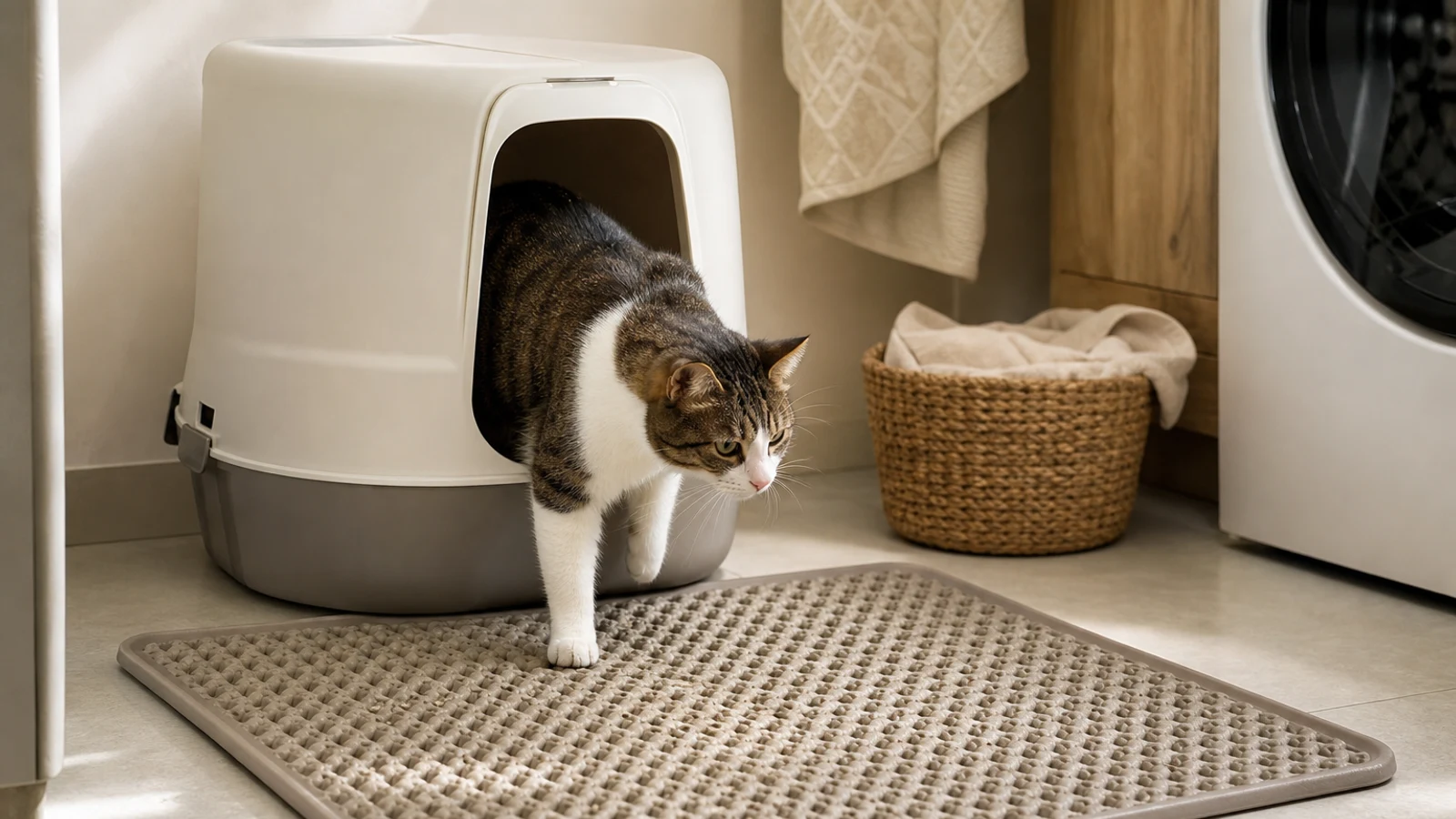
The most useful cat litter mat is not necessarily the largest or most heavily textured. It is the one your cat walks across, catches the litter your cat carries out, stays flat, and can be emptied without becoming a second chore.
Quick answer
Choose a cat litter mat based on the mess you are trying to control. Deep-groove and textured mats are practical for loose granules and simple shaking or vacuuming, while two-layer honeycomb mats are better when you want litter to fall into a collection space. Size the mat around the actual exit route, not just the box footprint. Avoid sharp edges, curling corners, unstable backing, strong odors, or surfaces your cat avoids. A mat can reduce paw-carried litter and protect the floor, but it will not fully stop litter kicked over low sides, weak clumps, or a cat that jumps around it.
Shop this guide
Current Amazon options
Six current listings related to this buying decision. Use the guide to compare fit and trade-offs, then verify the latest seller, price, size, and availability on Amazon.
As an Amazon Associate I earn from qualifying purchases. Product availability, seller, price, and listing details can change.
Key decision checks
Start with the type of litter mess
A cat litter mat has one main job: catch loose litter after it leaves the box and before it spreads through the room. That usually means collecting particles released from paws during the first few steps. It can also contain some litter kicked over the edge, but a mat is not a substitute for a box with suitable walls, adequate size, and a location your cat is willing to use.
Before comparing patterns, watch where the mess actually lands. Fine particles directly outside the entrance point to a tracking problem; a wide fan of litter beside or behind the box points more toward digging, jumping, or an exit route the mat does not cover. If the cat steps over the mat, even an effective surface pattern has little opportunity to work.
- Paw-carried litter: prioritize a textured surface or collection layer your cat will cross.
- Litter kicked from the box: consider box height, box shape, and placement as well as a mat.
- Urine or moisture near the box: prioritize a floor-protective base and easy cleaning.
- Litter spread along one narrow route: choose a longer runner rather than a small square.
Choose the mat style that fits your cleanup routine
Deep-groove, coil, and ridged mats keep granules in channels or textured spaces until you shake, sweep, or vacuum them. They are a straightforward choice when you want a mat that can be emptied quickly and inspected easily. Their effectiveness depends on the cat walking across enough of the textured area; a short mat at the edge of a long jump will collect less than its surface suggests.
Two-layer honeycomb mats use an open upper layer and a lower collection space. Loose litter can fall below the walking surface, which may reduce the amount sitting on top of the mat. They can be useful when you want to pour collected litter out later, but inspect the openings against your litter size and confirm that the layers separate or rinse as the manufacturer describes. Some particles may lodge between layers, especially if damp.
- For quick daily cleanup: choose a surface that can be shaken, swept, or vacuumed without unfolding.
- For larger amounts of tracked litter: consider a two-layer design with a practical emptying method.
- For sensitive paws: favor flexible, rounded, low-profile textures over stiff or sharp-edged grids.
- For pellet litter: confirm that the openings or grooves are compatible with the pellet size.
Size and placement matter more than appearance
The mat should cover the path your cat uses after leaving the box, including the first several steps or the landing area after a jump. Measure from the box opening to the point where the cat naturally turns, accelerates, or reaches the bare floor. A mat that is wide but too short may miss the highest-tracking zone; a long narrow runner may be better for a box with a straight front exit.
Leave enough room for the box to sit securely without forcing the cat to balance on a raised edge. If the box is against a wall, place the mat across the likely exit rather than only centered in front. For multiple boxes, measure each traffic pattern instead of assuming one large mat will cover every route.
- Watch one normal exit and one hurried exit before deciding on dimensions.
- Cover the first landing or walking zone, not merely the visible front edge of the box.
- Keep corners flat and avoid placing a fold or raised seam where the cat steps.
- Use a stable backing on smooth floors, but confirm it does not leave residue or slide under the box.
Paw comfort is a functional requirement
Cats do not have to like a litter mat, but they do have to tolerate crossing it. Very stiff plastic, large openings, rough fibers, unstable edges, or a strong new-product odor may cause a cat to step around the mat or leap over it. That turns a promising design into decoration. Introduce the mat without blocking access to the litter box, and watch whether your cat changes the way it enters or leaves.
Paw sensitivity, age, mobility, and previous experiences can change the best choice. A senior cat or a cat with joint discomfort may manage a low, flexible surface more easily than a deeply ridged or uneven one. A cat that suddenly avoids the box should not be trained to tolerate a new mat; a veterinarian should help rule out pain or illness first.
- Look for rounded edges, a flat profile, and no loose threads or pieces that can be pulled free.
- Avoid strong fragrance or surface treatments that could make the litter area less acceptable.
- Observe whether your cat walks normally across the mat instead of stepping over it.
- If the mat changes litter-box use, remove it and reassess the box setup promptly.
Compare options for your pet
Cat Litter Mats: What Actually Matters Before You Buy?
Compare current Amazon listings using the fit and safety checks in this guide. Confirm size, specifications, seller and availability before ordering.
See on Amazon →As an Amazon Associate I earn from qualifying purchases. Links open Amazon search results; individual listings have not been independently verified.
Prioritize cleaning over clever features
A litter mat works only if trapped litter is removed before it spills back onto the floor or becomes damp debris. Choose a design you can realistically empty as often as the area needs. A mat that hides litter inside a deep cavity may look cleaner between cleanings but create more work if you need to open, rinse, dry, and inspect several layers.
Check the care instructions before buying. Some mats can be shaken or vacuumed, while others are intended to be rinsed or wiped. Whatever the design, remove feces or wet litter promptly, allow washable materials to dry fully, and clean the floor beneath the mat. Do not assume that a waterproof-looking surface is suitable for prolonged urine exposure unless the manufacturer specifically says so.
- Confirm whether the mat is vacuum-friendly, rinseable, machine washable, or wipe-clean.
- Check how the mat opens if it has two layers or a litter-collection pocket.
- Choose a size you can lift, carry, and dry without awkward folding.
- Inspect underneath for trapped moisture, grit, curled edges, or floor discoloration.
Match the mat to the floor and litter station
Hard floors make loose litter easy to see but are usually simple to sweep around. Carpet can hide granules and hold moisture, so a mat with a protective lower surface may be more useful there. On either surface, a mat that slides can scatter the very litter it is meant to contain. Stability matters particularly around large boxes, covered boxes, and stations used by more than one cat.
The mat should support a clean litter area without crowding the cat. Keep the box itself in a quiet, accessible location with a clear way out. Do not move the box or add an intrusive mat in a way that makes the station feel trapped, noisy, or difficult to approach. If the box is already in an unsuitable location, changing the mat alone may not improve use.
- Hard floor: emphasize grip, flatness, and easy sweeping.
- Carpet: emphasize moisture protection, a mat that does not snag, and regular under-mat checks.
- Small room: favor a compact design that covers the exit without creating a trip hazard.
- Multi-cat area: use enough coverage for the shared traffic pattern and keep the station easy to access.
Know when the mat is not the real solution
A mat cannot stop every form of tracking. Very fine or lightweight litter may travel farther, damp clumps can break apart, and a cat that digs forcefully may throw litter over the box wall. In those situations, review the litter, box dimensions, wall height, and cleaning routine together rather than buying progressively larger mats. The appropriate combination depends on what your cat accepts and what your household can maintain.
A sudden change in litter-box behavior deserves more attention than a product swap. Straining, frequent attempts, accidents, reluctance to enter, vocalizing, or avoiding the box can be associated with medical or pain-related problems. Contact a veterinarian promptly for those changes, especially if urination appears difficult or reduced; product guidance should not replace medical evaluation.
- If litter is mostly outside the box, reassess box design and digging behavior.
- If litter is carried across several rooms, review the litter particle size and the entire exit route.
- If the cat avoids the mat, remove it rather than making access harder.
- If elimination changes suddenly, seek veterinary advice before changing several variables at once.
A practical buying checklist
The best mat is the one that fits the cat, the station, and the cleanup routine. You do not need the most elaborate design if a simple textured mat covers the real route and can be emptied quickly. Conversely, a low-cost flat mat may be disappointing if the problem is fine litter carried between the toes or a box positioned so the cat can jump over the available surface.
Before buying, take measurements and decide what you will do with captured litter. Check the product’s material and care instructions, then reassess after several days of normal use. Look at the floor around the mat, not just the mat itself: fewer granules beyond the walking zone is a more useful result than a mat that merely appears full.
- Measure the box opening, exit direction, first landing, and available floor space.
- Identify whether you need grooves, a honeycomb collection layer, moisture protection, or simple debris containment.
- Check edge height, backing, flexibility, odor, and cleaning method.
- Confirm the mat remains flat and accessible for every cat using the station.
- Judge success by reduced spread and manageable cleanup, not by a promise of a litter-free home.
Common questions
FAQ
Should the litter box sit on top of the cat litter mat?
Usually, the box can sit partly or fully on the mat if the surface remains flat and stable. Leave enough textured area beyond the entrance for your cat to take several steps. If the mat curls, slides, or makes the box unstable, use a different size or place the mat only along the exit path.
Are honeycomb cat litter mats better than flat mats?
They can be more useful for loose, paw-carried litter because particles may fall into the space below the walking layer. They are not automatically better: the openings must suit the litter, the cat must cross the mat, and the layers must be practical to empty and clean. A simple textured mat may be preferable for a household that wants fast vacuuming.
How often should a cat litter mat be cleaned?
Check it during routine litter-box cleaning and remove visible waste or accumulated litter before it spreads. The exact schedule depends on the number of cats, litter type, mat design, and room traffic. Wash or rinse it only as directed, and inspect underneath for moisture or residue before returning it.
Can a litter mat cause a cat to stop using the litter box?
It can contribute if the surface is unstable, uncomfortable, strongly scented, or blocks an easy exit. Watch for stepping around it, jumping over it, hesitation, or changes in box use. If your cat suddenly avoids the box or has accidents, remove the mat and contact a veterinarian to rule out medical or pain-related causes.
What should I do if litter is being kicked out of the box?
A mat can catch some of the scattered litter, but first review the box’s size, wall height, entry design, and placement. A larger or differently shaped box may contain digging better than a larger mat. Keep the box clean and accessible, and avoid changes that make your cat feel cornered or unable to leave comfortably.
Sources & further reading
Where the factual guidance comes from
Ready to choose?
Cat Litter Mats: What Actually Matters Before You Buy?
Compare current Amazon listings using the fit and safety checks in this guide. Confirm size, specifications, seller and availability before ordering.
See on Amazon →As an Amazon Associate I earn from qualifying purchases. Links open Amazon search results; individual listings have not been independently verified.
Keep researching