Cats · Play & Enrichment
Scratching Post vs Scratching Pad: Which Fits Your Cat and Space?
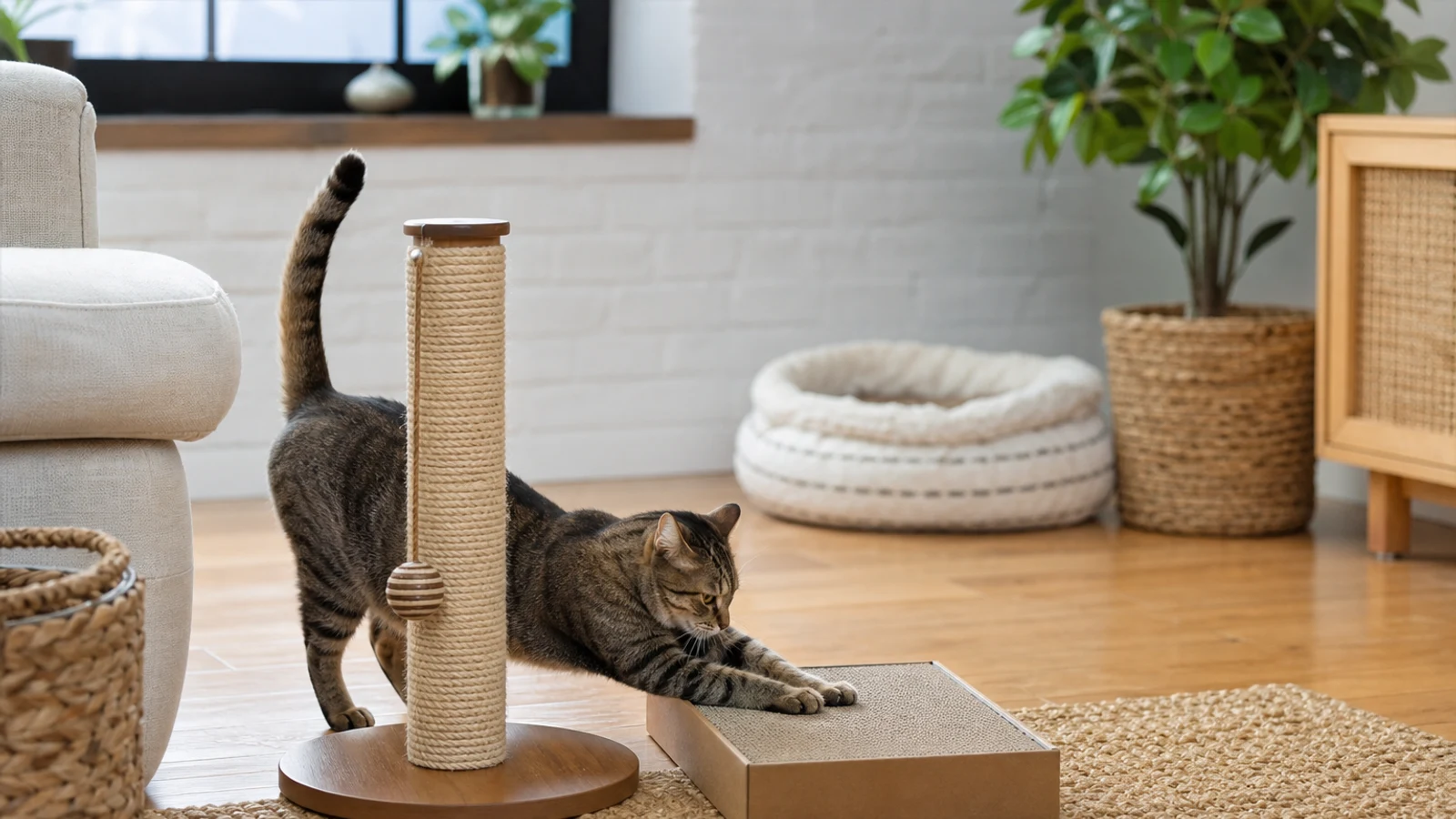
A vertical scratching post suits cats that stretch upward, while a horizontal pad fits cats that rake rugs or other floor-level surfaces. The best choice depends on what your cat already scratches, how stable the product is, and where it will live.
Quick answer
Choose a vertical scratching post if your cat stands up to scratch sofa arms, door frames, or other upright surfaces. Choose a horizontal scratching pad if your cat scratches rugs, carpet, or floor-level areas. If you are unsure, offer one of each near the locations your cat already uses; orientation, stability, texture, and placement all affect whether the product succeeds.
Shop this guide
Current Amazon options
Six current listings related to this buying decision. Use the guide to compare fit and trade-offs, then verify the latest seller, price, size, and availability on Amazon.
As an Amazon Associate I earn from qualifying purchases. Product availability, seller, price, and listing details can change.
Key decision checks
Post or pad: the practical difference
A scratching post gives your cat an upright surface for standing, stretching, pulling downward, and leaving a visible mark. It usually has a smaller floor footprint but needs enough height and a heavy, rigid base. A scratching pad lies flat or nearly flat, allowing a cat to crouch, brace low, and rake across the surface. It is easier to place under furniture edges or in narrow rooms, but it generally needs more floor length and may slide or shed material.
Neither format is automatically better. A cat that ignores a vertical post may be responding to the angle, the texture, movement, or location rather than rejecting scratching equipment altogether. Start with the surface your cat already chooses: upright furniture suggests a post, while rugs and carpet suggest a pad. Cats may use both, especially when different resting areas or rooms create different scratching routines.
- Vertical post: best match for upward stretching and upright furniture targets.
- Horizontal pad: best match for floor-level raking, rugs, and low-clearance spaces.
- Angled scratcher: useful when your cat attacks sofa corners, ramps, or sloped surfaces.
- Offer both when your cat’s behavior is mixed or still unclear.
Match the product to your cat’s posture
Watch how your cat scratches before buying. A cat that rises onto the hind legs, reaches high, and pulls down is giving you a strong reason to choose a vertical post. The post should allow a full-body stretch without the cat’s paws reaching above the usable scratching area. It must also stay planted when the cat leans into it; wobbling can make an otherwise appealing surface feel unsafe or frustrating.
A cat that crouches, kneels, or works backward across a rug is a better candidate for a horizontal pad. Choose a pad with enough usable surface for the cat’s normal stance, and place it so the cat can approach from the side rather than being forced against a wall or piece of furniture. If your cat scratches diagonally, an angled board may be a better first test than either a fully upright post or a completely flat pad.
- Record the height and direction of the furniture or flooring your cat already scratches.
- Observe whether the cat stretches upward, rakes low, or prefers a diagonal angle.
- Do not judge a format until it is stable, large enough, and placed near the existing target.
- A senior cat or a cat with joint discomfort may find a horizontal option easier to use.
Stability and size matter more than appearance
For a vertical post, stability is a first-order requirement, not a premium feature. The base should resist tipping, twisting, and walking across the floor when the cat pulls against it. A tall post with a narrow or lightweight base can occupy little space while still failing the job. Check the structure by applying moderate sideways pressure at the top; visible rocking is a warning sign before your cat ever uses it.
For a horizontal pad, the equivalent problem is sliding, curling, or collapsing. A pad that moves each time the cat digs in may be abandoned, especially if it is on smooth flooring. Look for a broad contact area, a non-skid underside, a rigid frame, or a placement that naturally prevents movement. Size should follow the cat’s body and scratching motion rather than the product photo: the usable surface needs to extend beyond the area where the cat normally braces and pulls.
- Prioritize a rigid frame and secure base over decorative height or extra attachments.
- Check that sisal, cardboard, carpet, or other covering is firmly attached and free of loose strands.
- Avoid exposed staples, sharp edges, unstable toys, and parts that can detach during scratching.
- For wall-mounted options, use appropriate hardware and install them securely rather than relying on adhesive alone.
Choose by texture, not just orientation
A cat can prefer a direction and still reject the material. Common scratching surfaces include sisal rope, sisal fabric, corrugated cardboard, carpet, rough fabric, and wood. Some cats like to sink claws into a yielding surface, while others prefer a firm, noisy, or fibrous texture. If your cat repeatedly scratches one material at home, use that observation as your starting point instead of assuming every sisal post or cardboard pad will feel equivalent.
Texture also affects cleanup and replacement. Corrugated cardboard can produce loose scraps as it wears, while fabric and rope may collect hair and dust. A replaceable insert can reduce waste from the frame, but only if replacements remain available and fit securely. For a multi-cat home, providing more than one texture can reduce competition and reveal whether a cat’s preference is about angle, material, or both.
- Match the new surface to the texture your cat already uses when possible.
- Offer different textures separately rather than changing angle and material at the same time.
- Replace heavily worn, frayed, damp, or structurally damaged scratching surfaces.
- Keep cardboard away from areas where spills, litter dust, or moisture will shorten its useful life.
Compare options for your pet
Scratching Post vs Scratching Pad: Which Fits Your Cat and Space?
Compare current Amazon listings using the fit and safety checks in this guide. Confirm size, specifications, seller and availability before ordering.
See on Amazon →As an Amazon Associate I earn from qualifying purchases. Links open Amazon search results; individual listings have not been independently verified.
Place the scratcher where the behavior happens
Placement often determines success more than the product category. Put a vertical post directly beside the sofa arm, door frame, or other upright target rather than across the room in an empty corner. Put a horizontal pad over or immediately beside a rug edge or floor area the cat already scratches. Once the cat uses the approved surface consistently, you can move it gradually, but relocating it too early may return the cat to the original furniture.
Cats commonly scratch after waking, during play, and near prominent household locations such as windows, doors, and social areas. A scratcher near a favorite sleeping place can catch post-nap stretching; one near an entryway may help with marking behavior. In a home with several cats, distribute scratching surfaces so one cat cannot block access to every option. A visually attractive location for people may be a poor location for the cat if it is isolated or difficult to approach.
- Place the scratcher within immediate reach of the current unwanted target.
- Add one near a favorite sleeping area if post-nap scratching is common.
- Use multiple locations in multi-cat homes or homes with several active rooms.
- Keep the approach clear, with enough space for the cat to turn, stretch, and leave.
Which option fits common household needs?
Choose a vertical post when floor area is limited but you have room for height, your cat scratches upright furniture, or you want a surface that supports a full stretch. A wall-mounted panel can conserve floor space if it is installed securely. A freestanding post is easier to reposition, but it needs a base that remains stable on the household’s flooring and under the cat’s force.
Choose a horizontal pad when your cat already scratches carpets, when a low profile matters, or when reaching upward appears uncomfortable. Pads can fit beneath a table edge, beside a bed, or in a walkway where a tall structure would obstruct movement. Their trade-offs are floor coverage, wear, debris, and possible sliding. If the room allows it, a vertical post near a social area and a horizontal pad near a sleeping area can cover two different scratching moments without forcing one product to do both jobs.
- Small apartment: consider a stable wall panel or compact post plus a thin pad near an existing target.
- Furniture protection: match the scratcher’s orientation and texture to the damaged surface.
- Senior or mobility-limited cat: start with an easy-access horizontal or gently angled surface and ask a veterinarian about new discomfort.
- Uncertain preference: use a short trial with one stable post and one stable pad, keeping placement and texture in mind.
Encourage use without forcing the choice
Place the new scratcher near the cat’s existing target and allow voluntary investigation. You can make it more interesting with a familiar toy, brief interactive play, catnip if your cat responds to it, or a reward delivered immediately after scratching the approved surface. Avoid dragging the cat’s paws across the material or physically placing the cat on it; forced contact can make the object less appealing.
Protect the original target while the habit changes by covering vulnerable furniture or limiting access when practical. Do not punish scratching. If scratching suddenly increases, shifts dramatically, or is accompanied by stiffness, limping, reluctance to jump, vocalization, or other behavior changes, seek veterinary advice. Product selection can support normal scratching, but it cannot diagnose pain, anxiety, or a medical problem.
- Reward voluntary use promptly with a preferred treat, toy, petting, or play.
- Keep the approved surface beside the unwanted target during the transition.
- Do not punish, declaw, or force the cat’s paws onto the scratcher.
- Ask a veterinarian about sudden behavior changes, signs of pain, or persistent distress.
Common questions
FAQ
Can a scratching pad replace a scratching post?
Yes, if your cat prefers horizontal scratching and the pad is long, stable, and placed where the cat wants to scratch. It may not replace the stretching opportunity provided by an upright surface, so many homes benefit from offering both orientations.
Why does my cat use the sofa but ignore the scratching post?
The post may be too short, unstable, poorly placed, or covered in an unappealing texture. Move it directly beside the sofa target, check whether it allows a full stretch, and consider matching the texture and orientation of the sofa area your cat already uses.
Are cardboard scratching pads safe for cats?
A well-made pad can be a suitable scratching surface. Inspect it regularly for loose pieces, sharp edges, detached parts, moisture, or excessive debris, and replace it when the structure no longer stays intact. Keep it away from spills and areas where it can become damp.
Should I buy a sisal post or a cardboard pad?
Choose based on your cat’s existing behavior first, then use texture as the next filter. Sisal is common on upright posts, while cardboard is common on flat pads, but either material can be accepted or rejected by an individual cat. If possible, test orientation and material separately.
Does a change from vertical to horizontal scratching mean my cat is sick?
Not necessarily, but a sudden change can reflect discomfort, reduced mobility, stress, or another problem. Older cats may find horizontal surfaces easier, while a cat with pain may change several behaviors at once. Contact your veterinarian if the change is abrupt or accompanied by stiffness, limping, reduced jumping, vocalization, or other unusual behavior.
Sources & further reading
Where the factual guidance comes from
Ready to choose?
Scratching Post vs Scratching Pad: Which Fits Your Cat and Space?
Compare current Amazon listings using the fit and safety checks in this guide. Confirm size, specifications, seller and availability before ordering.
See on Amazon →As an Amazon Associate I earn from qualifying purchases. Links open Amazon search results; individual listings have not been independently verified.
Keep researching