Cats · Play & Enrichment
Cat Tree vs Window Perch: Which Better Fits Your Space and Cat?
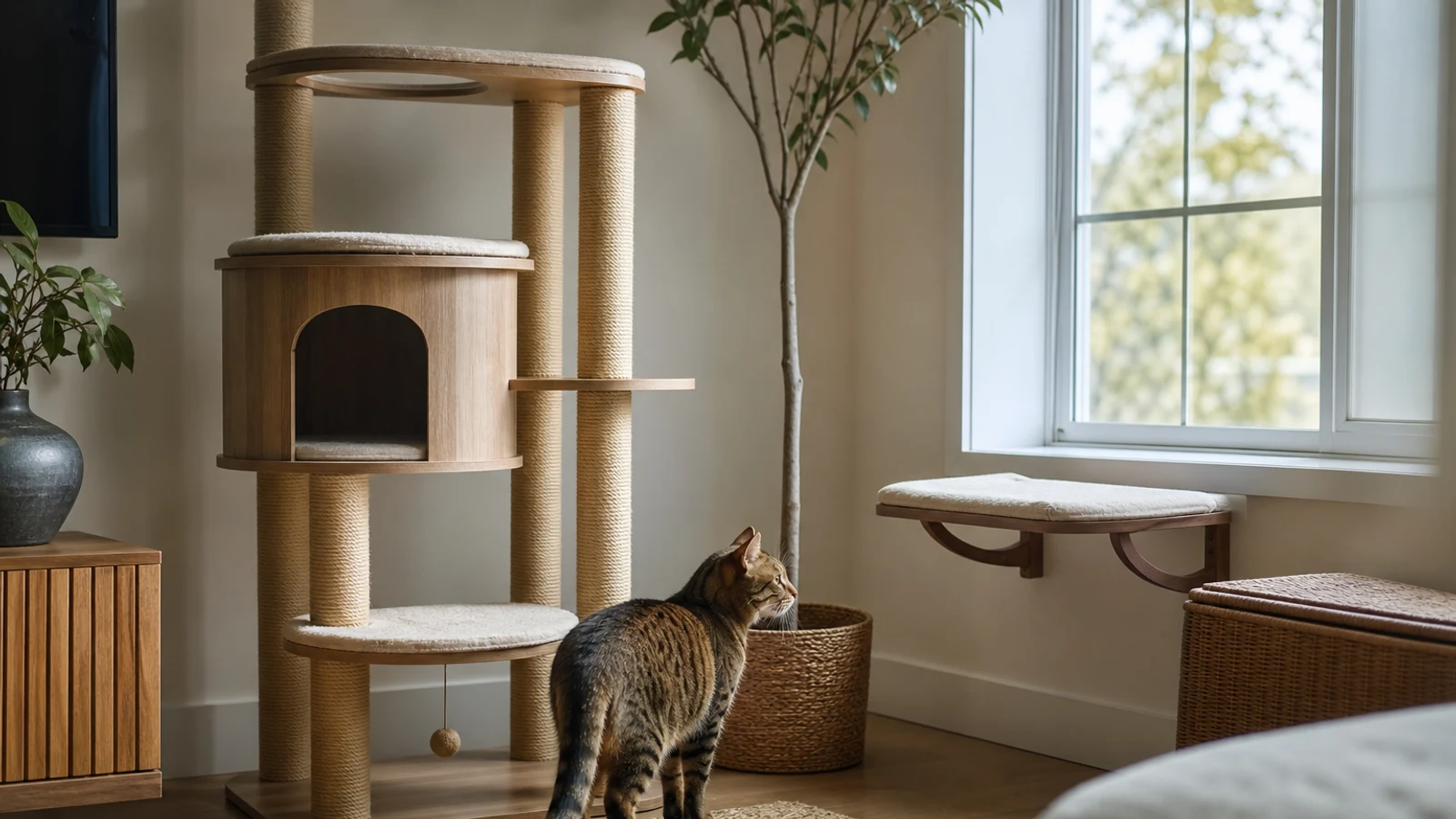
A cat tree is the more versatile choice for climbing, scratching, hiding, and multi-level movement. A window perch is better when your cat mainly wants a compact resting spot with an outdoor view.
Quick answer
Choose a cat tree if your cat needs climbing, scratching, hiding, exercise, or several usable levels. Choose a window perch if your cat already has other enrichment and mainly wants a quiet place to watch outdoors. For many indoor cats, the best setup is a stable cat tree or shelf system plus a window-facing resting spot—not necessarily one oversized product.
Shop this guide
Current Amazon options
Six current listings related to this buying decision. Use the guide to compare fit and trade-offs, then verify the latest seller, price, size, and availability on Amazon.
As an Amazon Associate I earn from qualifying purchases. Product availability, seller, price, and listing details can change.
Key decision checks
The practical difference is function, not height
A cat tree is a freestanding enrichment station. Depending on its design, it can combine elevated platforms, scratching posts, hideaways, ramps, beds, and multiple routes between levels. That makes it useful when the job is to add activity and usable territory to the room, especially for cats that climb, scratch, play, or need a place to retreat.
A window perch is primarily a viewing and resting station attached to or positioned beside a window. It can deliver sunlight, outdoor sights, and a high resting place while using little floor space, but it usually offers less climbing, scratching, hiding, and movement than a well-designed tree. The right choice depends on what your cat is missing rather than which product looks more elaborate.
- Choose a cat tree for climbing, scratching, hiding, exercise, or more than one cat.
- Choose a window perch for compact resting and reliable access to an interesting view.
- If your cat ignores elevated furniture, observe whether the missing feature is height, privacy, texture, access, or the view itself.
Choose a cat tree when your cat needs more than a lookout
A cat tree is usually the stronger first purchase for an indoor cat with limited enrichment, a strong scratching habit, or a preference for climbing and surveying the room. Veterinary and feline-welfare guidance consistently treats vertical space, elevated resting places, hiding areas, and scratching opportunities as useful parts of an enriched home. A tree can combine several of those functions in one footprint.
Look for a broad, stable base and platforms that are large enough for your cat to turn around, rest, and jump between levels without awkward landings. Tall models may need wall anchoring, particularly in homes with active cats, children, or other pets. A tree hidden in an unused room may be less valuable than a smaller one placed where the household naturally spends time.
- Best fit: active cats, climbers, scratchers, kittens, and homes needing several enrichment functions.
- Prioritize: stability, a useful scratching surface, comfortable platforms, and at least one retreat or covered area.
- For senior, overweight, arthritic, or mobility-limited cats, favor low steps, wide platforms, and easy access over maximum height.
- In a multi-cat home, consider separate resting levels or more than one elevated resource to reduce competition.
Choose a window perch when the view is the main attraction
A window perch makes sense when your cat already has play and scratching options but lacks a comfortable place to watch birds, people, weather, or household activity. It is especially useful in a small apartment or narrow room where a floor-standing tree would obstruct walkways. A perch can also be a good second station near a favorite window, provided the installation is secure.
The view matters more than the label. A quiet window with changing activity may be engaging, while a shaded or obstructed window may hold little interest. Place the perch where your cat can approach and leave it easily, and avoid forcing a fearful cat into an exposed position. Some cats prefer a covered or partially enclosed resting place rather than an open hammock in the middle of a busy room.
- Best fit: cats that spend time watching windows, sunbathing, or resting in elevated places.
- Prioritize: a solid sleeping surface, appropriate dimensions, easy cleaning, and a dependable attachment method.
- Check whether blinds, screens, window locks, radiators, cords, or nearby furniture create hazards or block access.
- A perch adds a lookout; it does not automatically replace scratching, play, hiding, or climbing opportunities.
Compare stability and installation before appearance
Installation is the biggest practical divide between these products. A floor-standing tree should sit level on a stable surface, with its base sized for the height and activity level of the cat. A very tall or narrow design can be less forgiving of jumping, chasing, or landing at an angle. Follow the manufacturer’s anchoring instructions rather than assuming weight alone makes a tree safe.
Window perches vary widely: some use suction cups, some rest on the sill, and others attach to a wall or window frame. Suction-cup designs require clean, compatible glass and regular inspection because attachment strength can change as cups age, surfaces become dirty, or temperatures fluctuate. Never exceed the product’s stated load limit, and do not treat a claimed weight capacity as a substitute for checking the actual mount and window condition.
- For a cat tree: check base width, overall height, anchoring hardware, platform size, and whether the structure rocks when lightly pushed.
- For a suction-cup perch: inspect every cup, frame, seam, and fastener before use and at regular intervals.
- For a sill- or wall-mounted perch: verify that the sill, wall, studs, anchors, and fasteners match the installation instructions.
- Keep both products away from fall hazards, unstable furniture, open windows, and dangling cords.
Compare options for your pet
Cat Tree vs Window Perch: Which Better Fits Your Space and Cat?
Compare current Amazon listings using the fit and safety checks in this guide. Confirm size, specifications, seller and availability before ordering.
See on Amazon →As an Amazon Associate I earn from qualifying purchases. Links open Amazon search results; individual listings have not been independently verified.
Match the product to the cat’s age, body, and confidence
A confident young climber may use a tall tree as a route for jumping, scratching, and play. A timid cat may value a high platform only if it also has a protected retreat and a way to leave without being cornered. A large cat needs generous platforms and a structure that stays steady during takeoff and landing. Cats differ substantially in enrichment preferences, so an expensive product is not automatically a better match.
Older cats or cats with pain, weakness, impaired vision, or reduced balance may need lower, wider, more predictable access. Product choice cannot diagnose or treat a mobility problem. If a cat suddenly stops jumping, avoids stairs, appears painful, or changes resting and movement patterns, arrange a veterinary evaluation before relying on new furniture as the solution.
- For kittens and athletic cats: provide secure routes, stable landings, and supervision during introduction.
- For senior or mobility-limited cats: choose low-entry designs, ramps or short steps, and surfaces that are not slippery.
- For shy cats: favor an elevated hideaway or partially enclosed bed over a completely exposed perch.
- For large cats: compare usable platform dimensions and structural stability, not just the advertised total height.
Consider cleaning, scratching, and everyday placement
A cat tree usually offers more enrichment but also more surfaces to vacuum, inspect, and clean. Removable cushions and replaceable scratcher sections can make maintenance easier. Check fabric for loose threads, exposed staples, damaged rope, and compressed platforms. If the structure becomes unstable or damaged, stop using the affected section until it is repaired or replaced according to the maker’s instructions.
A window perch is simpler when its cover can be removed and washed, but its location can expose it to dust, condensation, sunlight, and shedding. Place either product near the behavior it is meant to support: a scratcher near a favorite sleeping or viewing area, a tree where people spend time, or a perch at a genuinely interesting window. Placement often determines whether a cat uses the product.
- Vacuum hair and debris from fabric, seams, and hiding areas on a routine schedule.
- Inspect scratching posts, covers, platforms, suction cups, brackets, and fasteners for wear.
- Wash removable covers according to the care instructions and let parts dry fully before reassembly.
- Reassess placement if the cat repeatedly chooses a nearby chair, shelf, or floor-level bed instead.
A simple decision for most homes
Buy the cat tree first when your cat has no dependable vertical territory, scratches furniture, seeks high hiding places, or needs more opportunities to climb and move. Buy the window perch first when space is tight, your cat already has play and scratching resources, and the main unmet need is a comfortable window view. In either case, stable construction and a cat-appropriate route matter more than decorative features.
If your budget and space allow only one item, choose the product that solves the clearest missing behavior. If the cat wants a lookout but has no way to scratch, a perch may solve only half the problem. If the cat has a quiet window bed but no safe vertical exercise or retreat, a tree may offer more value. A modest, well-placed combination can outperform one oversized piece that does only one job.
- Pick a cat tree when versatility and activity are the priority.
- Pick a window perch when footprint and outdoor observation are the priority.
- Add a separate scratching post, bed, hiding box, or interactive play routine when the chosen product does not cover that need.
- Introduce new furniture gradually and allow the cat to investigate without being placed on it repeatedly.
Common questions
FAQ
Can a window perch replace a cat tree?
Usually not by itself. A window perch can replace the viewing and elevated-resting functions of a tree, but it generally provides less scratching, climbing, hiding, and movement. It may be enough for a cat that already has those resources elsewhere.
Are cat window perches safe for large cats?
They can be safe only when the specific product, attachment method, window or sill, and stated load limit are appropriate. Inspect the mount regularly and avoid relying on worn suction cups, damaged hardware, or a perch that flexes or shifts under normal use.
Should a cat tree be placed directly in front of a window?
It can be, if the tree remains stable and does not block safe window operation or create access to an unsecured opening. A window-facing tree may combine climbing and viewing, but place it where your cat can also retreat and where the household will not repeatedly disturb the resting area.
What if my cat ignores the new tree or perch?
Check whether the location, surface, height, access route, or level of privacy matches your cat’s preferences. Try placing a familiar blanket nearby, using play to create positive interest, or moving the product toward a favored resting area. Do not force the cat onto it.
Do cats need vertical space if they are indoor-outdoor cats?
Vertical enrichment can still make the indoor environment more usable and give a cat a secure resting or retreating option. The amount and type should fit the cat’s normal routine, confidence, mobility, and access to other safe enrichment.
Sources & further reading
Where the factual guidance comes from
Ready to choose?
Cat Tree vs Window Perch: Which Better Fits Your Space and Cat?
Compare current Amazon listings using the fit and safety checks in this guide. Confirm size, specifications, seller and availability before ordering.
See on Amazon →As an Amazon Associate I earn from qualifying purchases. Links open Amazon search results; individual listings have not been independently verified.
Keep researching