Dogs · Beds & Comfort
Bolster vs Flat Dog Bed: Which Fits Your Dog’s Resting Style?
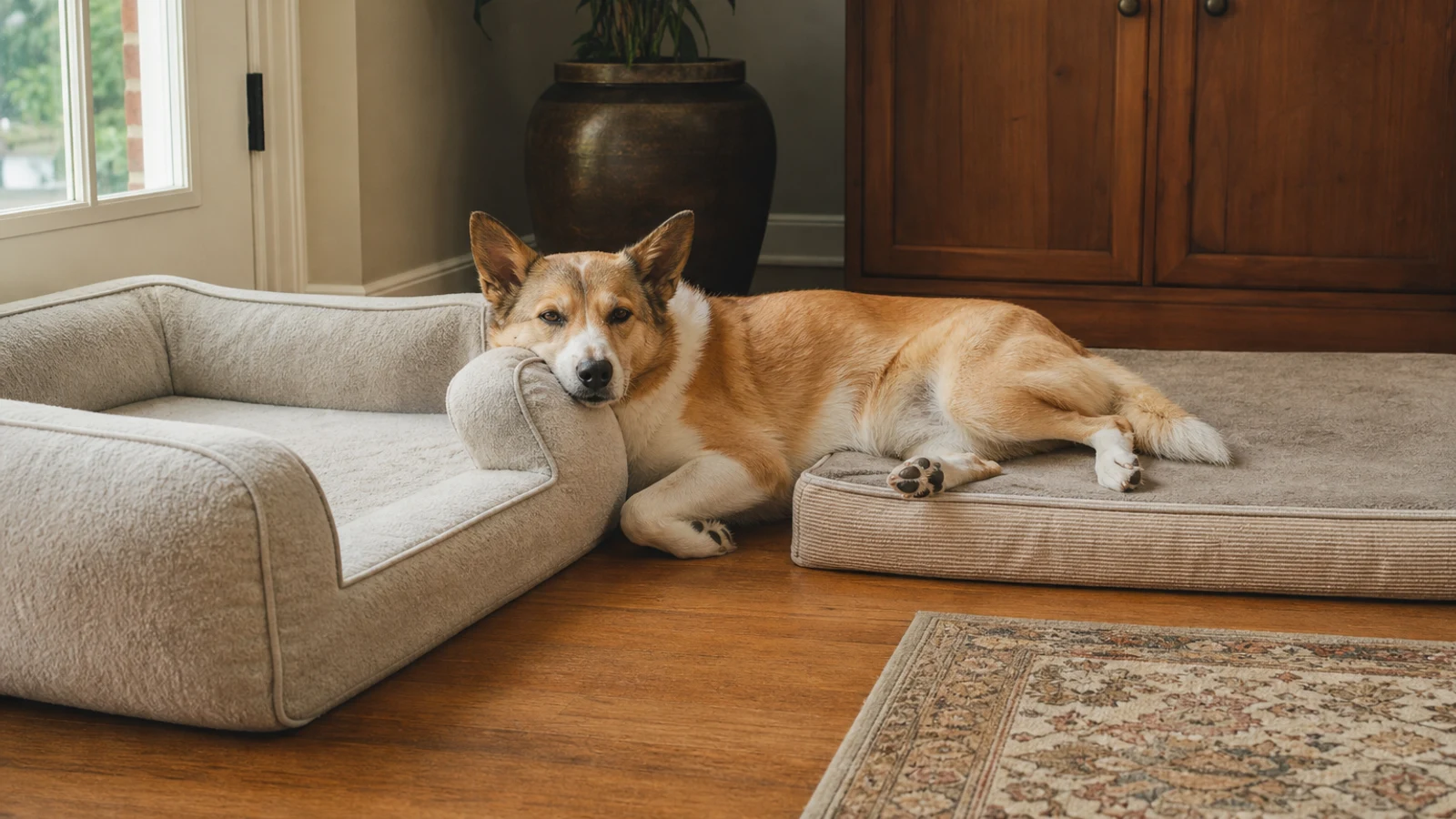
Bolster beds suit dogs that curl, lean, nest, or rest their head on an edge. Flat beds give sprawlers, warm sleepers, and dogs with limited mobility more open space and easier access. The best choice depends on how your dog actually rests—not which shape looks coziest in a product photo.
Quick answer
Choose a bolster bed if your dog curls up, leans against furniture, nests into corners, or regularly uses an edge as a headrest. Choose a flat bed if your dog stretches out, changes positions often, sleeps warm, or needs simple step-on access. When unsure, prioritize the largest usable sleeping surface that lets your dog curl, lie flat, stretch, and turn without being wedged against raised sides.
Shop this guide
Current Amazon options
Six current listings related to this buying decision. Use the guide to compare fit and trade-offs, then verify the latest seller, price, size, and availability on Amazon.
As an Amazon Associate I earn from qualifying purchases. Product availability, seller, price, and listing details can change.
Key decision checks
The practical difference: edge support versus open space
A bolster dog bed has a raised, cushioned edge around some or most of the sleeping surface. That edge can give a dog something to lean against, rest a chin on, or use as a boundary while curling up. A flat bed is essentially an open mattress or cushion, so the entire top surface remains available for stretching, turning, and entering from different directions.
Neither shape is universally better. A bolster uses part of the bed’s footprint for raised sides, while a flat bed gives more uninterrupted sleeping room. Compare the inside sleeping area—not just the advertised outside dimensions—because two beds that look similar in a room can offer very different usable space.
- Bolster: better match for curlers, leaners, nesters, and head-rest users.
- Flat: better match for sprawlers, frequent position-changers, and dogs that prefer open access.
- Low-entry bolster: a compromise for dogs that like an edge but should not climb over a tall side.
Match the bed to how your dog sleeps
Watch several naps before buying. Dogs may curl tightly for one nap, then lie on their side, stretch their legs, or sleep on their backs later. The bed should accommodate the longest position your dog uses comfortably, not only the compact position that makes a smaller bed appear to fit.
A bolster is a reasonable starting point when your dog presses against sofa cushions, wedges into corners, circles before settling, or places their head on pillows. A flat mattress is usually the safer starting point for a dog that sprawls, extends beyond the edge of small beds, overheats easily, or moves repeatedly during sleep.
- Choose bolster when your dog curls, leans, nests, or seeks a defined boundary.
- Choose flat when your dog side-sleeps, sprawls, stretches, or changes position frequently.
- If your dog uses both styles, choose for the larger position or provide two resting options.
Consider mobility before choosing raised sides
For puppies, healthy adult dogs, and agile jumpers, a moderate bolster may be easy to enter. For older dogs or dogs with stiffness, weakness, arthritis, neurologic problems, or another mobility concern, a tall side can become an obstacle. A flat bed or a bolster with a clearly lowered entry may be easier to use than a deep nest.
Bed choice is not a substitute for veterinary assessment. If your dog has recently become reluctant to lie down, struggles to rise, limps, cries out, falls, or avoids normal movement, contact a veterinarian rather than treating the change as a simple preference. A veterinarian can help identify whether pain or another health issue is affecting rest.
- Check that your dog can step in without lifting the legs high or scrambling.
- Look for a stable base that does not slide when the dog gets up.
- Prefer a low or recessed entry when mobility is limited.
- Leave a clear path around the bed so your dog does not need to make sharp turns.
Size for the dog’s longest comfortable position
Measure your dog while relaxed and stretched in a natural sleeping position, then compare that measurement with the bed’s actual sleeping surface. Allow room for the dog to turn and change positions. On a bolster bed, measure the interior floor area after accounting for the thickness of the raised sides; the outer footprint can be misleading.
If your dog is between sizes, the larger usable surface is generally more forgiving, provided the bed still fits the intended room, crate, or travel space. A bed that only accommodates curling may be rejected when the dog wants to stretch. Oversizing is usually less troublesome than forcing a large dog into a narrow interior.
- Measure nose-to-tail or front-to-back while the dog is comfortably stretched.
- Measure the widest position, including naturally extended legs.
- Use interior dimensions for bolsters and total usable surface for flat beds.
- Check the opening width if the bolster has one lowered entrance.
Compare options for your pet
Bolster vs Flat Dog Bed: Which Fits Your Dog’s Resting Style?
Compare current Amazon listings using the fit and safety checks in this guide. Confirm size, specifications, seller and availability before ordering.
See on Amazon →As an Amazon Associate I earn from qualifying purchases. Links open Amazon search results; individual listings have not been independently verified.
Warmth, airflow, and room placement matter
Bolster walls can create a more enclosed, nest-like feel and may help some dogs settle in a drafty room. The same enclosed shape can feel too warm for dogs that seek tile, hardwood, or other cool surfaces. A flat bed usually gives more freedom to move off a thick edge and may suit warm rooms or dogs that sleep extended on their sides.
Place either style in a quiet, draft-free area where the dog can rest undisturbed while still choosing to leave. A bed near the household’s main living area may encourage use, while a second bed in a quieter location gives the dog another option. Keep the bed away from door swings and busy walkways.
- For warm sleepers, favor breathable covers, open space, and a location with comfortable airflow.
- For dogs that seek warmth, a moderate bolster may provide a more sheltered edge.
- Avoid placing a bed where the dog must cross a slippery floor or block a household route.
- Offer more than one bed shape if your dog’s preferences change by season or location.
Cleaning and construction can outweigh the shape
A flat bed often has fewer seams, corners, and separate parts to clean. Bolsters can collect hair and debris along the raised edge, so removable covers and access to the bolster filling matter. Check the manufacturer’s washing and drying instructions before buying; a cover that cannot be removed may be inconvenient when the dog tracks in dirt or has an accident.
For support, judge the sleeping surface separately from the decorative edge. A plush bolster does not automatically mean the mattress is supportive, and a flat bed is not automatically firm or orthopedic. Consider the dog’s size, weight, age, and mobility, then compare the material and construction details documented by the manufacturer.
- Look for a removable, washable cover with practical zipper access.
- Check whether the inner cushion and bolster sections can be cleaned separately.
- Inspect seams, fabric, and the base for the dog’s chewing, digging, or moisture exposure.
- For older or mobility-compromised dogs, prioritize a stable, easy-clean surface that does not retain excessive heat.
Which bed should you buy?
Choose a bolster bed when your dog clearly uses edges as support and still has enough interior room to lie flat. A rectangular sofa-style bolster can offer a headrest without giving up as much floor space as a fully enclosed donut. Keep the entry low if your dog is stiff, and avoid sizing by the outside dimensions alone.
Choose a flat bed when your dog sprawls, sleeps warm, moves between positions, or needs the simplest possible entry. It is also a practical default when you do not yet know the dog’s preferences, because it leaves more room to stretch and does not require the dog to climb over a raised wall. If your dog ignores it, reassess location, temperature, texture, and size before assuming the shape is wrong.
- Best starting point for curlers and leaners: rectangular bolster with a generous interior.
- Best starting point for sprawlers and warm sleepers: flat mattress with an open perimeter.
- Best starting point for limited mobility: low-entry or recessed flat bed with a stable base.
- Best solution for mixed preferences: two beds with different shapes or locations.
Common questions
FAQ
Is a bolster bed better for dogs that like to curl up?
Often, yes. Raised sides can give a curling dog a boundary to lean against and may provide a more nest-like feel. The interior still needs to be large enough for the dog to lie on their side and stretch when they choose.
Are flat dog beds better for senior dogs?
A flat or low-entry bed may be easier for a senior dog to step onto, but age alone does not determine the best shape. Prioritize easy access, a stable base, adequate padding, washable materials, and enough room to change position. Ask a veterinarian about new stiffness, pain, or difficulty rising.
Can a bolster bed be too small even if my dog fits inside it?
Yes. A dog may fit while curled but lack room to stretch, turn, or lie comfortably on their side. Measure the interior sleeping area and compare it with your dog’s longest natural resting position.
Do flat beds keep dogs cooler than bolster beds?
They may, because an open design gives more room to spread out and less raised material around the body. Temperature also depends on the cover, padding, room, and dog. A warm sleeper may prefer an open, breathable surface regardless of shape.
Should I buy an orthopedic bed or focus on the shape first?
Treat them as separate decisions. First make sure the shape offers enough usable space and easy access. Then compare the sleeping surface, support materials, stability, and cleaning design. If your dog shows signs of pain or mobility change, seek veterinary guidance rather than relying on a product label.
Sources & further reading
Where the factual guidance comes from
Ready to choose?
Bolster vs Flat Dog Bed: Which Fits Your Dog’s Resting Style?
Compare current Amazon listings using the fit and safety checks in this guide. Confirm size, specifications, seller and availability before ordering.
See on Amazon →As an Amazon Associate I earn from qualifying purchases. Links open Amazon search results; individual listings have not been independently verified.
Keep researching