Dogs · Beds & Comfort
Removable-Cover vs One-Piece Dog Bed: Which Is Easier to Keep Clean?
A removable cover usually makes large, supportive dog beds easier to maintain, while a genuinely whole-bed washable design can be simpler for small pads, outdoor use, or frequent accidents. The better choice depends on what gets dirty, what your washer can handle, and how quickly the bed must be ready again.
Quick answer
For most indoor dogs, a removable-cover bed is easier to keep clean because you can wash the dirtier outer layer without soaking the entire cushion. It is especially practical for large foam beds, provided the inner liner protects the filling. A one-piece bed can be easier when it is thin, small enough for your washer, designed to dry evenly, or likely to need hose-down cleaning after mud or accidents. Check the full care instructions rather than trusting the word “washable” alone.
Shop this guide
Current Amazon options
Six current listings related to this buying decision. Use the guide to compare fit and trade-offs, then verify the latest seller, price, size, and availability on Amazon.
As an Amazon Associate I earn from qualifying purchases. Product availability, seller, price, and listing details can change.
Key decision checks
The practical difference comes down to what you wash
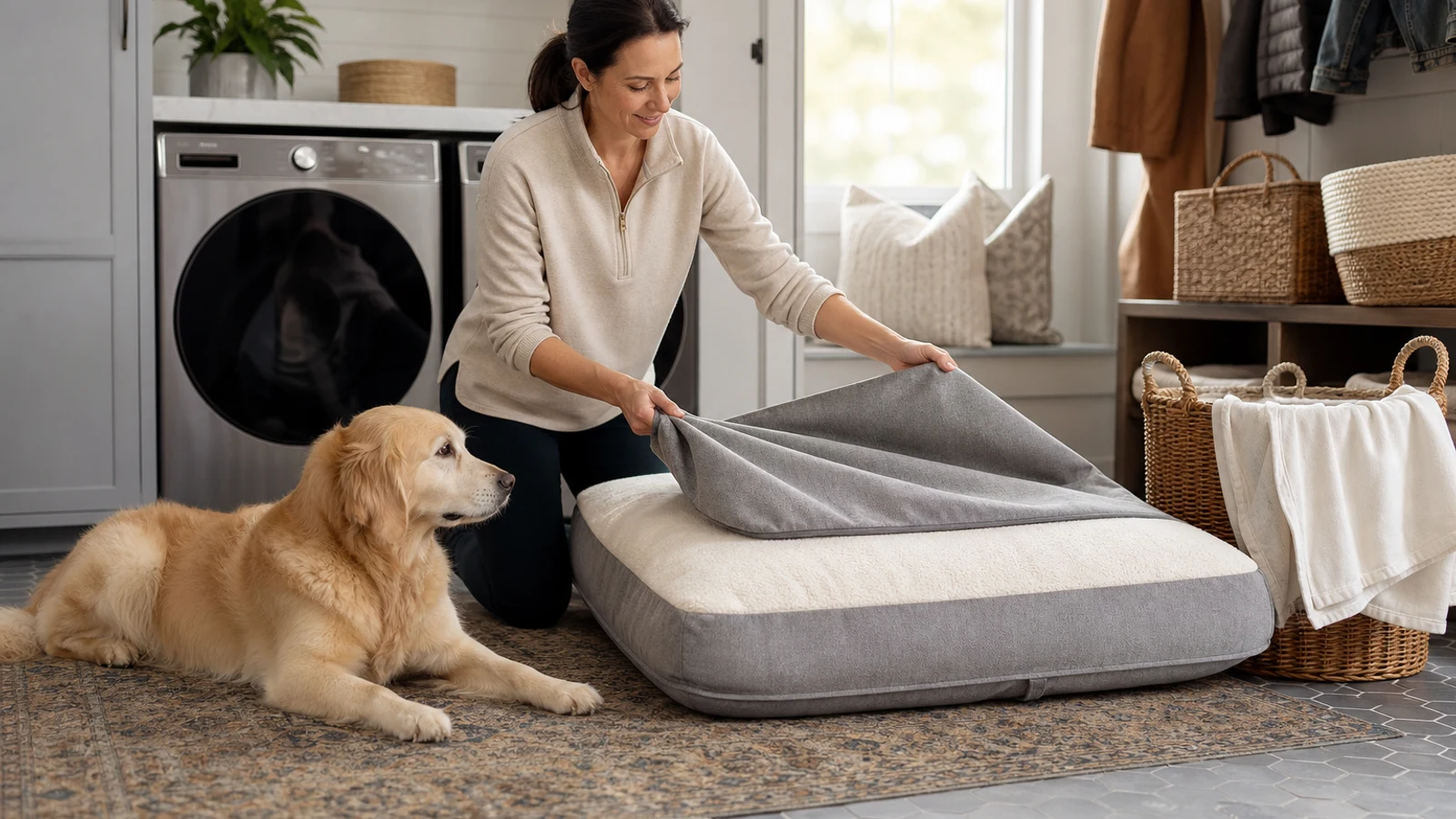
A removable-cover dog bed separates the sleep surface from the cushion or foam core. You unzip or pull off the outer fabric, wash that part, and usually spot-clean the insert according to the manufacturer’s instructions. A one-piece washable bed is designed to go into the wash as a complete unit, so the cover, filling, seams, and support material are cleaned together.
That distinction matters because “washable” can mean several things. Some beds are machine washable only as a cover; some are wipe-clean or hose-clean; and some thin pads can be machine washed whole. Treat the care label and product instructions as the actual specification. A zipper alone does not prove that the insert, liner, or entire bed is washable.
- Removable cover: lower laundry volume and easier repeat cleaning, but more disassembly and reassembly.
- Whole-bed washable: fewer parts to manage, but more weight, water, and drying time.
- Fixed-cover or spot-clean-only: a different category, with limited deep-cleaning options.
Removable covers usually win for large indoor beds
Choose a removable cover when the bed has thick foam, multiple bolsters, or a size that would crowd a household washing machine. Washing only the outer layer is generally more manageable than saturating the complete bed. It also lets you protect the insert with a separate liner and, if available, keep a spare cover ready while the first one is being cleaned.
This design is not automatically effortless. Bolsters can make the cover difficult to pull off and replace, while tight upholstery-style fits may require patience. A cover that technically comes off but takes several minutes to reinstall may be less convenient than a simple thin one-piece mat. Before buying, look for the zipper path, separate bolster pieces, liner access, and whether replacement covers are offered.
- Best fit: large foam mattresses, couch-style beds, orthopedic-style beds, and homes with limited laundry capacity.
- Main advantage: the dirtiest layer can be washed without soaking the support core.
- Main drawback: the cover may be awkward to remove, reinstall, or dry completely.
One-piece beds can be better for small pads and messy use
A genuinely whole-bed washable design can be the simpler option when the bed is thin enough to move freely in the washer and dryer. There is no cover to unzip, no foam insert to wrestle back into shape, and no separate inner layer that can retain odor. Small crate pads, travel mats, and lightweight beds often suit this format better than thick, heavily structured beds.
One-piece designs also make sense when the bed is used outdoors or in a utility area and the manufacturer allows hose cleaning or other simple washing. However, a wet bed becomes much heavier than a dry one, and dense filling may dry unevenly. A bed that is technically washable but remains damp in its center is not easy to maintain; drying space and turnaround time are part of the decision.
- Best fit: thin pads, small beds, travel beds, and beds used around mud or outdoor debris.
- Main advantage: fewer components and no cover-replacement step.
- Main drawback: bulky wet filling, longer drying, and possible washer-capacity limits.
Match the design to the mess your dog creates
Hair and surface dirt favor either style if you can vacuum before washing. The American Kennel Club advises removing loose hair first because wet hair can clump and contribute to washing-machine problems. A removable cover gives you a smaller, more manageable piece to shake out and launder. A smooth one-piece pad may be just as practical if it is easy to vacuum and does not trap debris in deep seams.
Mud and wet paws often favor wipe-clean surfaces, removable covers, or a bed with a washable top layer. Urine, vomit, and repeated accidents require more than a fresh-smelling surface: ask whether the liquid can reach the filling, whether the liner is waterproof or water-resistant, and whether the entire contaminated area can be cleaned and dried. For recurring accidents, incontinence, unusual odor, itching, or skin changes, involve a veterinarian rather than treating the bed choice as a medical solution.
- For shedding: prioritize accessible seams, a removable top layer, and a surface that can be vacuumed before laundering.
- For mud: consider wipe-clean fabric or a washable cover that can be removed before dirt spreads into the insert.
- For accidents: prioritize protected filling, clear cleaning instructions, and a backup bed or cover.
Compare options for your pet
Removable-Cover vs One-Piece Dog Bed: Which Is Easier to Keep Clean?
Compare current Amazon listings using the fit and safety checks in this guide. Confirm size, specifications, seller and availability before ordering.
See on Amazon →As an Amazon Associate I earn from qualifying purchases. Links open Amazon search results; individual listings have not been independently verified.
Check the wash-and-dry routine before buying
The most important buying check is not the marketing phrase “machine washable”; it is the complete care sequence. Confirm which components can be washed, the permitted water temperature and cycle, detergent restrictions, drying method, and whether the bed must be fully dry before use. Manufacturer instructions vary: some brands specify cold washing for covers, while some structured beds are intended for spot cleaning or hose rinsing instead.
Measure the packed bed against your washer, not just the dog’s sleeping area. A large cover may fit only in a commercial machine, and a whole bed may not tumble freely enough to rinse or dry properly. If the bed needs frequent cleaning, a spare cover or second simple bed can reduce pressure to put a damp cushion back into use.
- Read the care label for every layer: cover, liner, foam, fill, and bolster pieces.
- Check whether the bed fits your washer and has enough room to rinse and tumble.
- Plan for complete drying, especially around seams, corners, bolsters, and dense filling.
- Look for replacement covers or liners if the support core is expected to last longer than the fabric.
Comfort and construction still matter after cleanability
A bed that cleans easily is not useful if your dog avoids it or cannot step onto it comfortably. Match the shape and height to the dog’s sleeping style and mobility. Older dogs or dogs with limited mobility may need a low entry rather than a tall bolster, while dogs that curl, lean, or nest may prefer different edge support. Cleaning convenience should narrow the choices, not replace a basic fit and comfort check.
Construction also changes the cleaning trade-off. Foam cores generally need protection from saturation, while fiber-filled beds may have more parts that shift or clump. Zippers, seams, handles, and fabric edges deserve inspection if your dog digs or chews. No washable design should be treated as chew-proof unless the manufacturer specifically states that claim for the exact product.
- Measure your dog stretched out and compare that with the actual sleeping surface, not only the outside dimensions.
- Prefer an easy-entry profile for dogs with mobility limitations; ask a veterinarian about pain or mobility changes.
- Inspect seams, zipper guards, liners, and filling access if your dog digs, nests, or chews.
Bottom line: choose the simpler complete cleaning cycle
For most indoor households buying a large or supportive dog bed, a removable washable cover paired with a protected insert is the easier long-term setup. It reduces the amount of material that must go through each wash and is usually more practical when the cushion is bulky. The design works best when the cover comes off without a struggle, the liner blocks routine moisture, and the support core can be spot-cleaned as directed.
Choose a one-piece washable bed instead when the bed is small or thin, your dog frequently brings in mud, or you value a single-item wash over modular construction. The deciding question is not which label sounds better; it is whether you can remove dirt, wash the contaminated layer, dry every component fully, and return the bed to service without turning each cleanup into a project.
- Best general choice for large indoor beds: removable cover plus protected insert.
- Best simple choice for small or lightweight beds: whole-bed washable construction.
- Best choice for outdoor mess: a design the manufacturer explicitly permits you to wipe or hose clean.
Common questions
FAQ
Is a removable dog-bed cover better than a fully washable bed?
Usually for large indoor beds, yes, because only the outer layer needs routine laundering and the insert stays lighter and easier to handle. A fully washable bed may be simpler for small, thin pads or beds that regularly get muddy, but only if the complete bed fits your laundry setup and dries thoroughly.
Does a removable cover protect the foam from urine?
Not by itself. A washable fabric cover can absorb liquid and allow it to reach the insert. Look for a separate waterproof or water-resistant liner, then follow the manufacturer’s instructions for cleaning the liner and foam. If accidents are frequent, discuss the underlying problem with a veterinarian.
Are one-piece dog beds easier to dry?
Not necessarily. Thin, lightweight one-piece pads may dry efficiently, but dense filling, thick bolsters, and large beds can hold moisture in the center. A removable cover usually dries faster because less material is saturated, although the insert may still need separate spot cleaning and drying.
Can I wash any removable dog-bed cover in a home washing machine?
No. Check the product’s care label, dimensions, and washing instructions. Large covers may require a commercial machine, and some materials have specific temperature or drying limits. Remove loose hair before washing and do not return the cover or insert until it is completely dry.
What should I do if my dog bed still smells after washing?
Check whether the odor is coming from the insert, liner, seams, or filling rather than the cover. Follow the manufacturer’s cleaning method instead of adding unapproved chemicals that could damage fabric or leave residue. Persistent odor alongside skin irritation, discharge, urinary changes, or repeated accidents warrants veterinary advice.
Sources & further reading
Where the factual guidance comes from
Ready to choose?
Removable-Cover vs One-Piece Dog Bed: Which Is Easier to Keep Clean?
Compare current Amazon listings using the fit and safety checks in this guide. Confirm size, specifications, seller and availability before ordering.
See on Amazon →As an Amazon Associate I earn from qualifying purchases. Links open Amazon search results; individual listings have not been independently verified.
Keep researching