Dogs · Home & Safety
Pressure-Mounted vs Hardware-Mounted Pet Gate: Which Fits Your Space?
Pressure-mounted gates are convenient for many level doorways, while hardware-mounted gates make more sense when a gate must resist repeated force or protect the top of a staircase. The right choice depends on the opening, your dog’s behavior, and what happens if the gate moves.
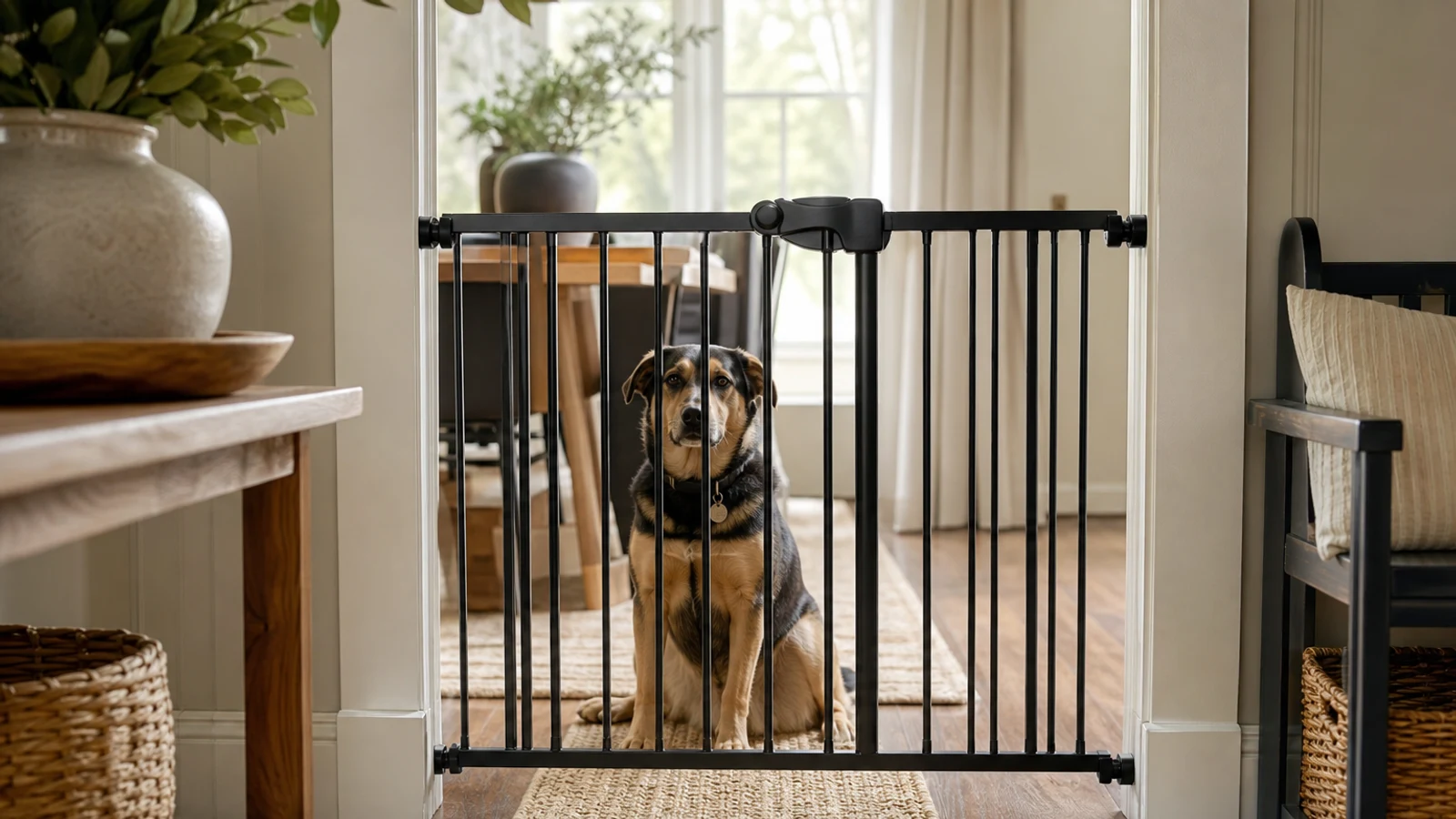
Quick answer
Choose a pressure-mounted dog gate when you need a removable, no-drill barrier across a suitable level doorway or hallway and your dog is unlikely to lean, jump, or push persistently. Choose a hardware-mounted gate when the gate is at the top of stairs, spans an awkward opening, or must withstand determined force. Always follow the specific manufacturer’s location limits: some models allow hardware-secured wall cups, while others require a dedicated hardware-mounted installation.
Shop this guide
Current Amazon options
Six current listings related to this buying decision. Use the guide to compare fit and trade-offs, then verify the latest seller, price, size, and availability on Amazon.
As an Amazon Associate I earn from qualifying purchases. Product availability, seller, price, and listing details can change.
Key decision checks
The practical difference in one minute
A pressure-mounted gate stays in place through tension between two opposing surfaces, such as the sides of a door frame. It is usually quicker to install, easier to remove, and friendlier to renters because it does not normally require drilling. Its performance depends on suitable contact surfaces, correct adjustment, and the gate remaining tight over time.
A hardware-mounted gate is secured with brackets, cups, or hinges fastened to a wall, stud, door frame, or suitable banister. It takes more planning and leaves mounting holes, but it provides a more fixed barrier and usually swings open like a door. That extra attachment matters most where a loose gate could create a fall, allow access to a dangerous area, or be pushed aside by a strong dog.
- Pressure-mounted: best for many level doorways, hallways, and temporary room boundaries.
- Hardware-mounted: best for stair tops, high-consequence openings, awkward geometry, and persistent pushers.
- Either type can fail if the opening, surface, width, height, latch, or installation does not match the product instructions.
Choose pressure-mounted for the right doorway
Pressure mounting is the convenient choice when the gate’s job is to keep a dog out of a kitchen, office, nursery, laundry area, or other room on the same level. It can also suit a rental or a household that expects to move the barrier between openings. Look for two firm, roughly parallel surfaces and a product whose stated width range covers the opening without relying on excessive extension panels.
The no-drill benefit does not mean “install and forget.” A pressure gate can shift if a dog repeatedly charges it, braces its front paws against it, or catches a collar or harness on the frame. A lower crossbar can also become a human trip point, especially in a busy passage. The gate should be placed where people can use it safely and where the dog cannot get leverage from nearby furniture.
- Measure the narrowest part of the opening, including trim and baseboards.
- Confirm that the gate is approved for pets and for the exact opening width.
- Prefer a latch that adults can operate without stepping over the gate.
- Check whether the product needs wall cups, rubber feet, or a specific minimum contact area.
- Avoid using the gate as a substitute for supervision with a dog that climbs, chews, or panics when separated.
Choose hardware-mounted for stairs and force
At the top of a staircase, a hardware-mounted gate is generally the safer category because it is attached to the structure rather than held only by friction. Several manufacturer instructions and child-safety resources specifically warn against using pressure-mounted gates at stair tops or approve only hardware-mounted installation there. A pet gate is not automatically exempt from that concern: a dog can lunge, lean, jump, or collide with the barrier, and a displaced gate can expose the stairs immediately.
Hardware mounting is also worth considering at the bottom of stairs, beside a drop, or across an opening where a gate failure would have consequences beyond the dog entering another room. The exact design still matters. The gate should open in the intended direction, avoid creating a dangerous swing path, and be fastened to material capable of holding the mounting hardware. Do not assume drywall, plaster, a thin decorative trim board, or a single spindle is an adequate anchor.
- Use the manufacturer’s stair-specific model or installation method rather than improvising.
- Identify studs, solid framing, or a manufacturer-approved banister adapter before drilling.
- Check whether the gate has a bottom threshold that could create a trip hazard.
- At a stair top, confirm the gate cannot swing out over the stairs.
- If the opening has newel posts, angled walls, or an unusual landing, consider professional installation.
Compare stability, convenience, and wall impact
Pressure mounting wins on reversibility. You can remove it when guests arrive, change the room layout, or move out of a rental, and many models leave little or no permanent damage when installed correctly. The trade-off is that you must monitor tension and accept that the barrier is dependent on the condition and shape of the surrounding surfaces.
Hardware mounting wins on fixed stability and predictable operation. Once installed correctly, it is less likely to shift when a dog presses against it, and a walk-through door can avoid the need to step over a threshold. The trade-offs are drilling, more careful measuring, possible repair work when the gate is removed, and the need to choose compatible mounting hardware for the wall or banister.
- For rentals: start with pressure mounting only in low-consequence, level openings and only if the product instructions allow it.
- For homes with a determined large dog: favor a structural attachment where the gate’s movement would matter.
- For frequent human traffic: compare latch height, one-hand operation, auto-close behavior, and threshold design.
- For wide openings: verify the full assembled width and whether extensions change the manufacturer’s approved mounting method.
Compare options for your pet
Pressure-Mounted vs Hardware-Mounted Pet Gate: Which Fits Your Space?
Compare current Amazon listings using the fit and safety checks in this guide. Confirm size, specifications, seller and availability before ordering.
See on Amazon →As an Amazon Associate I earn from qualifying purchases. Links open Amazon search results; individual listings have not been independently verified.
Match the gate to your dog, not only the room
A calm small dog that respects a visual boundary places different demands on a gate than a young, athletic, anxious, or highly motivated dog. Height, bar spacing, climbability, latch design, and attachment method all matter. A dog that can jump over a gate has not been safely contained by a stronger latch, and a dog that chews metal or paws at openings may need a sturdier design and a different management plan.
Observe what happens when you are not standing beside the barrier. If your dog repeatedly runs at it, shakes it, digs at the bottom, mouths the bars, or becomes distressed, stop treating the gate as a simple hardware problem. A qualified trainer or veterinary behavior professional can help address separation distress, barrier frustration, or escape behavior; product selection alone may not solve those risks.
- Measure your dog’s jump and climbing ability rather than relying only on breed labels.
- Check for paw, muzzle, collar, and harness entrapment points.
- Avoid horizontal features that give a climber useful footholds.
- Use a gate with a secure latch that your dog cannot nose open.
- Reassess the setup after growth, adoption of another pet, furniture changes, or a new behavior.
Install and inspect it correctly
Read the complete manual before choosing the location. Manufacturers differ on whether a particular gate may be used at a stair, whether wall cups are required, how wide the opening may be, and what surfaces are acceptable. A model marketed as both pressure- and hardware-mountable is not necessarily approved for every location in both configurations.
After installation, test the gate in the way your household will use it. Open and close the latch repeatedly, push at the upper corners, check that the door does not drag, and confirm that the gate returns to its intended locked position. Recheck it regularly, especially after moving the gate, adding an extension, cleaning around the feet, or noticing new wobble.
- Keep all included locks, base stabilizers, wall cups, and screws installed as directed.
- Do not use a gate with missing, bent, cracked, loose, or damaged parts.
- Retighten or reinstall a pressure gate if it moves when pulled or pushed.
- Confirm the latch is fully engaged instead of relying only on an auto-close feature.
- Keep nearby furniture, boxes, and dog beds far enough away that they cannot help the dog climb.
Which type fits common home situations?
For a level hallway in a rental, a properly fitted pressure-mounted gate is often the practical choice. For a top-of-stairs opening, choose a hardware-mounted model or a product whose instructions explicitly provide a secure, approved hardware installation for that location. For the bottom of stairs, either type may be possible depending on the model and the consequences of movement, but hardware mounting remains the more fixed option.
For a wide, irregular, or banister-sided opening, prioritize mounting compatibility before appearance. For a dog that persistently pushes or jumps, prioritize structural stability and sufficient height. For a dog with barrier anxiety, use the gate as part of a gradual training plan rather than expecting any mounting system to prevent distress or escape attempts.
- Best pressure-mount scenario: level doorway, parallel surfaces, moderate dog behavior, no drilling allowed.
- Best hardware-mount scenario: stair top, drop-off, strong pusher, permanent setup, or high cost of failure.
- Best mixed strategy: pressure-mounted gates for ordinary rooms and one hardware-mounted gate for the highest-risk opening.
Common questions
FAQ
Can I use a pressure-mounted dog gate at the top of stairs?
Do not assume that you can. Many manufacturers and safety resources restrict pressure-mounted gates at stair tops and require hardware mounting. Use the exact product manual as the authority; if it does not clearly approve the setup, choose a stair-specific hardware-mounted gate instead.
Are hardware-mounted gates better for large dogs?
They can be a better fit when a large or determined dog repeatedly pushes, jumps, or leans on the barrier, but mounting type is only one factor. The gate also needs enough height, a secure latch, suitable bar spacing, correct width, and solid attachment points.
Will a pressure-mounted gate damage my walls?
It may leave pressure marks, dents, scuffs, or impressions depending on the wall finish, gate tension, and length of use. Protective cups or pads can reduce marking on some surfaces, but they do not eliminate the need to follow the instructions or inspect the wall and gate feet.
Is a bottom-of-stairs gate different from a top-of-stairs gate?
The consequences of movement are usually different, but the correct choice still depends on the product instructions and layout. A hardware-mounted gate offers a fixed installation, while some pressure-mounted models may be approved for a bottom landing but not for a stair top.
What if my dog pushes the gate until it shifts?
Stop relying on that setup until the cause is corrected. Recheck the opening measurement, tension, wall contact, extensions, and latch. If the dog continues to test the barrier, move to a more secure hardware-mounted solution and consider help from a qualified trainer for barrier-related behavior.
Sources & further reading
Where the factual guidance comes from
Ready to choose?
Pressure-Mounted vs Hardware-Mounted Pet Gate: Which Fits Your Space?
Compare current Amazon listings using the fit and safety checks in this guide. Confirm size, specifications, seller and availability before ordering.
See on Amazon →As an Amazon Associate I earn from qualifying purchases. Links open Amazon search results; individual listings have not been independently verified.
Keep researching