Other Pets · Home & Safety
Small-Pet Playpen vs Room Gate: Which Setup Fits Safe Exercise Time?
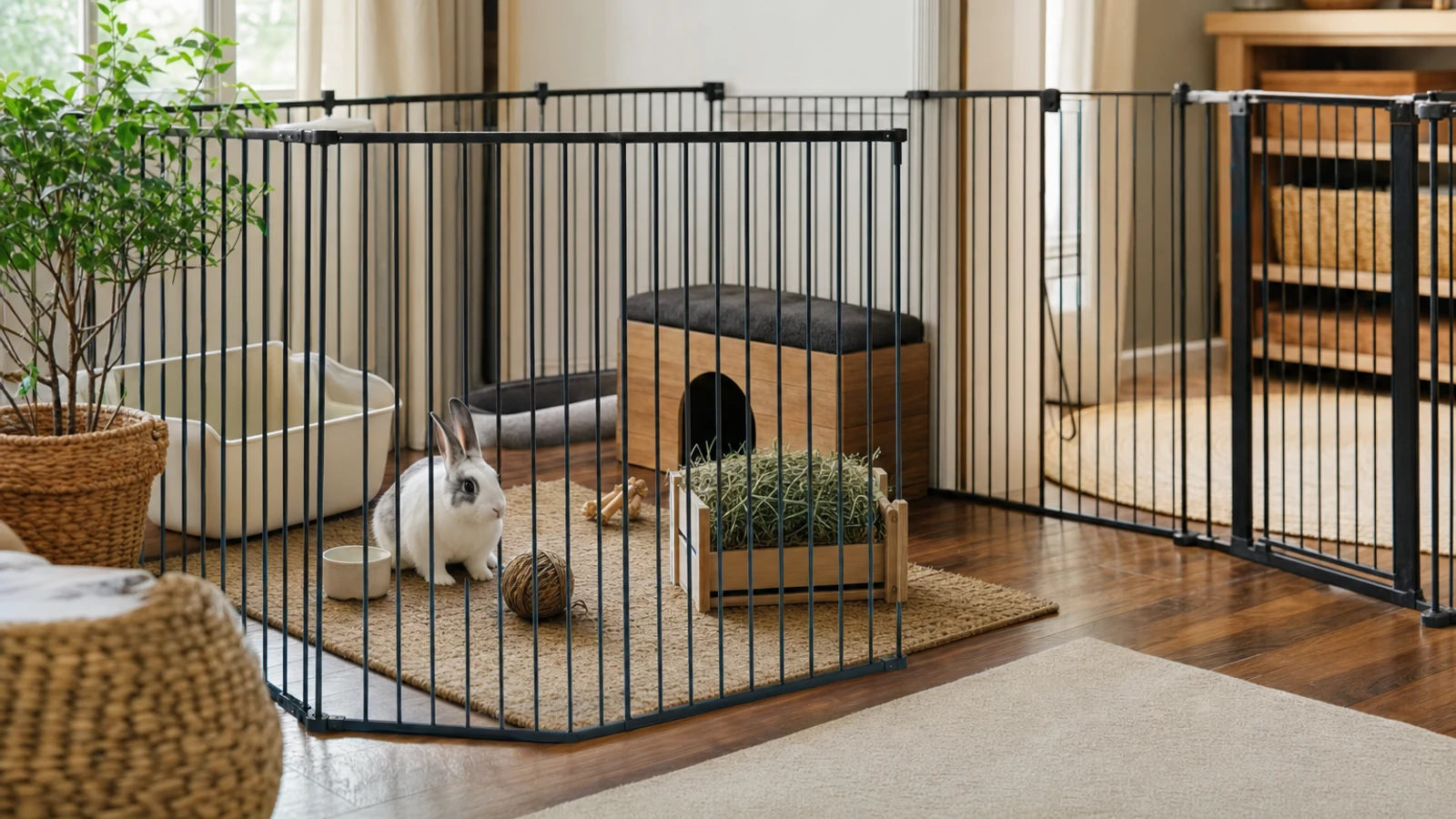
A playpen offers more predictable containment, while a room gate can provide more usable exercise space. The better choice depends on your pet’s escape skills, chewing habits, species, and how thoroughly the room is prepared.
Quick answer
Choose a playpen when you need reliable containment, a defined home base, or easier supervision. Choose a room gate when you can fully pet-proof a room and want more space for movement. For many rabbits and guinea pigs, the safest practical setup is a large pen or gated room with a secure base area, hiding places, food, water, and protection from cords, stairs, toxic materials, and other pets.
Shop this guide
Current Amazon options
Six current listings related to this buying decision. Use the guide to compare fit and trade-offs, then verify the latest seller, price, size, and availability on Amazon.
As an Amazon Associate I earn from qualifying purchases. Product availability, seller, price, and listing details can change.
Key decision checks
The practical difference: containment versus usable room space
A small-pet playpen creates a known boundary around the animal. It is usually easier to inspect, clean, furnish, and secure than an entire room, making it useful for young, newly adopted, medically recovering, highly curious, or escape-prone pets. It can also serve as a home base when you are asleep, away, or unable to supervise closely.
A room gate does the opposite: it blocks the pet from selected areas while giving access to most or all of a room. That can provide more running, hopping, tunneling, and enrichment space, but only if the room itself is safe. A gate is not a substitute for pet-proofing; it simply changes where the pet can go.
- Playpen: better control, simpler setup, easier separation from household hazards.
- Room gate: more floor space, more natural movement, and less visual confinement.
- Hybrid setup: a large pen or base area connected to a gated, pet-proofed room.
Choose a playpen when predictability matters most
A playpen is the stronger starting point when you cannot make a whole room safe yet. Rabbits and guinea pigs need room to exercise, but they also need secure hiding areas and protection from hazards such as electrical cords, unsuitable flooring, household chemicals, stairs, and interactions with dogs or cats. A pen lets you address those needs in one defined footprint before expanding access.
The pen should be large enough for normal movement and furnished for the species rather than treated as a temporary box. Plan space for a resting or hiding area, food, water, toilet or litter equipment where appropriate, and enrichment. For rabbits, welfare groups commonly recommend a large exercise pen or a bunny-proofed room instead of relying on a small cage. A pen that prevents movement is not a successful exercise setup.
- Use a pen as a home base, not as an excuse to provide only a cramped living area.
- Check every panel connection, door latch, corner, and floor edge before leaving the pet alone.
- Watch for climbing, jumping, squeezing, chewing, or pushing behaviors during the first several sessions.
- Use a solid, non-slip floor surface suited to the species; avoid exposed wire flooring.
Choose a room gate when the room can become the enclosure
A room gate makes sense when you can dedicate a bedroom, office, hallway, or other manageable area to exercise and remove or block its hazards. This approach often gives rabbits more room to stretch and run, and it can give guinea pigs space for tunnels, shelters, and exploration. The room should be treated as the enclosure, not as an ordinary room with a barrier at the doorway.
Before opening the gate, secure cords and outlets, protect baseboards and tempting furniture, remove toxic plants and accessible chemicals, and block unsafe gaps. Check whether the pet can jump over, climb, push under, or chew through the barrier. A gate designed for children or dogs may not be appropriate for a small animal with different body size and behavior.
- Use a gate only after inspecting the entire room at the pet’s eye level.
- Block stairs, vents, narrow gaps, recliners, sofa mechanisms, and other entrapment points.
- Keep cats, dogs, ferrets, and visiting animals separated unless interaction is specifically managed and appropriate.
- Recheck the room after rearranging furniture; a new launch point can create a new escape route.
Match the setup to the animal
Rabbits often benefit from a large pen, a bunny-proofed room, or a combination of both. They may chew cords, baseboards, rugs, and furniture, and some can jump or climb over barriers that appear adequate at first. A home base remains useful even for a rabbit that eventually has broader access, because it provides a familiar resting and feeding area and a safer fallback when supervision changes.
Guinea pigs are generally less likely than rabbits to clear a tall barrier, but their needs are not simply solved by giving them open floor space. They need secure hiding places, suitable tunnels, safe surfaces, and regular opportunities to exercise. Because they are prey animals, a setup that leaves them exposed to dogs, cats, loud activity, or a lack of cover may be stressful even when the room is physically large.
- Rabbit: prioritize chew protection, jump resistance, stable flooring, and a reliable home base.
- Guinea pig: prioritize floor area, hiding places, tunnels, safe footing, and protection from predator sight or smell.
- Ferret or another agile small pet: seek species-qualified guidance before relying on a standard pen or gate; climbing, digging, squeezing, and chewing can change the safety requirements.
- For any species, consider age, size, mobility, temperament, and whether the animal is recovering from illness or injury.
Compare options for your pet
Small-Pet Playpen vs Room Gate: Which Setup Fits Safe Exercise Time?
Compare current Amazon listings using the fit and safety checks in this guide. Confirm size, specifications, seller and availability before ordering.
See on Amazon →As an Amazon Associate I earn from qualifying purchases. Links open Amazon search results; individual listings have not been independently verified.
Inspect the barrier before trusting it
The most important product feature is not a marketing label such as “small-pet” or “room divider.” It is whether the barrier remains secure under the animal’s actual behavior. Test the setup while watching for pushing, lifting, climbing, chewing, squeezing through openings, and catching paws or heads in gaps. Inspect it again after the pet has had time to learn the layout.
Avoid relying on supervision alone for fast hazards such as electrical cords or narrow gaps. Rabbit welfare guidance specifically identifies cord access as a serious indoor danger, while guinea-pig guidance emphasizes secure hiding areas and protection from predators. If the pet repeatedly defeats the boundary, change the setup rather than assuming better attention will solve the problem.
- Confirm the barrier cannot tip, slide, fold, or open when nudged.
- Look for openings that could trap a head, paw, foot, or leg.
- Keep the barrier away from furniture that can act as a launch platform.
- Use doors or a second barrier where household traffic makes accidental openings likely.
- Stop using any panel, mesh, or connector that becomes bent, sharp, loose, or damaged.
A hybrid setup is often the most flexible choice
Many households do not need to choose permanently between a playpen and a room gate. A large pen can provide the pet’s secure base, while a gate opens access to a prepared room during exercise time. This arrangement limits the amount of the home that must be modified, gives the animal a familiar place to retreat, and makes it easier to reduce access when guests, cleaning, deliveries, or other pets create extra risk.
Expand access gradually. Start with a controlled area, observe how the pet uses it, and add space only after the hazards and boundary are understood. For rabbits especially, a pen or dedicated room may remain useful even after free-roam access increases. Exercise space should be available consistently, not offered only as an occasional novelty.
- Best for changing schedules, rented homes, multi-pet households, and gradual training.
- Keep food, water, litter equipment, and hiding places available in the familiar base area.
- Close off the expanded area whenever supervision, pet compatibility, or household activity changes.
- Ask a veterinarian or species-qualified behavior professional about restrictions after illness, injury, surgery, or unusual fear or aggression.
Bottom line: buy for the risk you can control
Choose a playpen if your main job is dependable containment, simple cleaning, or protecting a pet while you are not watching continuously. Choose a room gate if your main job is giving a thoroughly prepared room more exercise space and you can maintain the room’s safety over time. Neither option is automatically safer: the right choice is the one that prevents escape, chewing injuries, entrapment, unsafe contact, and access to household hazards.
For many indoor rabbits and guinea pigs, a secure base pen connected to a properly prepared room is the most adaptable arrangement. Reassess as the animal grows, learns the layout, changes mobility, or develops new chewing or climbing habits. Product guidance cannot replace veterinary advice when the pet has a health limitation or when you are unsure how much activity is appropriate.
- Pick a playpen for control and repeatable containment.
- Pick a room gate for greater usable space after thorough pet-proofing.
- Pick both when you want a secure base plus supervised room exercise.
- Do not use either setup until the barrier, floor, room, and other household animals have been checked.
Common questions
FAQ
Can I use a baby gate for a rabbit or guinea pig?
Sometimes, but the label alone does not establish suitability. Check the openings, stability, latch, height, and nearby furniture, then watch whether the animal can climb, jump, push, or squeeze through. A rabbit may defeat a gate that works for a less agile pet. A pet-specific barrier or a playpen may provide more predictable containment.
Is a playpen enough exercise for a rabbit?
It can be part of a suitable setup if it provides meaningful room for movement and is furnished safely, but a cramped enclosure is not adequate simply because it is called a playpen. Many rabbit welfare organizations recommend a large exercise pen, a bunny-proofed room, or a connected combination rather than a small cage. Ask a rabbit-experienced veterinarian about special space needs after illness or injury.
Should a guinea pig exercise area have hiding places?
Yes. Guinea pigs are prey animals and should have secure places to hide, rest, and retreat from activity. Include suitable shelters or tunnels without creating openings that can trap the animal. Keep the area protected from the sight, smell, and access of dogs, cats, ferrets, and other potential predators.
Can a room gate replace supervision?
No. A gate limits access but does not remove hazards inside the room or prevent all escape attempts. Continue checking cords, furniture, flooring, household traffic, and interactions with other animals. The required level of supervision depends on the species, individual behavior, room design, and whether the pet has a history of chewing, climbing, or panic.
When should I ask a veterinarian before increasing exercise space?
Ask a veterinarian before changing activity after surgery, injury, mobility problems, breathing problems, unexplained weakness, pain, or another health concern. A veterinarian or species-qualified professional can help determine whether the animal needs restricted movement, modified flooring, easier access to food and water, or a different enclosure design.
Sources & further reading
Where the factual guidance comes from
Ready to choose?
Small-Pet Playpen vs Room Gate: Which Setup Fits Safe Exercise Time?
Compare current Amazon listings using the fit and safety checks in this guide. Confirm size, specifications, seller and availability before ordering.
See on Amazon →As an Amazon Associate I earn from qualifying purchases. Links open Amazon search results; individual listings have not been independently verified.
Keep researching