Other Pets · Travel
Hard vs Soft Carrier for Small Pets: Which Fits the Trip?
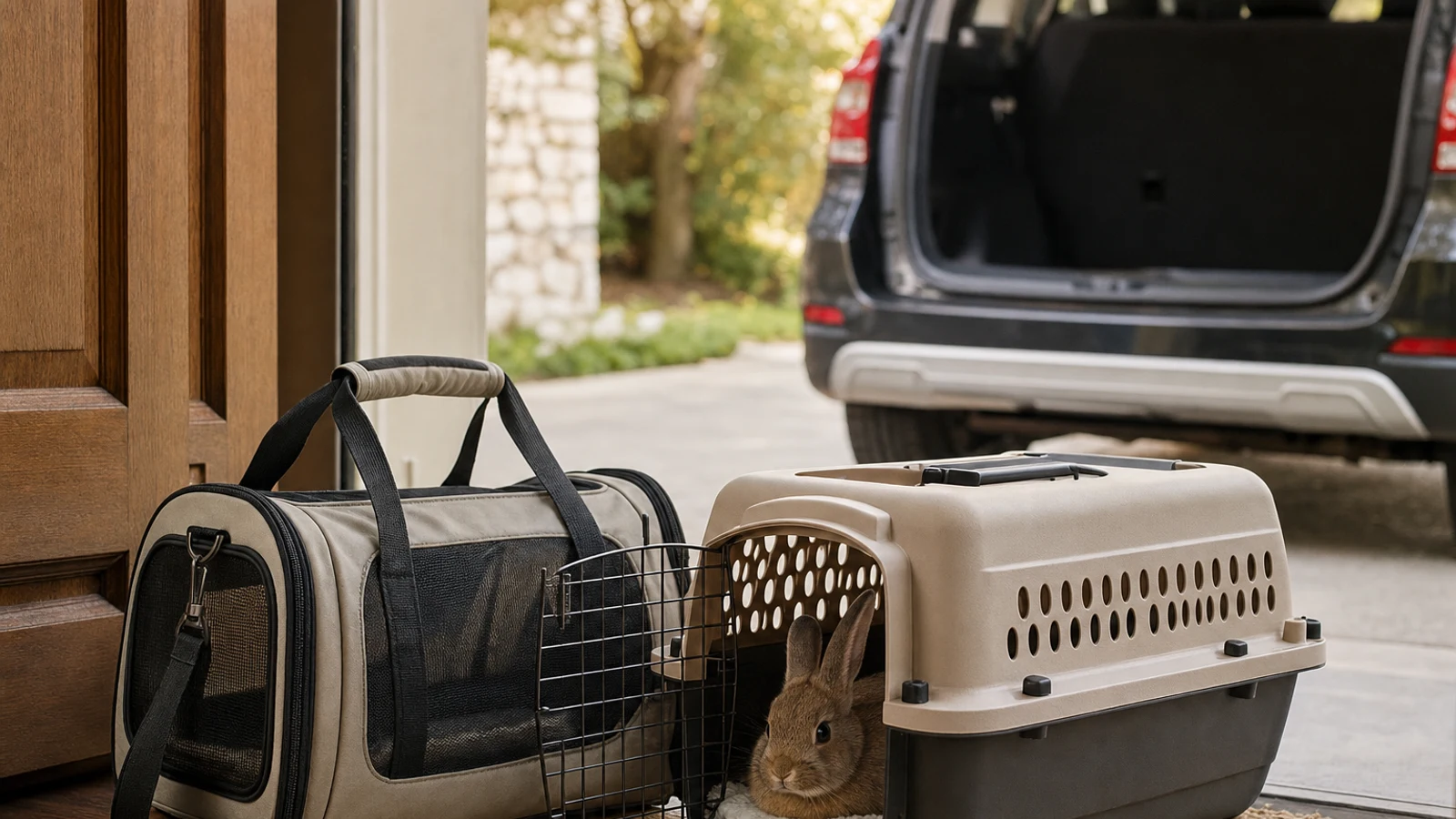
Hard carriers usually provide stronger containment, easier cleaning, and better resistance to chewing. Soft carriers can be lighter and easier to carry, but they require careful checks for ventilation, escape points, moisture, and airline fit.
Quick answer
For most rabbits, guinea pigs, and other small pets that may chew, a sturdy hard-sided carrier is the safer default for veterinary visits and car travel. Choose a soft carrier only when the animal does not chew fabric, the carrier has a rigid base and secure closures, and its lower weight or airline-size flexibility solves a real problem. Whichever style you choose, prioritize enough room to turn around and lie comfortably, strong ventilation, a nonslip absorbent floor, and a way to secure the carrier in the vehicle. Airline rules vary widely, and many airlines limit cabin pets to dogs and cats, so confirm the species and carrier requirements before buying for a flight.
Shop this guide
Current Amazon options
Six current listings related to this buying decision. Use the guide to compare fit and trade-offs, then verify the latest seller, price, size, and availability on Amazon.
As an Amazon Associate I earn from qualifying purchases. Product availability, seller, price, and listing details can change.
Key decision checks
Choose hard for containment; choose soft for portability
A hard-sided carrier is usually the better all-purpose choice for rabbits, guinea pigs, rats, ferrets, and other small pets that may chew, push at doors, or become stressed during handling. Rigid walls resist crushing, are easier to disinfect after an accident, and provide more dependable protection from luggage or other objects during a car trip. A top-opening door can also make it easier to lift out a nervous animal without pulling it through a narrow front opening.
A soft-sided carrier makes more sense when low weight, shoulder carrying, or fitting beneath an airplane seat matters more than chew resistance. Fabric sides can be easier to manage through an airport or around a clinic, but mesh is not automatically escape-proof, moisture-resistant, or durable. Treat a soft carrier as a specialized option rather than a universal upgrade, especially for a rabbit or any animal that actively chews.
- Hard-sided strengths: containment, cleanability, structural support, and resistance to external pressure.
- Soft-sided strengths: lower carrying weight, collapsibility, and easier handling in tight spaces.
- Neither style is suitable if it cannot provide adequate airflow, secure closures, and enough usable floor area.
Match the carrier to the animal, not just the trip
Species and behavior should decide the material. Rabbits can chew through unsuitable fabric or cardboard, while guinea pigs may soil bedding quickly and need a carrier that can be cleaned thoroughly. Ferrets may investigate zippers and seams, and small rodents can exploit surprisingly small gaps. A quiet animal that never chews may tolerate a quality soft carrier, but behavior can change when the pet is frightened, ill, or being handled by someone unfamiliar.
For bonded rabbits or other companion animals that normally travel together, the carrier must be large enough for the animals to lie comfortably without crowding. Do not use a small carrier simply because the trip is short. If you are unsure whether a particular species, pair, or medical condition can travel safely, ask a veterinarian familiar with that species before the journey.
- Check whether the animal chews fabric, zippers, plastic edges, or ventilation grilles.
- Measure the usable interior, not just the advertised outside dimensions.
- For multiple animals, allow comfortable lying and repositioning without creating a carrier that is too large to secure safely.
- Avoid unfamiliar carriers for the first time on the day of a stressful appointment.
Hard carriers usually win for car travel
For routine car trips, a rigid carrier generally offers the more dependable combination of strength, cleanability, and stable shape. Look for a model that can be secured with a seat belt or positioned firmly in a footwell without tipping. The carrier should not slide, face directly into a strong draft, or be placed in a sealed trunk area. A nonslip liner, towel, or absorbent pad helps the animal maintain footing and keeps urine or spilled water from spreading across the floor.
A hard shell does not make a carrier crash-safe. Unless a manufacturer provides credible, species-appropriate crash-testing information for the exact product and installation method, do not assume it protects an animal in a collision. The practical goal is to prevent the carrier from moving around during ordinary braking and cornering while maintaining ventilation and access for an emergency removal.
- Confirm the carrier has a stable base and a closure that cannot be nudged open from inside.
- Use the vehicle’s seat belt or another appropriate restraint method according to the carrier’s design.
- Keep the carrier out of direct sunlight and monitor heat, especially in warm weather.
- Never leave a small pet unattended in a parked vehicle.
Soft carriers can work, but inspect them more critically
A soft carrier can be practical for short, controlled trips when the animal is not a determined chewer and the carrier remains supported. Choose one with a firm, level base that does not fold under the animal’s weight, mesh panels on multiple sides, reinforced seams, and closures that can be secured against nosing or clawing. The interior should stay open enough for air to move; covering every mesh panel to reduce visual stimulation can create a heat and ventilation problem.
Fabric is more difficult to disinfect after urine, feces, vomit, or spilled water. Removable, washable liners are useful, but they do not replace a carrier that can be thoroughly cleaned. If the animal becomes wet, overheated, unusually quiet, or distressed, stop and contact a veterinarian rather than assuming the carrier is the only issue.
- Inspect zippers, seams, mesh, and attachment points before every trip.
- Avoid carriers with a sagging floor or soft sides that collapse around the animal.
- Use a washable absorbent liner and carry a spare for longer journeys.
- Do not rely on a soft carrier as a secure enclosure for an animal that chews or claws persistently.
Compare options for your pet
Hard vs Soft Carrier for Small Pets: Which Fits the Trip?
Compare current Amazon listings using the fit and safety checks in this guide. Confirm size, specifications, seller and availability before ordering.
See on Amazon →As an Amazon Associate I earn from qualifying purchases. Links open Amazon search results; individual listings have not been independently verified.
Size, ventilation, and access matter more than the label
A carrier should let the pet turn around, lie down in a natural position, and adjust posture without being forced against the walls. It should not be so oversized that the animal is thrown from side to side during vehicle movement. For rabbits, welfare guidance commonly emphasizes a sturdy, non-collapsible, well-ventilated, secure carrier with a nonslip floor and enough room to lie comfortably and turn around.
Ventilation openings should remain unobstructed on the journey. A partial cover can reduce visual stress in a bright car or waiting room, but it must not seal off the airflow. Top and front access is useful when a nervous animal resists being removed, while a wide door makes it easier to place bedding, hay, or a water setup where appropriate for the species and trip length.
- Prefer ventilation on more than one side rather than a single small mesh panel.
- Look for top access if the pet may resist being pulled through a front door.
- Use bedding or a liner that provides traction without blocking vents.
- Practice entering the carrier at home, leaving the door open during calm periods.
Air travel changes the decision completely
Do not buy a carrier for air travel until you have checked the operating airline, route, aircraft, and animal policy. Federal guidance leaves many details to individual airlines, including which species may travel in the cabin, the maximum carrier dimensions, whether the carrier must fit under the seat, and whether health documentation is required. Some airline policies specifically describe soft-sided carriers for cabin use, while other travel arrangements require a rigid kennel or do not accept certain small-pet species at all.
A soft carrier may have an advantage when an airline permits limited compression beneath the seat, but that advantage is irrelevant if the airline does not accept the species or the carrier fails its ventilation, leak-proof, or dimension rules. For cargo or longer transport, requirements can be more demanding than ordinary cabin travel. Confirm the rules in writing or on the airline’s current policy page before purchasing tickets or equipment.
- Verify that the airline accepts your species, not merely that it accepts pets generally.
- Measure the carrier when loaded and check the airline’s exact under-seat limits.
- Ask about documentation, temperature restrictions, layovers, and whether the carrier must remain closed throughout travel.
- Do not improvise a soft carrier for a rabbit or other chewing animal because it appears to fit the seat space.
A practical buying checklist
For most small-pet households, start with a sturdy hard carrier that has dependable ventilation, a secure door, a washable base, and both top and front access. This is especially sensible when the carrier will serve for vet visits, emergency evacuation, car travel, or occasional moves. A second soft carrier may be worthwhile for an animal that does not chew and for trips where carrying weight or airline dimensions are the main constraint.
Before buying, compare the carrier against the actual journey rather than choosing by appearance. A lightweight design that cannot stay upright, remain cool, or contain the animal is not a bargain. Conversely, a large rigid carrier may be unnecessarily awkward for a brief walk to the clinic if it cannot be carried safely and still fits the vehicle.
- Animal fit: species, body size, number of animals, chewing, clawing, and stress behavior.
- Trip fit: walking, car, public transit, airline cabin, cargo, or emergency evacuation.
- Cleaning fit: removable liner, washable surfaces, and access to corners and seams.
- Security fit: door strength, escape resistance, stable base, and vehicle tie-down options.
- Comfort fit: traction, shade without blocked ventilation, and enough space to reposition.
Common questions
FAQ
Is a soft carrier safe for a rabbit?
It can be appropriate for a calm rabbit that does not chew or claw through fabric, but a sturdy hard-sided carrier is usually the more dependable choice. If you use a soft carrier, inspect the mesh and seams, provide a firm nonslip base, maintain airflow, and supervise the rabbit closely. Ask a rabbit-experienced veterinarian if the animal has health concerns or the journey is long.
Can guinea pigs share one carrier?
Only if the carrier provides enough room for each guinea pig to lie comfortably and reposition without crowding, and the animals normally live together peacefully. A cramped carrier increases the risk of stress and soiling. For a longer trip, plan bedding changes and species-appropriate food or hydration with veterinary guidance.
Should a small-pet carrier open from the top?
Top access is often helpful because it allows an anxious or reluctant animal to be lifted out with less pulling and handling. It is not essential if the front door is wide and the carrier is easy to clean, but having both top and front access gives more flexibility at home and in a veterinary clinic.
Can I use a cat carrier for a rabbit or guinea pig?
A cat carrier may work if its interior size, ventilation, door security, floor traction, and cleanability suit the animal. Check that the pet cannot escape through the door or chew vulnerable parts, and add a secure nonslip liner. The label matters less than the carrier’s actual design and the animal’s behavior.
What should go inside a small-pet carrier?
Use a clean, absorbent, nonslip liner and familiar bedding where appropriate. Rabbits commonly benefit from hay during transport, while food and water arrangements depend on species, trip length, temperature, and veterinary advice. Avoid loose objects that can roll or injure the animal. Carry spare bedding, towels, and cleaning supplies for longer journeys.
Sources & further reading
Where the factual guidance comes from
Ready to choose?
Hard vs Soft Carrier for Small Pets: Which Fits the Trip?
Compare current Amazon listings using the fit and safety checks in this guide. Confirm size, specifications, seller and availability before ordering.
See on Amazon →As an Amazon Associate I earn from qualifying purchases. Links open Amazon search results; individual listings have not been independently verified.
Keep researching