Cats · Grooming
Cat Nail Grinder vs Clippers: Which Tool Is Easier to Control?
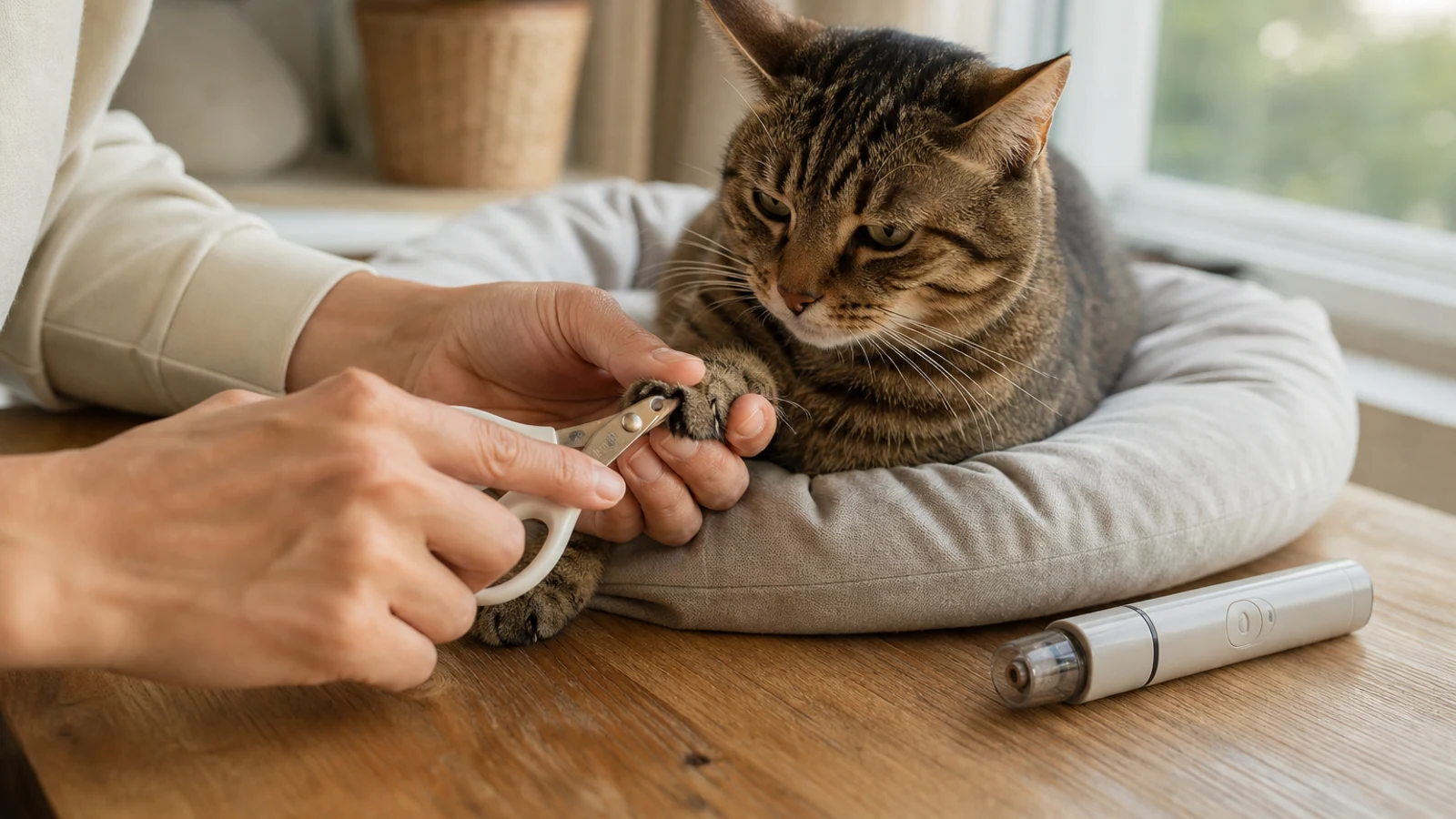
Cat nail clippers are usually easier for quick, quiet trims, while grinders offer more gradual control and a smoother edge. The better choice depends on your cat’s tolerance for sound, paw handling, and the tool’s learning curve.
Quick answer
For most cooperative cats, small pet nail clippers are easier to control because they remove the sharp tip quickly and quietly. A grinder can offer finer, incremental control and a smoother finish, but only if your cat accepts its sound and vibration. Choose clippers for speed and simplicity; choose a grinder for gradual shaping, uneven edges, or a cat that tolerates powered tools better than a sudden clip.
Shop this guide
Current Amazon options
Six current listings related to this buying decision. Use the guide to compare fit and trade-offs, then verify the latest seller, price, size, and availability on Amazon.
As an Amazon Associate I earn from qualifying purchases. Product availability, seller, price, and listing details can change.
Key decision checks
Clippers are easier when the priority is a fast, quiet trim
Cat nail clippers usually give you the most direct control: position the cutting edge just beyond the quick, squeeze once, and remove the hooked tip. That makes them a practical choice for cats that tolerate brief paw handling but become impatient during longer grooming sessions. A sharp, cat-sized scissor-style or plier-style clipper is generally easier to maneuver around small claws than a large dog clipper.
The main limitation is that clippers remove a noticeable piece at once. You must identify the quick and place the tool accurately before cutting. Dull blades can squeeze, crush, or splinter the nail instead of making a clean cut, so condition matters as much as the clipper design. If the nail is dark, unusually thick, damaged, or difficult to position, a veterinarian or trained groomer can demonstrate the safest approach.
- Best for cats that dislike prolonged handling or powered-tool noise.
- Usually the faster option for routine removal of sharp tips.
- Quiet operation can be easier for sound-sensitive cats.
- Requires a clear view of the quick and confident, accurate placement.
A grinder gives gradual control, but the cat must accept the process
A nail grinder removes small amounts of nail through abrasion rather than cutting through it in one motion. That can make depth control more incremental, especially when you are smoothing a pointed edge or shaping a nail that is difficult to cut cleanly. It may also leave a rounder, less sharp finish than clippers, which can be useful when snagging is a concern.
The trade-off is that a grinder adds sound, vibration, movement, and time. Some cats object to the motor before the abrasive tip ever touches a paw. Others tolerate it well, particularly when it is introduced gradually. A grinder is not automatically gentler: pressing too firmly, working too long on one nail, or ignoring signs of distress can make the experience uncomfortable. Use light contact, short sessions, and frequent breaks rather than trying to finish every nail at once.
- Best for owners who want to remove small amounts gradually.
- Useful for smoothing sharp or uneven edges after clipping.
- Can be harder to control if the cat pulls away from vibration.
- Requires gradual desensitization to the tool’s sight, sound, and feel.
The better tool depends on your cat’s response, not just your hand preference
The most controllable tool is the one your cat allows you to use calmly. A cat that stays relaxed for a few seconds may do better with clippers, even if you need several short sessions. A cat that panics at the clip sound but accepts a low, steady vibration may be a grinder candidate. The reverse is also common: a cat may tolerate one quick clip but become distressed by a motor near the paw.
Watch the cat’s body language rather than forcing a predetermined method. Pulling the paw away, flattening the ears, leaning away, trembling, struggling, or repeatedly trying to escape are reasons to pause. Nail-care training guidance from veterinary behavior resources recommends building tolerance in stages: first the room and handling, then the tool’s presence, followed by the sound or sensation, and finally one brief trim.
- Choose clippers when your cat tolerates short, decisive handling.
- Choose a grinder only if your cat can remain calm around its sound and vibration.
- Do not switch tools during an already stressful session as a last-minute fix.
- A professional trim may be the safest choice for a highly fearful, aggressive, or painful cat.
Compare options for your pet
Cat Nail Grinder vs Clippers: Which Tool Is Easier to Control?
Compare current Amazon listings using the fit and safety checks in this guide. Confirm size, specifications, seller and availability before ordering.
See on Amazon →As an Amazon Associate I earn from qualifying purchases. Links open Amazon search results; individual listings have not been independently verified.
Quick safety matters more than the tool type
Both tools are safe only when you remove the sharp, curved tip without entering the quick. The quick contains blood vessels and nerves; cutting it can cause pain and bleeding. With light-colored nails, it may appear as a pink area near the base. With dark nails, visibility is more limited, so remove very small amounts and stop when the cut surface changes or you are no longer confident about the remaining distance.
Keep good lighting, a stable non-slip surface, and a suitable styptic product or other veterinarian-approved first-aid option nearby. Do not continue if the cat is struggling hard enough to twist a leg or injure itself. If bleeding does not stop promptly, the nail is split, the paw is swollen, or a claw has grown into the pad, contact a veterinarian rather than treating the issue as a normal grooming task.
- Trim only the hooked or pointed end unless a veterinary professional advises otherwise.
- Use cat-sized tools with sharp, clean cutting surfaces.
- Pause after each nail and reward calm behavior.
- Ask a veterinary professional to show you the quick if you are unsure.
How to choose between a grinder and clippers
Start with the least complicated tool that matches your cat’s tolerance. For a calm cat with visible nails and an owner who wants a short routine, clippers are usually the sensible first choice. For an owner who prefers gradual removal, wants to smooth edges, or has a cat that accepts vibration better than clipping, a grinder may be worth learning. Neither option replaces acclimation and good restraint technique.
If you are considering a grinder, look for a model intended for small pets with a manageable tip, straightforward controls, and a design that lets you see the nail clearly. If you are considering clippers, prioritize a compact size, sharp blades, comfortable handles, and a shape that lets you approach the claw without twisting the toe. Marketing terms such as “silent,” “safe,” or “professional” should not substitute for checking the tool’s actual fit and your cat’s reaction.
- For clippers, check: cat-appropriate size, sharp blades, clear visibility, and easy one-handed use.
- For grinders, check: low vibration, manageable noise, visible working area, and short-session control.
- Avoid tools that force the nail into a tight opening or make the quick difficult to see.
- Keep both options available if your cat’s tolerance changes or one tool cannot reach a particular claw.
A gradual routine is more important than buying the perfect tool
Introduce either tool before expecting a trim. Let your cat inspect it, then pair its presence with treats. For clippers, you can practice the sound away from the paw and briefly touch the tool to a nail without cutting. For a grinder, start with the motor several feet away, move closer only while the cat remains relaxed, and introduce paw contact separately. Work toward one nail, reward immediately, and end the session before resistance escalates.
Do not assume a cat that accepts paw handling will automatically accept nail care. Short, repeated sessions often build more cooperation than an ambitious full trim. Some cats need a second person for gentle support, while others become more distressed when restrained. A veterinarian, veterinary technician, or professional groomer can help you learn positioning and decide whether the cat needs a different handling plan.
- Practice when the cat is relaxed, not immediately after a struggle.
- Use one or two nails as a successful session if that is all the cat accepts.
- Stop at early stress signals instead of waiting for a full escape attempt.
- Keep scratching posts available, but do not rely on scratching alone to manage every claw.
Common questions
FAQ
Can a cat nail grinder replace clippers?
Usually, yes, for routine tip reduction if the cat accepts the grinder and you can see the nail clearly. Keeping clippers available is still practical because some claws or positions may be easier to shorten with a single clean cut. A combination approach can work, but introducing two tools may require separate training.
Which is less likely to cut the quick?
A grinder can make gradual removal easier because you take off small amounts at a time, but it is not risk-free. Clippers can also be safe when you understand the nail anatomy and remove only the tip. The safest choice is the tool you can use accurately while your cat remains calm.
Are human nail clippers safe for cats?
Veterinary guidance commonly favors tools that are sharp and appropriate for the nail size. Some veterinary sources say ordinary human clippers can work in certain situations, while other animal-care guidance recommends pet-specific tools. For a consistent home routine, use a clean, sharp tool that gives you clear control and ask a veterinary professional to demonstrate if you are uncertain.
When should a veterinarian trim my cat’s nails?
Arrange professional help when the claws are severely overgrown, curling toward or into the paw pad, split, painful, or difficult to inspect. Professional assistance is also appropriate when your cat shows intense fear, aggression, or repeated escape attempts. A veterinary team can check for underlying paw problems and advise on handling or calming support when necessary.
Sources & further reading
Where the factual guidance comes from
Ready to choose?
Cat Nail Grinder vs Clippers: Which Tool Is Easier to Control?
Compare current Amazon listings using the fit and safety checks in this guide. Confirm size, specifications, seller and availability before ordering.
See on Amazon →As an Amazon Associate I earn from qualifying purchases. Links open Amazon search results; individual listings have not been independently verified.
Keep researching