Cats · Play & Enrichment
Wand Toy vs Automatic Cat Toy: Which Fits Interactive Play Better?
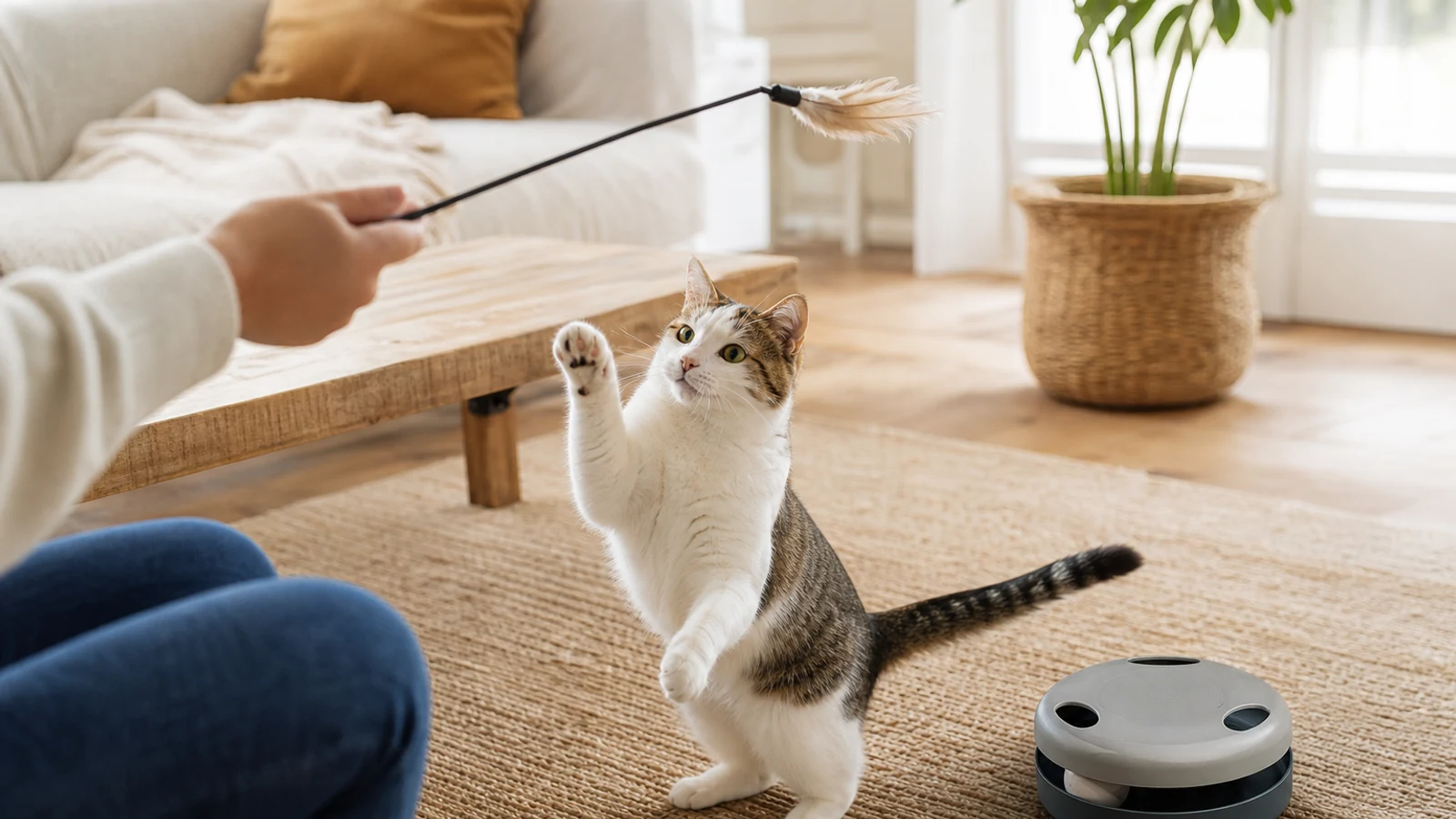
Wand toys usually offer the most responsive, human-led play, while automatic toys can add activity when you are busy or away. The better choice depends on whether your priority is shared interaction, independent stimulation, or a combination of both.
Quick answer
Choose a wand toy when you want the most interactive play, precise control over movement, and a stronger person-cat activity. Choose an automatic toy when your cat enjoys chasing moving objects and needs additional solo enrichment while you are occupied. For many households, the most useful setup is both: supervised wand sessions for shared play plus a carefully selected automatic toy for variety. Neither option replaces observation, toy rotation, or ordinary attention to your cat’s preferences and safety.
Shop this guide
Current Amazon options
Six current listings related to this buying decision. Use the guide to compare fit and trade-offs, then verify the latest seller, price, size, and availability on Amazon.
As an Amazon Associate I earn from qualifying purchases. Product availability, seller, price, and listing details can change.
Key decision checks
Wand toys and automatic toys solve different play problems
A wand toy is a tool for shared, human-led play. You control the speed, direction, pauses, hiding, and final capture, so you can make a feather, fabric lure, or soft attachment behave more like prey. That responsiveness makes a wand especially useful for cats that seek attention, need encouragement to move, or become engaged when a person makes the toy unpredictable.
An automatic cat toy moves, spins, vibrates, rolls, or presents a target without requiring you to hold it continuously. It can provide an outlet when you are working, sleeping, or away, but its movement is usually less adaptable to the individual cat. Some cats enjoy that independence; others quickly ignore a repetitive pattern or prefer a person’s involvement.
- Best for shared interaction: wand toy.
- Best for adding solo activity: automatic toy.
- Best overall coverage for many homes: supervised wand play plus rotating independent toys.
Choose a wand toy for bonding and precise control
The main advantage of a wand is control. You can keep the toy low for a cautious cat, create short chases for an older or less athletic cat, or add brief pauses that invite stalking and pouncing. You can also let the cat catch and hold the toy, which helps make the sequence feel complete instead of turning play into an endless chase with no successful capture.
Wand play is also easier to adapt from one session to the next. A cat that ignores fast aerial movement may respond to a lure creeping along the floor, disappearing behind furniture, or changing direction after a pause. That flexibility is difficult for a fixed automatic mechanism to reproduce, particularly in homes with cats that have very different play preferences.
- Use a wand when your cat responds to your voice, movement, or attention.
- Prefer interchangeable attachments if your cat loses interest in one texture or shape.
- Keep the toy away from hands and feet so biting and clawing stay directed toward the toy.
- End with a catch, then put the wand away rather than leaving string or elastic accessible.
Choose an automatic toy for flexible solo enrichment
Automatic toys are most useful as a supplement to human interaction. They can create movement and novelty during parts of the day when a person cannot actively play, and they may help a cat that enjoys batting, chasing, or investigating objects independently. They are particularly practical when the household schedule makes several short play opportunities difficult to provide consistently.
The category is broad, so compare the type of activity rather than assuming every motorized toy works the same way. A rolling toy encourages pursuit, a stationary motion toy may invite pawing from one place, and a treat-dispensing or puzzle-style toy adds searching and manipulation. A toy that moves continuously may be exciting for one cat but annoying, intimidating, or easy to predict for another.
- Look for movement your cat already enjoys, such as rolling, hiding, fluttering, or batting.
- Check whether the toy can be paused, scheduled, or used only during supervised sessions.
- Avoid treating automatic play as a guaranteed exercise plan; interest varies widely between cats.
- Introduce the toy while you are present so you can observe fear, frustration, chewing, or unsafe climbing.
Interactive play is more than making a toy move
If interactive play means active participation between you and your cat, the wand is the clearer fit. It lets you read body language and change the game immediately: slow down when the cat is stalking, give space for a leap, or move closer to the floor when high jumping is unsuitable. This shared timing can make the session more engaging than a toy operating on its own.
Automatic toys can still support meaningful enrichment, but their value is usually independence and variety rather than relationship-building. They work best alongside other outlets, including toy rotation, hiding games, food puzzles, scratching areas, and safe places to climb or observe. A cat that repeatedly chooses people over machines is giving useful information about its preference, not failing to use the product correctly.
- For bonding: start with a wand.
- For filling short gaps in the day: consider an automatic option.
- For a cat that becomes frustrated: slow the game down and provide successful catches.
- For a cat that ignores both: change the movement, texture, location, or timing before buying more toys.
Compare options for your pet
Wand Toy vs Automatic Cat Toy: Which Fits Interactive Play Better?
Compare current Amazon listings using the fit and safety checks in this guide. Confirm size, specifications, seller and availability before ordering.
See on Amazon →As an Amazon Associate I earn from qualifying purchases. Links open Amazon search results; individual listings have not been independently verified.
Safety and supervision should decide the setup
Wand toys require direct supervision because string, elastic, feathers, and small attachments can become tangled, chewed, or swallowed. Store the toy out of reach after play, inspect the attachment regularly, and remove it if pieces begin to separate. Do not encourage a cat to leap toward unstable furniture or hard edges, and keep the play area clear of cords and objects that could fall.
Automatic toys are not automatically safe to leave running without checking the design and the cat. Examine openings, moving parts, battery compartments, seams, and detachable pieces, and follow the manufacturer’s instructions for use. A cat that chews, carries, becomes trapped by, or intensely attacks the toy may need a different design or closer supervision. If a cat swallows string, ribbon, or another non-food part, contact a veterinarian promptly rather than attempting home treatment.
- Supervise all new toys until you know how your cat uses them.
- Remove loose string, ribbons, feathers, bells, or small parts.
- Keep batteries, charging cables, and electrical cords inaccessible.
- Stop play if your cat appears frightened, overheated, painful, or unusually frustrated.
- Ask a veterinarian about a toy-related concern, injury, swallowing risk, or sudden change in play behavior.
Match the toy to your cat’s body, temperament, and routine
A young, energetic cat may enjoy both options but still need the wand because it provides more varied movement and a chance to practice stalking and pouncing. A shy cat may prefer an automatic toy that stays at a distance, while another shy cat may only relax when a familiar person controls the pace. Older cats, cats with mobility limitations, and cats recovering from illness need lower-impact play and should not be pushed into repeated jumping.
The household routine matters just as much as the cat’s age. If you regularly have time for short play sessions, a wand may deliver more value than a complicated device. If work or caregiving makes availability unpredictable, an automatic toy can add useful variety, provided it is safe and your cat actually uses it. For multiple cats, watch for competition and provide enough space or separate activities to prevent one cat from controlling the toy.
- High energy: choose varied movement and a clear catch, not just nonstop speed.
- Cautious or easily startled: choose quieter motion and introduce it gradually.
- Older or less mobile: keep play low, short, and easy to stop.
- Chewers or toy destroyers: favor sturdy, inspectable designs and close supervision.
- Multi-cat homes: observe whether the toy causes crowding, guarding, or conflict.
Buying checklist: prioritize fit over features
The best purchase is not necessarily the toy with the most modes, lights, or attachments. Start with the behavior you want to support, then select the simplest design that creates that behavior safely. A wand with a comfortable handle and replaceable, inspectable attachments may be more useful than a complicated system your cat finds predictable. Likewise, an automatic toy should be easy to clean, retrieve, pause, and store.
Before buying, consider where the toy will be used and how often it will be checked. Moving toys can disappear under furniture, collect fur, or become inaccessible in a small room. A toy that requires frequent charging, specialized parts, or complicated setup may see less use than a simpler option. Product claims about stimulation or exercise should be treated as possibilities, not guarantees, because individual cats differ substantially.
- Can you inspect and clean every part that your cat touches?
- Are attachments secure, appropriately sized, and free of easily swallowed pieces?
- Can you stop the toy quickly if your cat becomes frightened or overexcited?
- Does the movement fit your cat’s preferred speed, sound, and play surface?
- Will the toy remain useful after novelty fades, or can you rotate it with other options?
A practical routine: use both without overcomplicating play
For many cats, a mixed routine is more useful than choosing one category exclusively. Use the wand when you can participate, vary the movement, allow a catch, and finish calmly. Offer the automatic toy at another time for independent investigation, then put it away or pause it when the session ends. Rotating a small selection can preserve novelty without filling the home with toys your cat rarely uses.
Observe the outcome rather than judging success by how advanced the product appears. Useful signs include voluntary approach, stalking, pouncing, batting, carrying, and relaxed recovery after play. If your cat suddenly stops playing, seems painful, loses appetite, becomes unusually tired, or shows a major behavior change, the issue may not be a toy preference and warrants veterinary advice.
- Begin with short sessions and stop while your cat is still interested.
- Offer a tangible toy the cat can catch rather than creating endless unsuccessful pursuit.
- Rotate toys instead of leaving every option available at once.
- Keep a simple record of which movements and textures reliably attract your cat.
- Seek veterinary guidance for sudden changes in activity, mobility, appetite, or behavior.
Common questions
FAQ
Is a wand toy better than an automatic toy for indoor cats?
Not universally. A wand usually provides more adaptable movement and direct human interaction, while an automatic toy can add independent activity when you are unavailable. Indoor cats often benefit from a mixture of interactive play, solo toys, scratching opportunities, exploration, and suitable resting or climbing spaces.
Can I leave a wand toy out for my cat to use alone?
It is safer to store wand and fishing-pole toys after supervised play. String, elastic, feathers, and small attachments can tangle, break apart, or be swallowed. Choose separate toys designed for independent use and inspect them regularly.
Should an automatic cat toy run while I am away?
Only if the specific toy is designed for that use and you have already observed your cat using it safely. Check for accessible moving parts, detachable pieces, battery or charging hazards, and places where the toy could trap a paw or become lodged. If you are uncertain, use it only while someone is present.
Why does my cat ignore an automatic toy but love a wand?
A wand responds to your cat’s timing and can imitate prey more naturally, while an automatic toy may move too quickly, too loudly, too predictably, or in an unappealing pattern. Try changing the location, speed, attachment, or time of day before deciding the category is unsuitable.
How often should I replace a cat toy?
Replace or remove a toy when it has loose pieces, exposed stuffing, damaged string, cracked plastic, unsafe batteries, or other changes that could create a swallowing or injury risk. There is no universal replacement schedule; inspect toys based on how your cat plays with them.
Can play replace exercise or veterinary care?
Play can support movement and enrichment, but it is not a treatment plan and cannot diagnose the reason for low activity or a behavior change. A veterinarian should assess sudden inactivity, pain, breathing difficulty, appetite changes, or other concerning signs.
Sources & further reading
Where the factual guidance comes from
Ready to choose?
Wand Toy vs Automatic Cat Toy: Which Fits Interactive Play Better?
Compare current Amazon listings using the fit and safety checks in this guide. Confirm size, specifications, seller and availability before ordering.
See on Amazon →As an Amazon Associate I earn from qualifying purchases. Links open Amazon search results; individual listings have not been independently verified.
Keep researching