Cats · Play & Enrichment
Fabric Cat Tunnel vs Collapsible Tunnel: What Actually Changes?
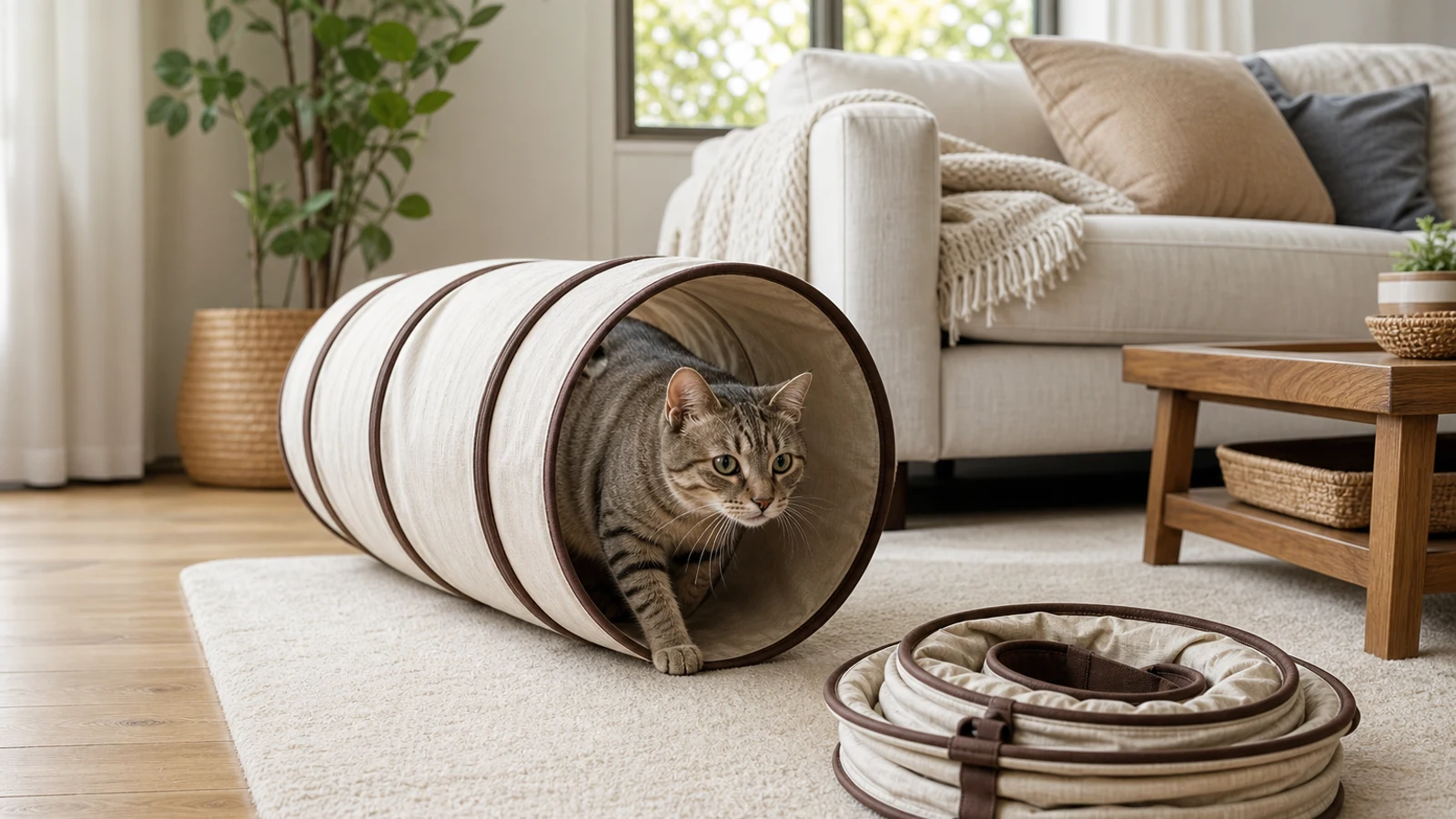
Fabric and collapsible cat tunnels are not always separate categories. Fabric describes the tunnel’s outer material, while collapsible usually describes its spring-wire frame or fold-flat design. The practical choice comes down to how much structure, storage convenience, washability, and daily use your cat needs.
Quick answer
Choose a collapsible fabric tunnel if you need easy storage, portability, or a tunnel that can be brought out only during play sessions. Choose a more structured fabric tunnel if your cat prefers a stable hideaway, naps inside the tunnel, or tends to push and pounce against the sides. In many products, these features overlap: a tunnel can be fabric, collapsible, or both.
Shop this guide
Current Amazon options
Six current listings related to this buying decision. Use the guide to compare fit and trade-offs, then verify the latest seller, price, size, and availability on Amazon.
As an Amazon Associate I earn from qualifying purchases. Product availability, seller, price, and listing details can change.
Key decision checks
The main difference is material versus construction
A fabric cat tunnel is defined mainly by its covering: fleece, polyester, plush, felt, or another soft textile. A collapsible tunnel is defined by how it holds its shape and stores, commonly using spring steel or another flexible frame that twists or folds down. That means many products are both fabric and collapsible rather than one or the other.
For shoppers, this distinction matters because the fabric affects comfort, noise, warmth, hair collection, and cleaning, while the frame affects shape, portability, and stability. Before comparing listings, check whether “fabric” means a soft fixed tunnel or simply a fabric cover stretched over a foldable frame.
- Fabric answers: What touches the cat, and how does the tunnel feel?
- Collapsible answers: How does the tunnel open, fold, and hold its shape?
- A fabric tunnel may still be collapsible, and a collapsible tunnel may have plush, crinkle, or smooth fabric panels.
Choose a collapsible design for storage and rotation
A collapsible tunnel is usually the better fit when the household cannot leave a large toy on the floor all day. It can be folded between sessions, moved from room to room, or packed for travel more easily than a rigid or heavily padded tunnel. This is especially useful in smaller homes, shared living spaces, and rooms where clear walkways matter.
The trade-off is that a foldable frame may not feel as substantial as a fixed structure. Some tunnels spring back into shape well; others can flatten, twist, or shift when a cat launches into them. A stable floor, correctly opened frame, and enough clearance around the tunnel help reduce unwanted movement during active play.
- Best fit: limited storage, toy rotation, temporary setups, or portability.
- Check: folded dimensions, storage strap, frame construction, and whether the tunnel stays open without propping.
- Avoid assuming “collapsible” means machine washable; the frame and lining may have separate care instructions.
Choose a more structured fabric tunnel for a steady hideaway
A thicker or more structured fabric tunnel can make sense for cats that use tunnels as resting places as well as chase toys. Plush or padded materials may feel warmer and quieter, while a firm interior can provide a more predictable passage for a cat that dislikes sagging fabric. Tunnel-bed combinations may also appeal to cats that prefer one product for hiding and lounging.
The disadvantages are bulk and maintenance. Padded fabric can collect hair, hold moisture, and take longer to dry. Some designs have removable cushions that can be washed while the tunnel body must be wiped or spot-cleaned, so the product’s care label matters more than the general word “fabric.”
- Best fit: cats that nap, hide, or retreat inside the tunnel between play sessions.
- Check: interior diameter, padding, removable covers, seam strength, and drying requirements.
- Be cautious with very soft tunnels if your cat chews textile edges or pulls loose threads.
Play feel changes more than the label suggests
The tunnel’s shape and sensory details often influence play more than whether the product is marketed as fabric or collapsible. A straight tube supports running through, stalking, and toy-chasing. Curved or multi-opening designs create surprise exits and may be more engaging for cats that enjoy ambush play. Peek holes, crinkle panels, and hanging toys add stimulation but also add parts to inspect and clean.
Cats differ in sound and texture preferences. A crinkle lining may attract one cat and discourage another, while plush fabric may be inviting for resting but less appealing for fast movement. If your cat is cautious, begin with the tunnel open in a familiar area and let the cat investigate without being pushed, pulled, or trapped inside.
- For sprinting: prioritize a clear, open passage and a diameter that allows comfortable movement.
- For ambush play: consider peek holes, curves, or multiple exits.
- For quiet homes: look for low-noise fabric and avoid assuming every crinkle panel is gentle or silent.
- For cautious cats: choose an easy-entry design with no closing flap or narrow dead end.
Compare options for your pet
Fabric Cat Tunnel vs Collapsible Tunnel: What Actually Changes?
Compare current Amazon listings using the fit and safety checks in this guide. Confirm size, specifications, seller and availability before ordering.
See on Amazon →As an Amazon Associate I earn from qualifying purchases. Links open Amazon search results; individual listings have not been independently verified.
Cleaning and inspection should decide between close alternatives
The practical difference between two similar tunnels often appears during cleaning. Smooth polyester may be easier to vacuum or wipe, while fleece, plush, and padded surfaces can retain fur and debris. A removable cushion is useful only if it can be removed without dismantling the tunnel and if it dries fully before use. Follow the manufacturer’s care instructions rather than treating every fabric tunnel as machine washable.
Inspect any tunnel regularly, especially one with a flexible wire frame. Stop using it if the fabric tears, stitching opens, the frame bends, or wire becomes exposed. Hanging balls, elastic loops, and crinkle material also deserve attention because damaged or detached components can create an entanglement, ingestion, or choking risk.
- Confirm which parts are machine washable, hand washable, wipe-clean, or spot-clean only.
- Remove hair and debris from seams, openings, and the underside.
- Air-dry fabric completely before folding or storing it.
- Retire the tunnel if the frame or fabric is damaged rather than trying to conceal exposed wire.
Fit matters more than the advertised length
A long tunnel is not automatically a better tunnel. Measure the usable opening, not only the outside length, and consider your cat’s body size, coat, and preferred posture. The opening should allow the cat to enter, turn, and leave without appearing cramped. For large cats, kittens that are still growing, or homes with multiple cats, compare the internal diameter and exit layout carefully.
Also consider where the tunnel will sit. A lightweight collapsible tunnel may slide on smooth flooring, while a padded fabric tunnel may grip better but occupy more space. Keep it away from stairs, heaters, sharp edges, and cluttered areas where a fast-moving cat could become trapped or collide with furniture.
- Measure the opening and interior passage, not just the listed overall length.
- Leave a clear route to at least one exit.
- Use a nonslip surface if the tunnel shifts during normal play.
- For multi-cat homes, more than one exit can reduce blocking and unwanted conflict.
Which one should you buy?
For most households, a collapsible fabric tunnel is the flexible middle ground: it provides a soft play surface, can be folded away, and is easy to rotate with other enrichment. It is the strongest choice when storage and portability matter as much as play. Choose a more substantial fabric tunnel instead when your cat regularly naps inside, prefers quiet enclosed spaces, or dislikes a tunnel that shifts or loses its shape.
No tunnel guarantees continued interest. Cats often respond to novelty, placement, and how the tunnel is used. Rotate it with other safe enrichment, place a toy near rather than forcing it through the tunnel, and supervise initial sessions. Product selection is separate from veterinary advice; consult a veterinarian or qualified feline behavior professional if hiding, fear, or sudden changes in play are persistent or accompanied by other behavior changes.
- Choose collapsible fabric for storage, portability, and occasional play.
- Choose structured or padded fabric for steadier hiding and lounging.
- Choose a multi-opening layout for ambush play and easier exits.
- Prioritize intact construction and appropriate size over decorative features.
Common questions
FAQ
Are fabric cat tunnels and collapsible cat tunnels the same thing?
Not always. Fabric describes the outer or inner material, while collapsible describes the frame or storage method. Many popular cat tunnels are both fabric and collapsible, so compare the construction details rather than relying on the product title.
Is a collapsible cat tunnel safe to leave out all day?
It may be suitable for unsupervised access only while it remains intact and stable, but inspect it regularly and follow the manufacturer’s instructions. Remove it if the fabric tears, the frame bends, or any wire or attachment becomes exposed.
Which tunnel is easier to clean?
Smooth, lightly lined fabric is usually simpler to vacuum or wipe than thick plush or padded fabric. The deciding detail is the care label: some tunnels have removable washable cushions, while the main tunnel body may require spot cleaning.
Do cats prefer tunnels with crinkle material?
Some cats enjoy the sound and movement, while others avoid noisy textures. If your cat is cautious or noise-sensitive, start with a quieter tunnel and introduce crinkle features gradually without forcing interaction.
What tunnel size is suitable for a large cat?
Check the actual interior opening and passage rather than the total outside length. The cat should be able to enter, move through, and exit without appearing cramped. For a large or long-haired cat, compare internal measurements carefully and choose a design with easy exits.
Sources & further reading
Where the factual guidance comes from
Ready to choose?
Fabric Cat Tunnel vs Collapsible Tunnel: What Actually Changes?
Compare current Amazon listings using the fit and safety checks in this guide. Confirm size, specifications, seller and availability before ordering.
See on Amazon →As an Amazon Associate I earn from qualifying purchases. Links open Amazon search results; individual listings have not been independently verified.
Keep researching