Dogs · Home & Safety
Wire vs Plastic Dog Crate: Which Fits Home and Travel Better?
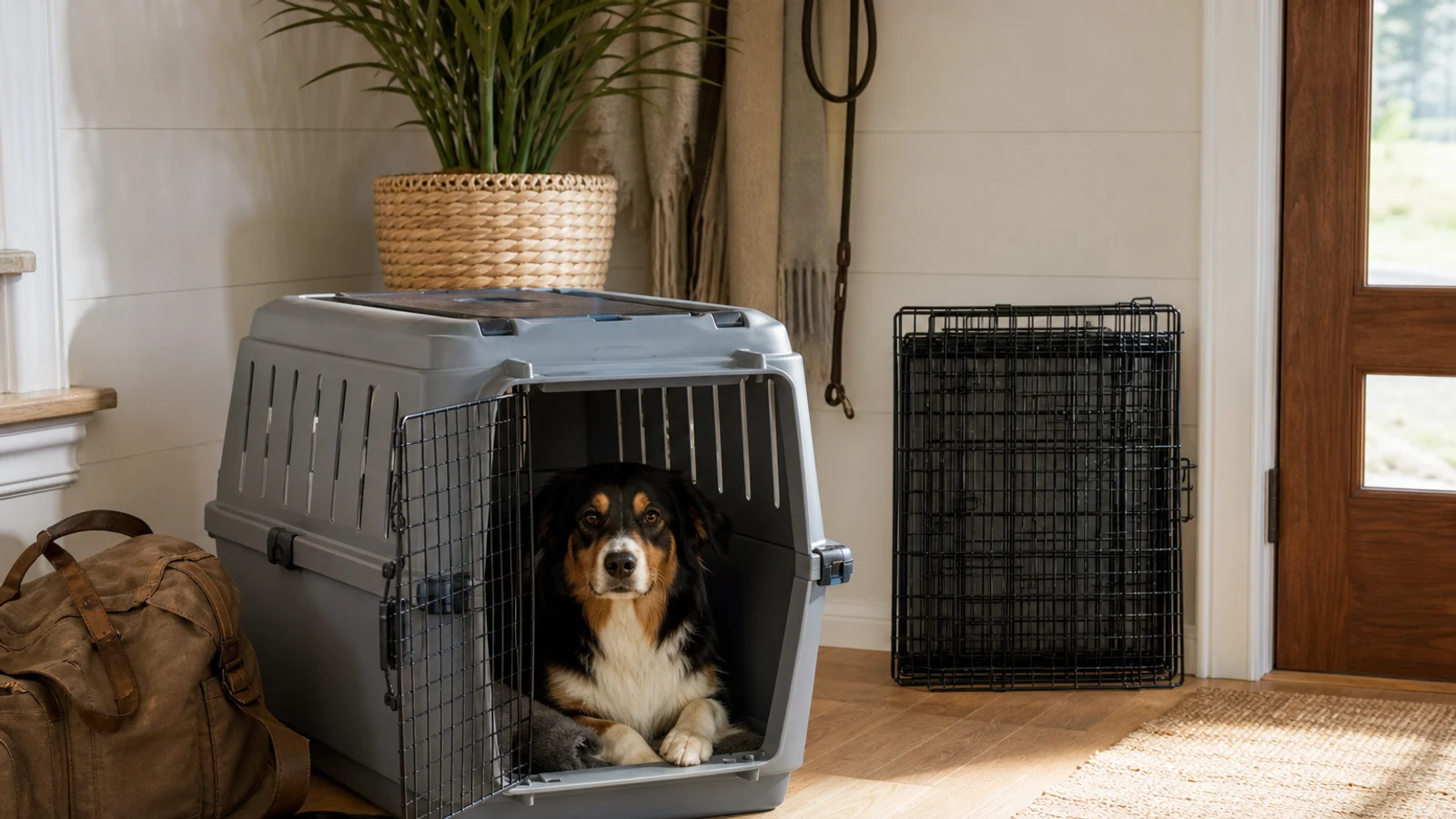
Wire crates usually suit home training and flexible everyday use, while hard plastic crates often make a better travel-focused den. The right choice depends on your dog’s behavior, your space, and whether air travel is part of the plan.
Quick answer
Choose a wire crate when your main job is home use, puppy training, visibility, ventilation, folding storage, or adjusting the interior with a divider. Choose a hard plastic crate when your dog settles better in a more enclosed den or you need a travel kennel designed around common air-cargo requirements. If you fly, do not assume any crate is airline approved: confirm the exact model, size, door, ventilation, labeling, and current rules with the airline before booking.
Shop this guide
Current Amazon options
Six current listings related to this buying decision. Use the guide to compare fit and trade-offs, then verify the latest seller, price, size, and availability on Amazon.
As an Amazon Associate I earn from qualifying purchases. Product availability, seller, price, and listing details can change.
Key decision checks
The practical difference: home crate versus travel kennel
For most households, a wire crate is the more flexible everyday option. The open metal panels give your dog a broad view of the room, make it easier for you to check on them, and commonly allow the crate to fold flat for storage. Many wire models also include a divider, which lets you reduce the usable space for a growing puppy without buying a succession of crates.
A hard plastic crate is more enclosed and usually feels more like a small den. That can help some dogs settle when household activity, bright light, or visual distractions keep them alert. Plastic also makes sense when one crate must serve as both a home resting space and a travel kennel, but air travel adds requirements that ordinary home use does not.
- Best starting point for home and puppy training: wire.
- Best starting point for privacy and travel-focused use: hard plastic.
- Best choice for frequent air travel: a hard-sided model specifically matched to the airline’s current requirements.
Choose wire when home training and flexibility come first
Wire is usually the better fit when the crate will stay in a bedroom, living room, or puppy-training area. Visibility can help you monitor a dog without opening the door, and the open construction generally provides strong airflow. A removable pan is useful after accidents, while a divider can keep a puppy from treating one end as a sleeping area and the other as a bathroom.
The trade-off is exposure. A dog that watches every person, sound, and movement may have trouble settling in an uncovered wire crate. A properly fitted cover over some sides can reduce visual stimulation, but it should never block necessary airflow or allow fabric to become a chewing hazard. If your dog scratches, bends, or chews the wire, inspect the crate frequently and reconsider the design.
- Look for a secure latch with no reachable sharp edges or gaps that could catch a paw or collar.
- Check that the pan slides out easily and cannot be pushed out by the dog.
- Prefer a divider for puppies, but adjust it as the dog grows rather than leaving excessive empty space.
- Measure the folded crate and its assembled footprint before choosing it for a small room or vehicle.
Choose plastic when privacy and transport matter more
Hard plastic can suit dogs that relax better with reduced visual access. The solid shell helps create a quieter, more enclosed environment than an uncovered wire crate, although dogs vary: some become calmer, while others dislike reduced visibility. Plastic surfaces are generally straightforward to wipe down, and the shell can help contain bedding or mess during ordinary trips.
Plastic is also the more common starting point for cargo-style air travel, but “plastic” alone is not enough. A suitable travel kennel needs to be the correct size, structurally sound, securely latched, properly ventilated, free of dangerous interior projections, and compatible with the airline’s rules. Some plastic crates are intended only for home or car use, so read the manufacturer’s travel documentation and confirm acceptance with the airline.
- Choose a model with a metal door and secure hardware when air travel is under consideration.
- Check for ventilation on the required sides without covering the openings with bedding or accessories.
- Avoid assuming that a product labeled “airline approved” will meet every airline’s current policy.
- Treat wheels, add-on shelves, and protruding accessories as potential travel-rule problems unless the airline specifically allows them.
Which crate is better for car travel?
For car trips, the better crate is the one that fits the vehicle, can be secured appropriately, and keeps the dog contained without creating avoidable movement or escape opportunities. A plastic crate may be easier to position as a contained travel kennel, while a folding wire crate can be convenient for trips where it will also be used at the destination. Neither material automatically makes a car setup safe.
Measure the vehicle opening, cargo area, and crate footprint before buying. Keep the crate away from direct heat, maintain adequate airflow, and do not leave a dog unattended in a hot or cold vehicle. For crash protection, follow the vehicle and crate manufacturer’s instructions rather than treating a general-purpose crate as crash-tested unless the maker provides specific, verifiable documentation.
- Confirm the crate can be kept level and cannot slide into a door, seat, or cargo opening.
- Use a vehicle setup appropriate to the crate’s instructions; do not improvise with a weak tether or unstable stack.
- Make sure the dog can stand, turn, lie down naturally, and breathe comfortably.
- For a major trip, practice short drives first so the crate itself is familiar.
Compare options for your pet
Wire vs Plastic Dog Crate: Which Fits Home and Travel Better?
Compare current Amazon listings using the fit and safety checks in this guide. Confirm size, specifications, seller and availability before ordering.
See on Amazon →As an Amazon Associate I earn from qualifying purchases. Links open Amazon search results; individual listings have not been independently verified.
Fit and comfort matter more than the material
Both crate types should be large enough for the dog to stand without touching the top, turn around, sit naturally, and lie down comfortably. A puppy may need an adult-size crate with a divider, while an adult dog should not be confined to a space that forces crouching or prevents normal repositioning. Short-nosed dogs and dogs with breathing concerns need especially careful travel planning rather than a one-size-fits-all crate decision.
A crate is a management and resting tool, not a substitute for exercise, supervision, training, or veterinary care. Introduce it gradually with rewards and open-door access at first. If a dog shows persistent panic, frantic escape attempts, heavy distress, injury, or breathing difficulty, stop treating the issue as a simple product preference and consult a veterinarian or qualified behavior professional.
- Measure the dog while standing, then compare those measurements with the manufacturer’s interior dimensions.
- Use a thin, secure, washable mat only if the dog does not shred or ingest bedding.
- Inspect doors, hinges, wire joints, pans, and plastic hardware regularly for damage.
- Never use the crate as punishment or force a frightened dog inside.
Air travel changes the buying decision
If flying is a real possibility, decide that before purchasing the crate. U.S. government transport rules for regulated commercial transport require a primary enclosure that is strong, secure, free of injurious projections, ventilated, leak-resistant at the bottom, and appropriately sized. Veterinary travel guidance also points to hard-sided construction, secure locking, handles, absorbent material, and ventilation on multiple sides for cargo travel.
Airlines can impose additional or different requirements involving dimensions, breed restrictions, weather, labeling, food and water dishes, and whether a dog may travel in the cabin or cargo area. Policies can change, and a crate that works for a road trip may not be accepted for a particular flight. Confirm the route, aircraft, crate model, and dog’s size with the airline before buying tickets; ask your veterinarian whether your dog is medically suited to the planned travel.
- For cargo travel, start with a hard-sided kennel that the airline explicitly accepts for your route.
- Verify the required interior size, ventilation pattern, door construction, handles, labels, and attached food or water containers.
- Do not sedate a dog for travel unless your veterinarian specifically advises on the risks and plan.
- Practice in the exact travel crate well before departure; familiarity can reduce stress, but it does not remove travel risks.
A simple decision guide
Pick wire if the crate will primarily support house-training, everyday rest, puppy growth, visibility, and compact storage. It is also the more adaptable choice when you want to place the crate in different rooms or use a divider as the dog grows. Add privacy carefully if your dog needs it, and prioritize a design with reliable hardware and an easy-clean pan.
Pick hard plastic if your dog settles better in a more enclosed space, you want a travel-oriented kennel, or you regularly move between home, the car, boarding, and other locations. If you need both a roomy home crate and an airline-compliant kennel, owning two purpose-matched crates may be more practical than forcing one design to do everything. The dog’s comfort and the crate’s actual job should decide the purchase.
- Home-first household: wire is usually the stronger default.
- Privacy-first dog: plastic may be the calmer fit, though individual preference decides.
- Road-trip household: choose based on secure vehicle fit, portability, and destination use.
- Air-travel household: buy to the airline’s written requirements, not to material alone.
Common questions
FAQ
Can a wire dog crate be used for air travel?
Do not assume so. Cargo airlines commonly require a strong hard-sided primary enclosure with specific ventilation, door, labeling, sizing, and food or water provisions. Contact the airline for the exact route and crate requirements before travel; a general-purpose folding wire crate may not be accepted.
Is a plastic crate better for a dog that gets overstimulated?
It may be, because the more enclosed shell can reduce visual distractions. However, some dogs become more anxious when they cannot see out. Introduce either crate gradually and observe whether your dog rests, pants, scratches, vocalizes, or attempts to escape.
Should I buy a large crate for a puppy?
You can buy for the expected adult size if the crate includes a secure divider. Set the divider so the puppy has room to stand, turn, lie down, and rest without excessive unused space, then move it as the puppy grows.
Which crate is easier to clean?
Both can be manageable. Wire crates usually have a removable plastic pan, while plastic crates have a shell that can be wiped down. Compare how easily the door, corners, seams, pan, and hardware can be reached before buying.
Can I cover a wire crate to make it more den-like?
A partial cover can reduce visual stimulation, but keep ventilation openings clear and prevent the dog from pulling, chewing, or ingesting the fabric. If your dog repeatedly damages the cover or remains unsettled, a hard plastic crate may be a better fit.
Sources & further reading
Where the factual guidance comes from
Ready to choose?
Wire vs Plastic Dog Crate: Which Fits Home and Travel Better?
Compare current Amazon listings using the fit and safety checks in this guide. Confirm size, specifications, seller and availability before ordering.
See on Amazon →As an Amazon Associate I earn from qualifying purchases. Links open Amazon search results; individual listings have not been independently verified.
Keep researching