Dogs · Home & Safety
Freestanding vs Pressure-Mounted Dog Gate: Which Fits Your Home?
Freestanding gates are flexible and rental-friendly, while pressure-mounted gates usually give a cleaner fit in standard doorways. The better choice depends on your dog's pushing and jumping behavior, the opening you need to block, and whether the gate must stay fixed.
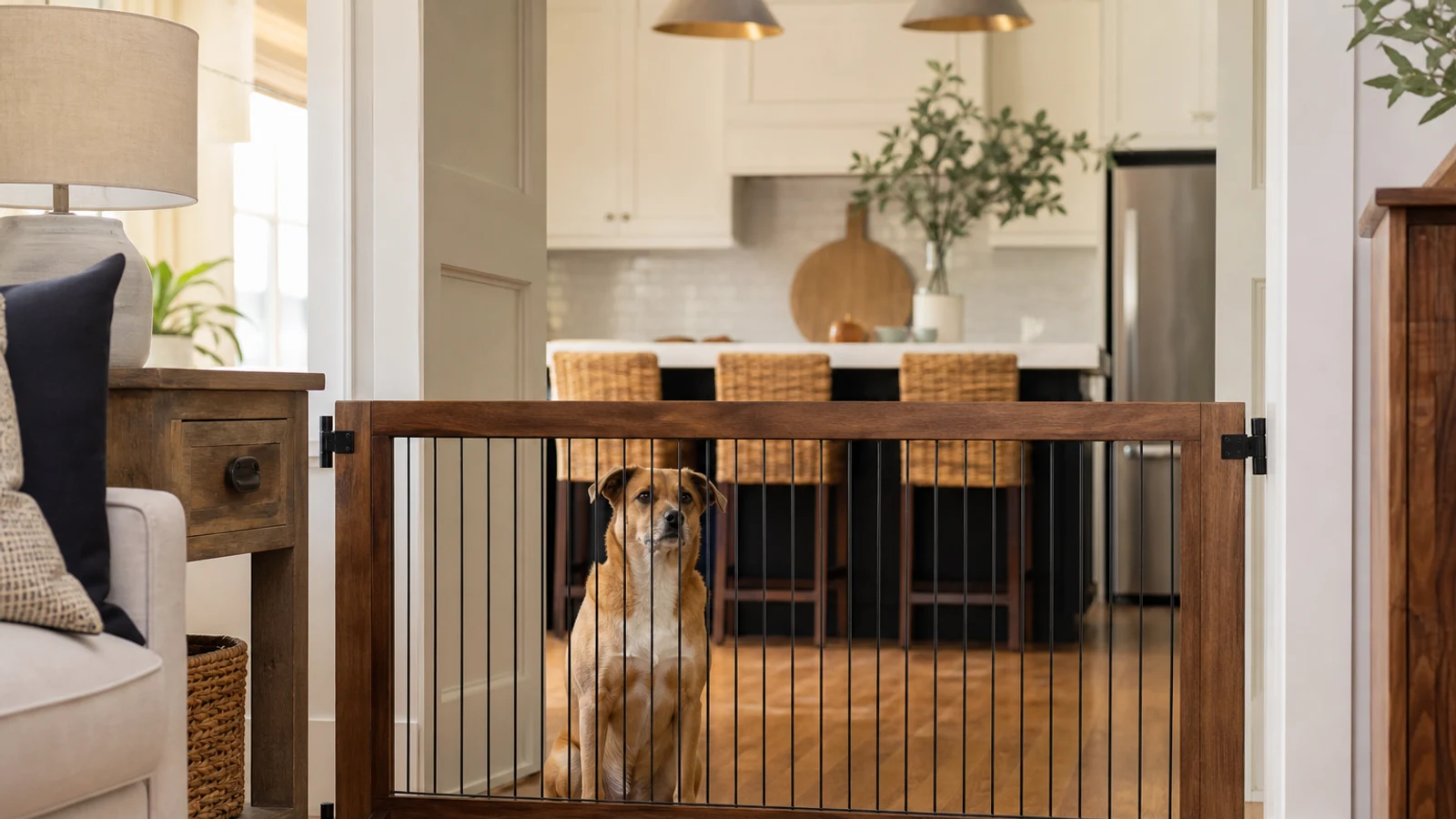
Quick answer
Choose a pressure-mounted dog gate for a standard, level doorway when you want a close-fitting barrier without drilling and your dog is unlikely to ram, climb, or repeatedly test it. Choose a freestanding gate for wide or irregular openings, rental homes, frequent repositioning, or spaces without suitable opposing walls. Neither type should be treated as a universal solution for the top of stairs; follow the specific manufacturer's instructions, and use a properly hardware-mounted system when a fall could result.
Shop this guide
Current Amazon options
Six current listings related to this buying decision. Use the guide to compare fit and trade-offs, then verify the latest seller, price, size, and availability on Amazon.
As an Amazon Associate I earn from qualifying purchases. Product availability, seller, price, and listing details can change.
Key decision checks
The practical difference between the two gate types
A pressure-mounted dog gate spans an opening by pushing adjustable contact points against two opposing surfaces, usually a door frame or parallel walls. It is best understood as a fitted doorway barrier: once installed correctly, it occupies the opening and can often include a walk-through door. Many models use wall cups or mounting plates for a firmer connection, even when the gate itself does not require drilling.
A freestanding dog gate stands on its own through its weight, feet, angled panels, or a folding configuration. It does not need two walls to create tension, so it can sit across a wide room entrance, around furniture, or in an open-plan area. Its flexibility is also its limitation: a determined dog may push, shift, climb, or walk around a barrier that is not anchored.
- Pressure-mounted: a fitted barrier for compatible openings.
- Freestanding: a movable barrier that depends on its design and the dog's behavior.
- Hardware-mounted: a separate category that uses screws and should be considered where a gate failure could cause a fall.
Choose pressure-mounted for a normal doorway and a tidy fit
Pressure mounting is usually the more practical choice when you are blocking a standard doorway or hallway with two sound, opposing surfaces. It keeps the gate aligned with the opening, typically leaves the floor mostly clear except for any lower rail, and avoids permanent screw holes. That makes it attractive for renters, temporary puppy management, and households that want a walk-through gate rather than a panel barrier.
The fit must be exact. Measure the narrowest part of the opening, account for baseboards or molding, and confirm that the gate's contact points can sit flat and level. Some manufacturer instructions warn that uneven trim prevents even pressure. Do not assume a gate is secure because it feels tight immediately after installation; engage the latch, check movement, and recheck tension as the product instructions specify.
- Best fit: level doorways and hallways with structurally sound opposing surfaces.
- Useful features: walk-through door, visual pressure indicator, wall cups, and a latch you can operate reliably.
- Main concern: a dog that repeatedly leans, charges, paws, or works at the gate can expose weaknesses in fit or installation.
Choose freestanding for flexibility, wide openings, and rentals
Freestanding gates make more sense when the opening is too wide, angled, irregular, or lacking two suitable walls. Folded panels can form a V, L, C, or zigzag shape, and some designs include stabilizing feet or extension panels. That makes them useful for open-plan homes, temporary room divisions, blocking access around furniture, or moving the boundary between rooms during the day.
They are not automatically stronger because they are heavier or taller. Stability depends on the panel geometry, floor contact, gate height, width, and how force reaches the barrier. A freestanding gate set in an angle may resist movement better than the same panels placed in a straight line. Follow the model's required configuration rather than improvising a shape that looks convenient.
- Best fit: wide entrances, open rooms, unusual layouts, and homes where drilling is undesirable.
- Look for: broad feet, non-slip contact points, a stable angled configuration, and a height suited to your dog.
- Avoid relying on it for: a strong jumper, persistent climber, large dog that can push through, or a dog that chews exposed materials.
Match the gate to your dog's behavior, not only body size
The deciding question is not simply whether your dog is small, medium, or large. Ask how your dog behaves when blocked from food, people, another pet, or an interesting room. A quiet dog that pauses at a visual boundary may do well with a freestanding gate. A dog that charges the kitchen, paws at latches, squeezes through gaps, or treats barriers as a challenge needs a more secure design and closer supervision while you evaluate it.
Height and spacing still matter. Measure your dog from the floor to the shoulder, then consider jumping ability, climbing style, and whether the dog can get its paws into the pattern. Check the manufacturer's stated use, bar spacing, minimum and maximum width, and any restrictions on extensions. Pet gates are not automatically child-safety devices, and a gate marketed for pets should not be used to manage a child.
- For a puppy: allow for rapid growth and chewing, not just today's size.
- For a senior or injured dog: avoid layouts that create a trip hazard or require stepping over a loose barrier.
- For a multi-pet home: check whether a smaller animal could pass through or become trapped in the gate pattern.
- For a persistent escape artist: favor a securely fitted or professionally anchored solution over a lightweight portable barrier.
Compare options for your pet
Freestanding vs Pressure-Mounted Dog Gate: Which Fits Your Home?
Compare current Amazon listings using the fit and safety checks in this guide. Confirm size, specifications, seller and availability before ordering.
See on Amazon →As an Amazon Associate I earn from qualifying purchases. Links open Amazon search results; individual listings have not been independently verified.
Wall protection, installation, and daily use
Pressure-mounted gates avoid screw holes, but they are not damage-free in every home. Concentrated pressure can mark soft paint, dent weak trim, or leave impressions where the contact points sit. Wall cups may improve stability but require screws or another approved attachment method, so decide whether the extra security is worth the installation. Never place a pressure gate between surfaces that are loose, fragile, slippery, or too irregular to provide even contact.
Freestanding gates protect walls from mounting hardware but may still move across flooring, rub baseboards, or tip into furniture if the setup is poorly chosen. Whichever type you buy, treat installation as part of the product's performance. A gate that is compatible on paper can be unsuitable in practice if the opening is out of level, the latch is awkward, or the dog can reach the hinge and manipulate it.
- Measure width at floor level and higher up; openings can taper or vary because of trim.
- Check that the gate closes and locks fully every time, including when opened with one hand.
- Inspect pressure knobs, wall cups, hinges, feet, and latch parts regularly.
- Stop using the gate if components are cracked, missing, bent, or no longer hold the intended position.
Stairs require a stricter decision
Do not choose between freestanding and pressure-mounted solely on convenience when stairs are involved. A loose, shifted, or toppled gate can turn a containment problem into a fall hazard. Many pet-gate instructions specifically prohibit use at the top of stairs, while some pressure-mounted designs are limited to particular locations or require approved wall cups. The product's instructions control; a generic claim that a gate is 'extra sturdy' is not enough.
For the top of stairs, look for a gate specifically designed and approved for that location, normally with hardware anchored into structurally sound surfaces. A pressure-mounted or freestanding pet gate may be appropriate for a lower-risk room boundary, but it should not be repurposed for a stair opening unless the manufacturer explicitly allows that exact installation. If the stair structure is unusual, ask a qualified installer or veterinarian about the dog's mobility needs and a building professional about secure fitting.
- Top of stairs: do not use a freestanding gate unless the manufacturer explicitly designs it for that application.
- Pressure-mounted stair use: follow the exact model instructions, including any required wall cups or mounting hardware.
- Bottom of stairs: still check for shifting, trip bars, narrow gaps, and the dog's ability to push the gate toward the steps.
- If children also use the home: choose a separately compliant child-safety solution rather than treating a pet gate as dual-purpose.
A simple buying decision
Choose pressure-mounted when you have a clean, level doorway, want a walk-through design, need a close fit, and your dog is not likely to attack the barrier. Choose freestanding when you need to move the boundary, span a wide or irregular area, avoid drilling, or create a flexible room divider. If your dog is strong, highly motivated, or repeatedly defeats either option, the answer may be a hardware-mounted gate, a closed door, supervised separation, or a professionally designed containment setup.
Before ordering, write down the opening width, surface type, baseboard shape, dog height, jumping behavior, chewing habits, and whether the barrier is near stairs or another fall risk. Then compare the manufacturer's fit range and installation limits against those facts. The best gate is the one that remains correctly positioned and fully latched during the situations in which you actually need it.
- Pick pressure-mounted for: standard doorway, no-drill setup, walk-through access, moderate containment needs.
- Pick freestanding for: portability, wide spans, open-plan layouts, and irregular room boundaries.
- Choose neither as a casual shortcut for: top-of-stair protection, a forceful escape artist, or a gate that must also protect children.
- Plan a different solution if the dog can jump over, squeeze under, chew, or push the selected design.
Common questions
FAQ
Can a freestanding dog gate be used in a doorway?
Yes, if the model is designed for that width and configuration. Set it according to the manufacturer's stability instructions, especially if the panels must be angled or fitted with stabilizing feet. A freestanding gate may be less secure than a fitted gate if the dog pushes directly against it.
Are pressure-mounted dog gates safe for the top of stairs?
Do not assume they are safe there. Many pet-gate instructions prohibit top-of-stair use, and approved stair gates commonly require hardware anchoring. Check the exact product instructions; if a fall is possible, choose a gate specifically designed for the location and consider professional installation.
Will a pressure-mounted gate damage my walls?
It can leave marks or impressions, particularly on soft paint, weak trim, or uneven surfaces. Wall cups can distribute or improve the attachment but may require screws. Use only structurally sound contact surfaces and follow the manufacturer's installation guidance.
What type of gate is better for a large or pushy dog?
Neither type is automatically suitable. A pressure-mounted gate may work in a correctly fitted doorway if the manufacturer permits the dog's size and behavior, but repeated charging can shift it. A freestanding gate can also be pushed or walked away. A hardware-mounted or purpose-built containment solution is often more appropriate when failure would create a serious risk.
Sources & further reading
Where the factual guidance comes from
Ready to choose?
Freestanding vs Pressure-Mounted Dog Gate: Which Fits Your Home?
Compare current Amazon listings using the fit and safety checks in this guide. Confirm size, specifications, seller and availability before ordering.
See on Amazon →As an Amazon Associate I earn from qualifying purchases. Links open Amazon search results; individual listings have not been independently verified.
Keep researching